What Is Organic SEO? A Plain-English Definition
Fifty-three percent of all website traffic comes from organic search, which means more than half of every visitor to every website got there by typing something into Google and clicking an unpaid result. That single stat explains why organic SEO matters to anyone who runs a website.
What Is Organic SEO? A Plain-English Definition
Fifty-three percent of all website traffic comes from organic search, which means more than half of every visitor to every website got there by typing something into Google and clicking an unpaid result. That single stat explains why organic SEO matters to anyone who runs a website.
So what is SEO, exactly? Google's own documentation puts it plainly: SEO is about helping search engines understand your content and helping users find your site. The "organic" qualifier narrows the scope to unpaid results, the listings that appear below the ads because Google's algorithm determined they were the most relevant answer to a query.
That's the SEO definition in one sentence: optimizing your website so it appears higher in search results without paying for placement.
How Search Engines Decide What to Show You
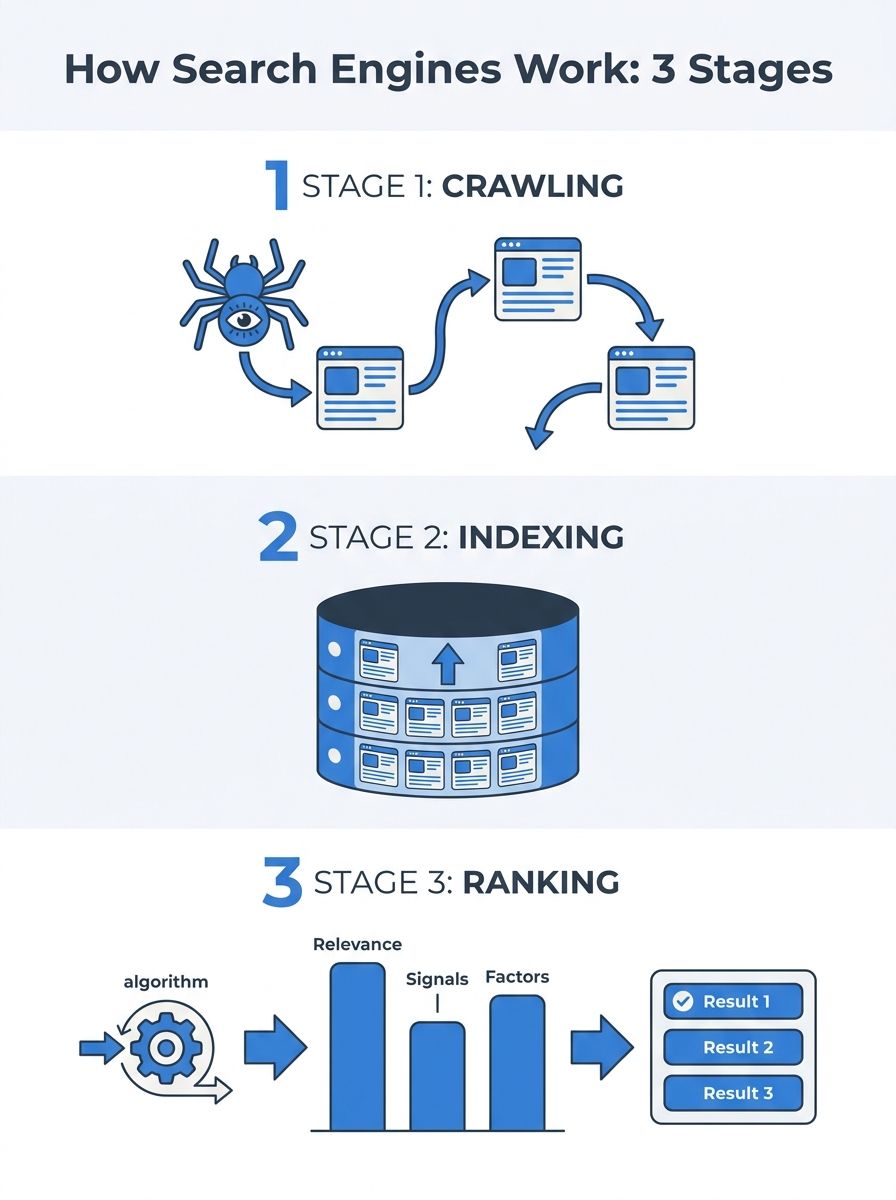
Google's ranking systems sort through hundreds of billions of web pages to surface the most useful results in a fraction of a second. The process has three distinct stages.
Crawling. Google sends automated programs (called crawlers or spiders) out across the web, following links from page to page. When a crawler lands on your site, it reads your HTML, your text, your images, and your metadata.
Indexing. If the crawler decides your page is worth storing, it gets added to Google's index, a massive database of web content. Pages that are blocked by robots.txt, flagged as duplicate, or riddled with technical errors may never make it into the index at all.
Ranking. When someone searches for "best running shoes for flat feet," Google pulls candidate pages from its index and ranks them using hundreds of signals. According to Google's own explanation, these signals include the words in your query, the relevance and usability of pages, the expertise of sources, and your location.
The ranking stage is where organic SEO lives. Every optimization you make, from writing better content to fixing broken links to earning backlinks, is an attempt to send stronger signals during this stage.
What Google Actually Evaluates
Google has never published a complete list of ranking factors, but the broad categories are well documented. According to HubSpot's analysis of Google's known ranking factors, the search engine evaluates the combined strength of content quality, authority, user experience, and technical health. None of these operate in isolation. A page with excellent content but a five-second load time will struggle, and a lightning-fast page with thin content won't rank either.
First Page Sage's research on Google's algorithm found that backlinks, once the dominant signal, have been losing ground since 2018 to two other factors: consistent publication of satisfying content and keyword placement in meta title tags. Backlinks still matter, but the balance has shifted toward content quality in a meaningful way.
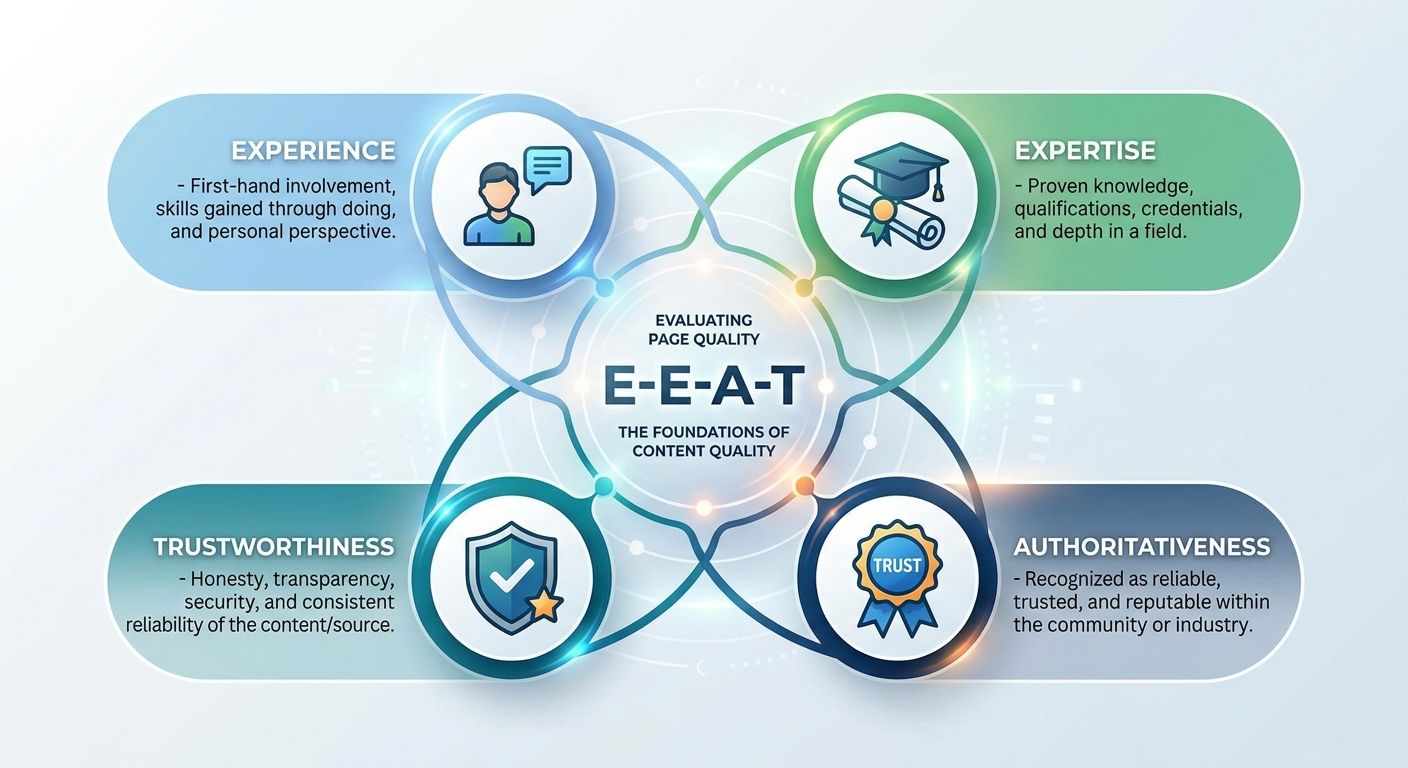
Google's E-E-A-T framework (Experience, Expertise, Authoritativeness, Trustworthiness) also plays a central role, particularly for topics that affect health, finances, or safety. If you're writing about medical symptoms or investment strategies, Google holds your content to a higher standard of credibility.
Organic Results vs. Paid Results
When you search for something on Google, the top two or three results are usually ads. They're labeled with a small "Sponsored" tag. Everything below those ads is organic.
The difference is straightforward: paid results are bought through Google Ads on a cost-per-click basis, and organic results are earned through SEO. As Indeed's comparison notes, organic results are "natural in that the search engine algorithm found the pages and chose them for containing the most relevant information".
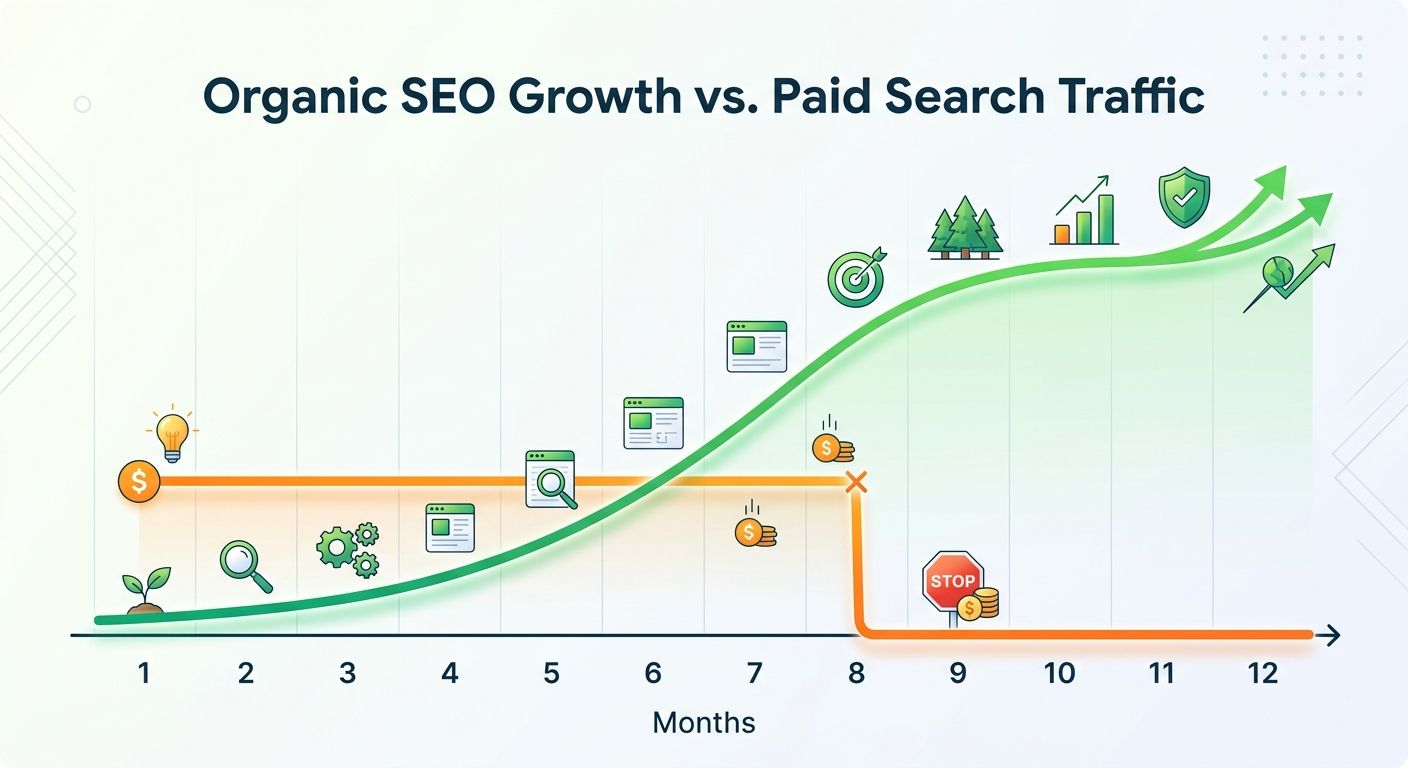
The economics diverge sharply. Google estimates brands earn roughly $2 for every $1 spent on Google Ads, which is a solid 200% ROI. But organic search earns an estimated 3x the leads and 6x the conversions of other marketing tactics. The tradeoff is time. You can't buy your way to page one overnight. Paid search gives you immediate visibility; organic search compounds over months and years.
For most businesses, the smart play is both. Paid search fills the gap while organic rankings build. Once your organic positions are strong, you can scale back ad spend on those same keywords.
The Three Pillars of Organic SEO
Every organic SEO strategy breaks down into three areas, and neglecting any one of them creates a ceiling on your results.
Content
Content is the reason search engines exist. If your page doesn't contain a clear, thorough, genuinely useful answer to the searcher's question, no amount of technical optimization will save it. This means understanding search intent — is the person looking for information, comparing products, or ready to buy? — and matching your content format to that intent.
Building topical authority matters too. A site that publishes one article about retirement planning won't compete with a site that has fifty articles covering every subtopic from 401(k) rollovers to required minimum distributions. Google recognizes depth, and it rewards sites that demonstrate genuine expertise across a subject area.
Technical Health
Your site needs to be crawlable, indexable, and fast. Core Web Vitals, Google's metrics for loading speed, interactivity, and visual stability, have been a confirmed ranking factor since 2021. Mobile-friendliness isn't optional; it's the baseline. Structured data (schema markup) helps search engines parse your content more accurately, which can improve how your pages appear in search results.
Authority
Authority signals tell Google that other people on the internet vouch for your content. The primary mechanism is backlinks. When another site links to yours, it functions as a vote of confidence. Pages ranking #1 in Google have roughly 3.8x more backlinks than pages in positions 2 through 10, according to Backlinko's research.
But earning quality backlinks is hard work. The white-hat approaches include creating original research worth citing, writing guest posts for reputable publications, finding broken links on relevant sites and offering your content as a replacement, and reaching out to sites that mention your brand without linking to you.
Why Organic SEO Takes Time
If you're used to paid advertising, where you flip a switch and traffic arrives, organic SEO will test your patience. New content typically takes three to six months to reach its ranking potential. A brand-new domain with no existing authority can take even longer.
The reason is structural. Google needs time to crawl your new pages, evaluate their quality, observe how users interact with them, and compare them against established competitors. You're essentially building a reputation, and reputations aren't built overnight.
This is also what makes organic SEO durable. Once you've earned strong rankings, they tend to hold. You don't lose them the moment you stop spending money. A well-ranked page can drive traffic for years with only periodic updates to keep the content current.
The Open Questions
The organic SEO landscape keeps shifting, and several things remain genuinely uncertain.
AI-generated search answers (Google's AI Overviews, ChatGPT's search features, Perplexity) are changing how people interact with results. If Google answers a query directly in the AI Overview, fewer people click through to any website. How much traffic this will pull away from organic results over the next few years is an open question that nobody has a confident answer to yet.
The role of brand mentions versus traditional backlinks is also evolving. Early data suggests that brand mentions without hyperlinks may carry increasing weight as an authority signal, particularly in AI-driven search contexts. If that trend holds, it could reshape link-building strategies significantly.
And then there's the question of how much E-E-A-T enforcement will tighten. Google has been progressively raising the bar for content quality, especially in health, finance, and legal topics. Whether that standard extends more aggressively into other verticals will determine how much effort every site needs to put into demonstrating real expertise.
What hasn't changed, and is unlikely to change, is the core logic. Google wants to show people the best answer to their question from a trustworthy source. Build pages that genuinely serve that goal, make them technically sound, and earn recognition from other credible sites. That's organic SEO stripped of jargon. The tactics evolve year to year, but the underlying principle has held steady for over two decades, and there's no sign of it going anywhere.
OrganicSEO.org Editorial
Editorial team writing about Ethical, white-hat, organic SEO education.
Frequently Asked Questions
- What percentage of website traffic comes from organic search?
- Fifty-three percent of all website traffic comes from organic search, meaning more than half of every visitor to websites got there by typing something into Google and clicking an unpaid result.
- How long does it take for new content to rank in Google?
- New content typically takes three to six months to reach its ranking potential, as Google needs time to crawl pages, evaluate quality, observe user interactions, and compare them against established competitors.
- What are the three pillars of organic SEO?
- The three pillars of organic SEO are content (creating clear, useful answers matched to search intent), technical health (ensuring your site is crawlable, indexable, and fast), and authority (earning backlinks and recognition from other credible sites).
- What is the difference between organic and paid search results?
- Organic results are earned through SEO and chosen by Google's algorithm for relevance, while paid results are bought through Google Ads on a cost-per-click basis and labeled with a 'Sponsored' tag.
- How many backlinks do top-ranking pages have?
- Pages ranking #1 in Google have roughly 3.8x more backlinks than pages in positions 2 through 10, according to Backlinko's research.
- What is Google's E-E-A-T framework?
- Google's E-E-A-T framework stands for Experience, Expertise, Authoritativeness, and Trustworthiness, and plays a central role particularly for topics that affect health, finances, or safety.
- What are Core Web Vitals and why do they matter for SEO?
- Core Web Vitals are Google's metrics for loading speed, interactivity, and visual stability, and have been a confirmed ranking factor since 2021 that affects your site's search performance.
- How much more revenue does organic search generate compared to paid ads?
- Organic search earns an estimated 3x the leads and 6x the conversions of other marketing tactics, while Google estimates brands earn roughly $2 for every $1 spent on Google Ads.