Black-Hat SEO Risks: What You Would Be Trading Away
Forbes Advisor, CNN Underscored, and the Wall Street Journal's Buy Side section all lost search visibility when Google's March 2024 Core Update went after site reputation abuse. These were trusted brands with massive domain authority.
Black-Hat SEO Risks: What You Would Be Trading Away
Forbes Advisor, CNN Underscored, and the Wall Street Journal's Buy Side section all lost search visibility when Google's March 2024 Core Update went after site reputation abuse. These were trusted brands with massive domain authority. They'd allowed third-party affiliate content onto their domains, and Google treated that arrangement as ranking manipulation.
That enforcement action shifted the risk calculation for everyone touching black hat SEO. But it didn't emerge from nothing. The crackdown followed years of escalating abuse and an increasingly sophisticated detection apparatus on Google's side. Here's how we got here, what the penalties actually cost, and why the recovery path turns out to be far harder than the original shortcut.
How Black Hat Techniques Reached Critical Mass
The standard black hat SEO playbook stayed remarkably consistent for over a decade. Keyword stuffing. Cloaking (showing search engines different content than what users see). Private Blog Networks for artificial link building. Hidden text and links. These techniques worked because detection was slow, penalties were inconsistent, and the short-term ranking gains were real enough to keep operators coming back.
Two developments pushed things toward a tipping point. First, AI content generation tools made it trivially cheap to produce enormous volumes of text. The practice sometimes called "AI-washing" meant sites could publish hundreds or thousands of pages per week with minimal human oversight. According to analysis from Agnikii Digital, the mass production of low-quality automated content became one of the most common black hat techniques alongside keyword stuffing and PBNs.
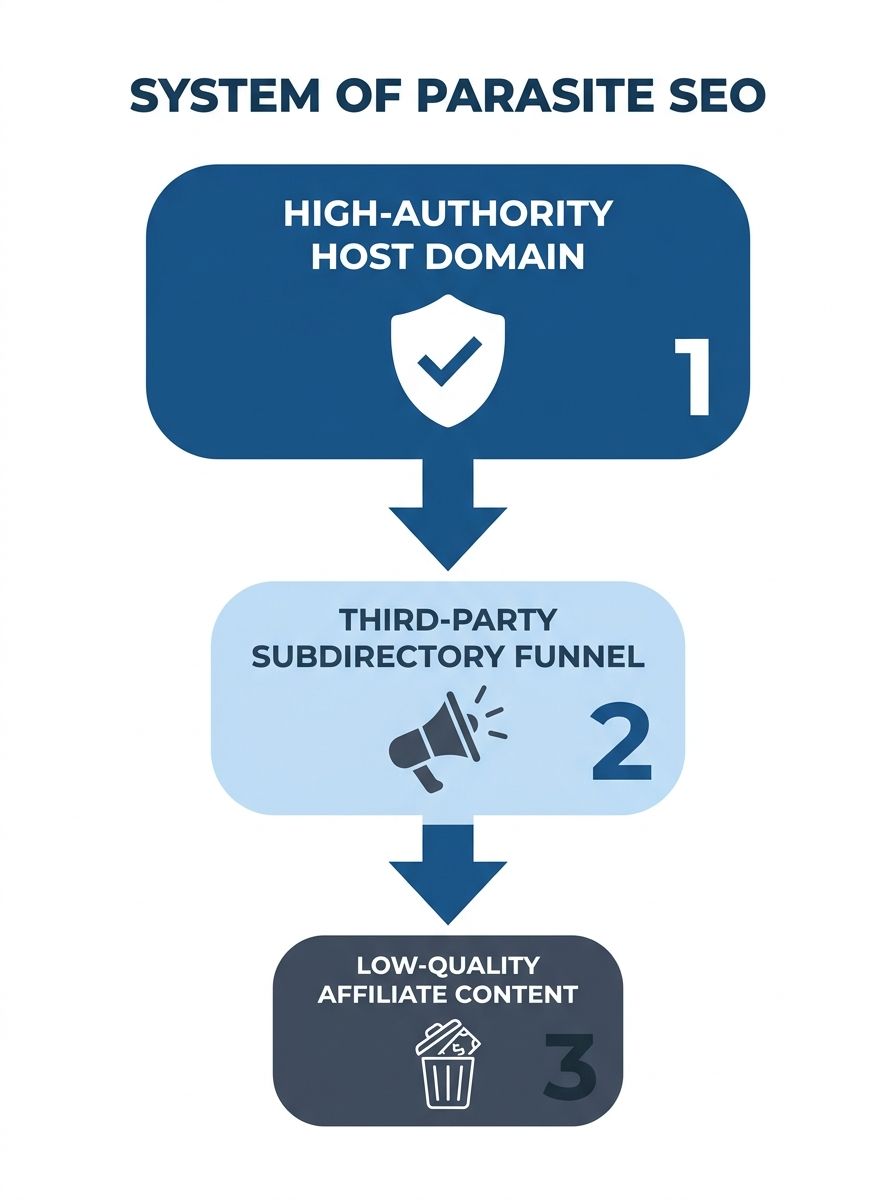
Second, a tactic called parasite SEO (now officially termed "site reputation abuse" by Google) matured into a full industry. Operators would rent subdirectories or subdomains on high-authority sites, publish affiliate or casino content there, and ride the host site's domain trust to rank quickly. The host got paid. The operator got rankings. And the search results got worse for everyone else.
Google's SpamBrain AI system was being trained on all of this throughout the process, analyzing what the company describes as over 40 billion spam pages daily. The system learned patterns in publishing velocity, content quality signals, user engagement metrics, and link profiles that flagged manipulative content at scale.
March 2024: Google Draws Three Lines at Once
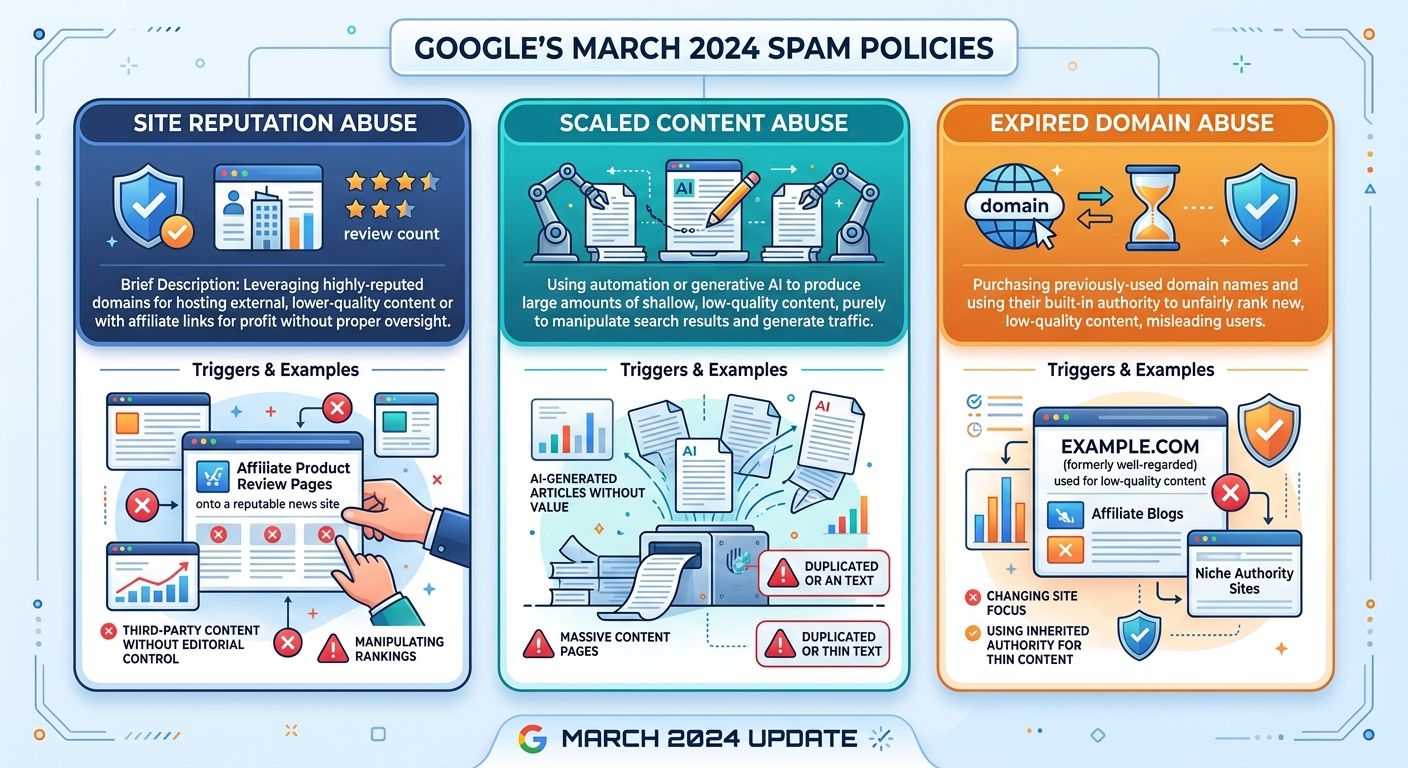
Google's March 2024 Core Update was the most aggressive anti-spam action in over a decade. Instead of targeting one tactic, the update introduced three distinct spam policies simultaneously.
Site Reputation Abuse addressed the parasite SEO problem directly. If a third party publishes content on your domain primarily to exploit your ranking signals, both the content and potentially the host site face penalties. The Forbes, CNN, and WSJ examples made it clear that brand size offered zero protection.
Scaled Content Abuse targeted mass-produced content created for ranking manipulation regardless of how it was made. The wording was deliberate: AI-generated, automated, or human-written content all fall under this policy if the primary purpose is gaming search results rather than serving users.
Expired Domain Abuse went after the practice of buying lapsed domains (sometimes former government or educational sites) and repurposing their existing backlink profiles for unrelated commercial content. Google cited examples like casino content hosted on former school websites.
The distinction that matters: Google didn't ban AI content or automation outright. Google's Search Liaison Danny Sullivan clarified that content created primarily for search engine rankings, however it's produced, violates their guidance. Content that's helpful and created for people first doesn't trigger policy violations. The line sits at intent and quality, which gives Google wide enforcement latitude.
What the First 72 Hours Look Like
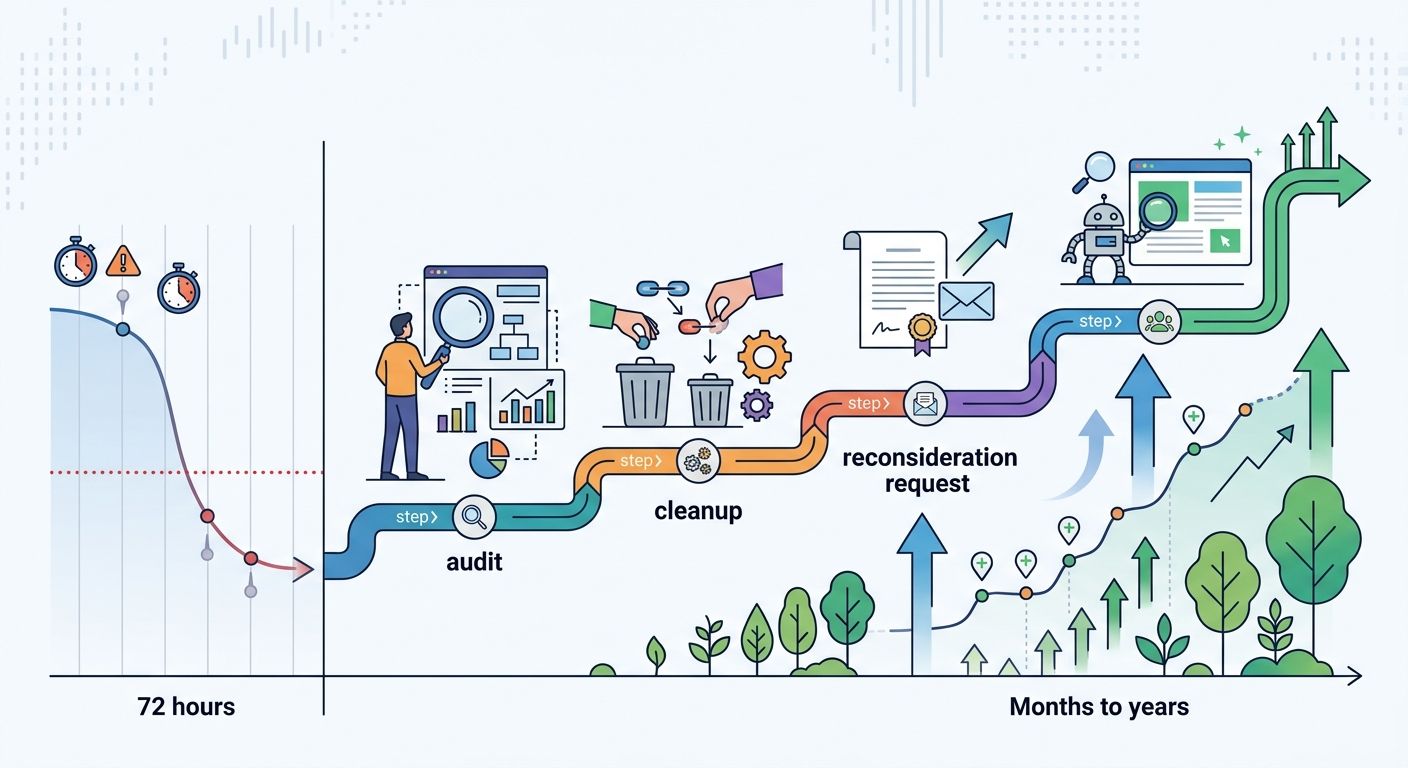
The speed of penalty enforcement surprised a lot of site operators. Data from the March 2024 rollout showed traffic drops of 50–95% within 72 hours for sites that triggered the new policies. Google penalties for black hat SEO can range from a ranking drop to complete deindexing, which means total removal from search results.
Two penalty mechanisms are at work. Manual penalties happen when a human reviewer at Google flags your site, and you'll see a notification in Google Search Console. Algorithmic penalties happen automatically when Google's systems detect patterns that match spam signals. You won't get a notification for those. You'll just watch your traffic graph fall off a cliff.
As Shopify's SEO Strategist Greg Bernhardt put it, "Black hat SEO sacrifices long-term success for theoretical and unproven short-term gains." The word "theoretical" is worth emphasizing. Many operators assume they'll get a profitable window of rankings before any penalty hits. But with SpamBrain processing billions of pages daily, that window has compressed to weeks or even days.
The financial toll extends well beyond lost traffic. Businesses that relied on organic search for revenue face catastrophic drops overnight. Research suggests around 40% of penalized businesses close within six months when organic traffic was their primary acquisition channel. For larger companies, the damage shows up differently: stock price drops, revenue guidance reductions, and the cost of hiring specialists to attempt recovery.
The Recovery Problem
Getting penalized is fast. Getting un-penalized is agonizingly slow, and that asymmetry is where the real cost of black hat SEO reveals itself.
For manual penalties, the process involves filing a reconsideration request after you've cleaned up the violations. Google reviews the request, and if they're satisfied, lifts the penalty. According to SearchLogistics' recovery guide, manual penalties can take weeks to months to resolve even after you've completed the remediation work.
Algorithmic penalties are harder. There's no reconsideration form to submit. Recovery requires fixing the underlying problems: removing spammy backlinks, improving content quality, eliminating cloaking or hidden text. Then you wait for Google to re-crawl and reassess your site. That reassessment doesn't happen on your timeline. Algorithmic recovery commonly takes several months, and severe cases can stretch past a year or two.
Some categories of penalty have no viable recovery path at all. Site reputation abuse content, for instance, must be removed or noindexed entirely. If your business model depended on that content ranking, the model is gone.
The recovery work itself is expensive. You're paying for detailed site audits, backlink analysis and disavow file creation, content rewrites or removals, and ongoing monitoring. All of that effort goes toward getting back to where you started, not toward moving ahead. Every month spent on recovery is a month your competitors are building real organic authority.
Understanding how crawling, indexing, and ranking actually work makes this dynamic clearer. Google's systems need to re-crawl your cleaned-up pages, re-index them, and then re-evaluate your site's overall quality signals. Each step takes time, and there's no mechanism to accelerate it from your side.
Where This Lands Now
By early 2026, the gap between black hat returns and white hat returns has widened dramatically in favor of doing things properly. Google's December 2025 update added explicit warnings about penalizing sites that manipulate outgoing links for SEO benefits, closing yet another loophole that had sustained a cottage industry of paid link schemes.
The practical reality is that black hat SEO trades away three things you can't easily recover.
Time. Recovery from SEO penalties consumes months or years that could have been spent building genuine authority. A site that starts with ethical link building practices from day one will be far ahead of a recovered site on the same timeline, and that competitive gap only widens as the clean site compounds its organic signals.
Trust. A manual penalty leaves a mark on your site's history with Google. Even after recovery, some practitioners report that previously penalized domains never fully regain their former ranking potential. Whether this is technically the case or simply a reflection of lost competitive ground during the recovery period, the practical outcome is the same: you're playing from behind.
Revenue stability. Organic traffic built through proper on-page optimization and the principles behind organic SEO compounds over time. Traffic built through manipulation is always one algorithm update away from disappearing. Every recalibration is a threat to rankings that depend on artificial signals, and Google has shown no signs of slowing down its update cadence.
The calculus is straightforward. Black hat tactics offer uncertain short-term gains paired with guaranteed long-term risk. Ethical SEO offers slower initial progress with compounding long-term returns. Every major Google update in the past two years has made the first option worse and the second more reliable. The trend is visible in the data, it's consistent across industries, and there's nothing in Google's trajectory that suggests it will reverse.
OrganicSEO.org Editorial
Editorial team writing about Ethical, white-hat, organic SEO education.
Frequently Asked Questions
- What happened to Forbes, CNN, and Wall Street Journal in Google's March 2024 update?
- These trusted brands lost significant search visibility when Google's March 2024 Core Update penalized them for site reputation abuse—they had allowed third-party affiliate content onto their domains, which Google treated as ranking manipulation. The enforcement action demonstrated that even massive domain authority provided no protection against these penalties.
- What is site reputation abuse in SEO?
- Site reputation abuse is when third parties publish content on a high-authority domain primarily to exploit that site's ranking signals for their own benefit, typically through affiliate or casino content on rented subdirectories or subdomains. Both the content and potentially the host site face penalties when Google detects this practice.
- How fast does Google penalize black hat SEO violations?
- Traffic drops of 50-95% can occur within 72 hours for sites triggering Google's spam policies. With SpamBrain processing billions of pages daily, the window before penalty enforcement has compressed to weeks or even days rather than months.
- How long does it take to recover from a Google SEO penalty?
- Manual penalties can take weeks to months to resolve after remediation, while algorithmic penalties commonly take several months and severe cases can stretch past a year or two. There is no guaranteed timeline since recovery depends on Google's crawl and reassessment schedule, which you cannot accelerate.
- What are the main black hat SEO techniques Google is cracking down on?
- Google's March 2024 Core Update targeted three distinct practices: site reputation abuse (parasite SEO), scaled content abuse (mass-produced content created for ranking manipulation), and expired domain abuse (repurposing lapsed domains with backlinks for unrelated commercial content).
- Can AI-generated content violate Google's guidelines?
- Google doesn't ban AI content outright, but content created primarily for search engine rankings—whether AI-generated, automated, or human-written—violates their guidance. Content that's helpful and created for people first doesn't trigger policy violations.
- What percentage of penalized businesses close after a Google penalty?
- Research suggests approximately 40% of penalized businesses close within six months when organic search traffic was their primary acquisition channel.
- Why is black hat SEO not worth the short-term gains?
- Black hat SEO trades away three unrecoverable assets: time spent on recovery instead of building genuine authority, trust with Google (penalized domains may never regain former ranking potential), and revenue stability since manipulated rankings disappear with each algorithm update. Meanwhile, competitors using ethical SEO compound their organic signals during your recovery period.