SEO Glossary: Every Term You Need, Defined
Google's SEO Starter Guide, hosted at developers.google.com, runs through the entire lifecycle of how a page gets discovered, evaluated, and ranked. It's the closest thing the industry has to an official textbook.
SEO Glossary: Every Term You Need, Defined
Google's SEO Starter Guide, hosted at developers.google.com, runs through the entire lifecycle of how a page gets discovered, evaluated, and ranked. It's the closest thing the industry has to an official textbook. But it also stops short in revealing how these concepts interact, and it doesn't define a third of the terms that working SEO practitioners use daily. So this glossary does something different: it walks through the Starter Guide's framework section by section, defines every term you'll encounter along the way, and fills the gaps where Google's own documentation goes quiet.
Think of this as an SEO glossary organized the way search actually works, from discovery to ranking to measurement, rather than in alphabetical order where context goes to die.
How Google Finds Anything: The Discovery Layer
The Starter Guide opens with discovery because nothing else matters until Google knows your page exists. Here are the SEO terms that describe this process.
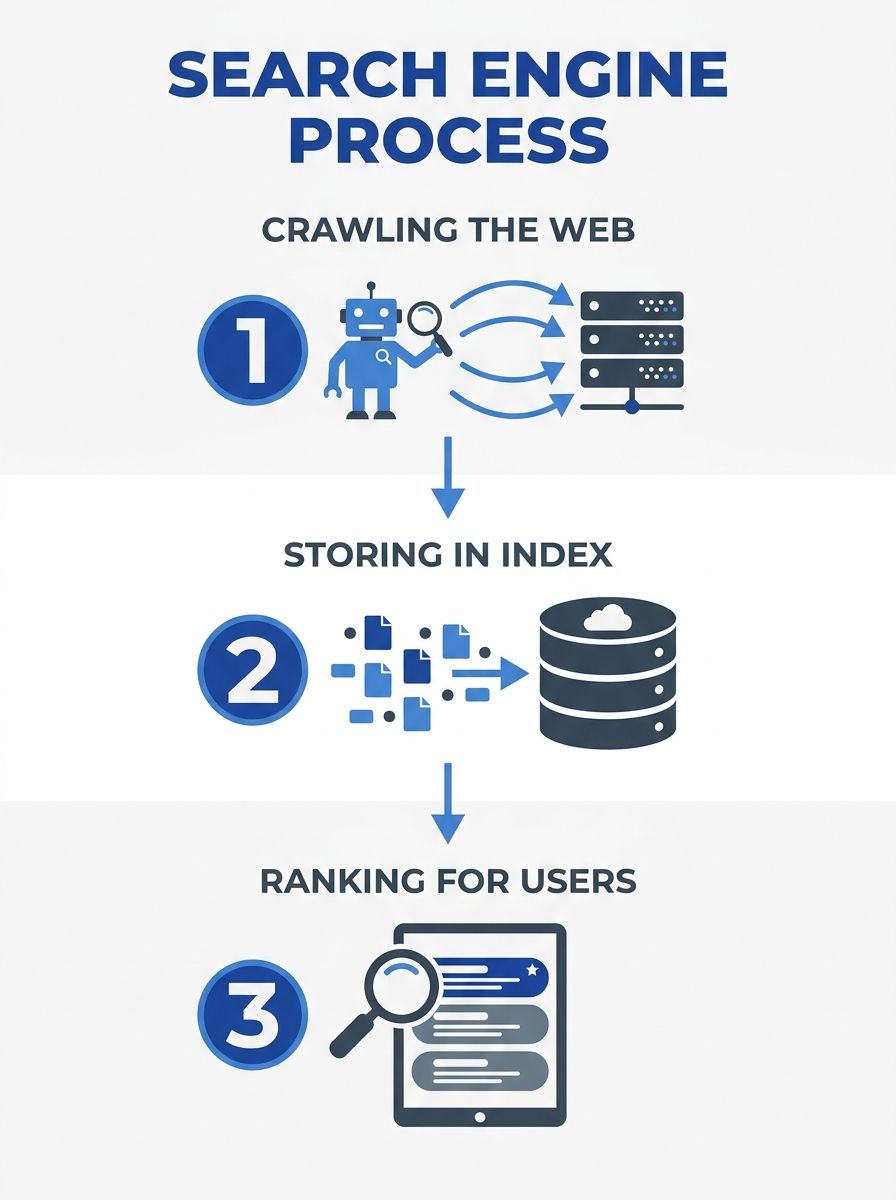
Crawling is Google sending automated programs (called crawlers, spiders, or Googlebots) to fetch pages across the web. The crawler follows links from page to page, reading HTML and discovering new URLs. If you've ever wondered why internal linking matters so much, this is the reason: crawlers navigate your site the same way a visitor would, by following links.
Crawl budget refers to the number of pages Google will crawl on your site within a given time frame. Small sites rarely need to worry about this. Large sites with tens of thousands of pages do, because Google won't crawl everything in one pass.
Robots.txt is a plain text file at your domain's root that tells crawlers which parts of your site they're allowed or disallowed to access. It doesn't remove pages from Google's index if they've already been crawled, a common misunderstanding.
Sitemap (XML Sitemap) is a file that lists every URL you want search engines to know about. Think of it as a table of contents you hand directly to Google, especially useful for new sites or pages that aren't well-linked internally.
Indexing is what happens after crawling. Google stores and organizes the content it found. A page can be crawled but not indexed if Google decides it's duplicate, thin, or otherwise not worth keeping. You can read a deeper breakdown in our explanation of how search engines handle crawling, indexing, and ranking.
Canonical tag (rel="canonical") tells Google which version of a page is the "official" one when duplicate or near-duplicate versions exist. If you have the same product page accessible at three different URLs, the canonical tag consolidates ranking signals to one.
Noindex is a meta directive that tells search engines not to include a page in their index. Unlike robots.txt, which prevents crawling, noindex allows crawling but blocks the page from appearing in search results.
Rendering is the process by which Google executes JavaScript on a page to see its final content. Pages built heavily with client-side JavaScript depend on Google's rendering step to be indexed correctly.
The Ranking Vocabulary Hidden in Google's Framework
Once a page is indexed, Google evaluates it against hundreds of signals to determine where it appears in search results. This is where the SEO terminology gets dense.
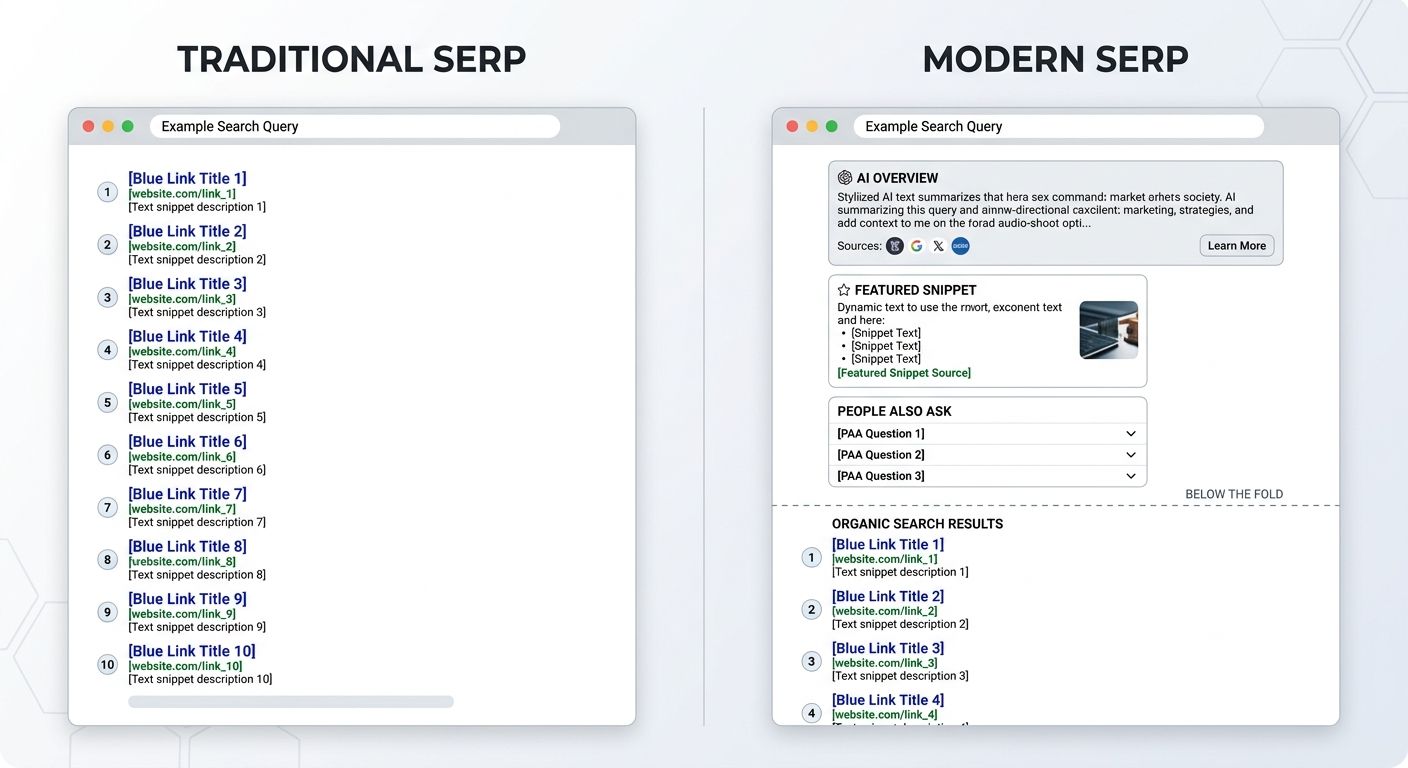
SERP (Search Engine Results Page) is the page Google shows you after a query. SERPs now include far more than ten blue links: featured snippets, knowledge panels, image carousels, video results, People Also Ask boxes, and AI Overviews all compete for space.
Algorithm is the set of rules and machine learning models Google uses to rank pages. Google runs multiple algorithm systems simultaneously (e.g., BERT for language understanding, RankBrain for query interpretation, the Helpful Content System for quality assessment).
Ranking factors are the signals Google's algorithm weighs. These include content relevance, backlink quality, page experience metrics, and hundreds of others. No one outside Google knows the complete list or exact weightings.
Keywords are the words and phrases people type into search engines. Understanding how to research and select them is foundational to SEO. We've covered how to find queries real people actually search for in a separate guide.
Search intent describes what a user actually wants when they type a query. Google categorizes intent broadly as informational (learning something), navigational (finding a specific site), commercial (researching before buying), or transactional (ready to buy or act). Matching intent matters more than matching exact keywords.
Long-tail keywords are longer, more specific phrases (usually 3+ words) with lower search volume but higher conversion potential. "Running shoes" is a head term. "Best running shoes for flat feet women" is long-tail.
Featured snippets are the answer boxes that appear above organic results for certain queries. As Moz's SEO glossary notes, these are organic results pulled from indexed pages, displayed in a special format.
Knowledge panel is the information box Google shows on the right side of results for well-known entities (people, companies, places). It's populated from Google's Knowledge Graph.
AI Overviews are Google's AI-generated summaries that appear at the top of certain SERPs. Over 30% of searches now involve some form of AI-generated response, which has created an entirely new vocabulary around visibility.
Answer Engine Optimization (AEO) focuses on structuring content so AI systems can extract direct answers for voice queries, featured snippets, and AI overviews.
Generative Engine Optimization (GEO) targets earning citations within responses generated by large language models like ChatGPT and Perplexity. GEO cares about whether your content gets cited as a source, not whether it ranks on a traditional SERP.
On-Page Terms: What You Directly Control
The Starter Guide dedicates its longest section to on-page elements, and for good reason: these are the factors a site owner has full authority over. If you want the complete walkthrough on applying these concepts, our on-page SEO optimization guide covers the practical side.
Title tag is the HTML element (<title>) that defines a page's title. It shows up in browser tabs, search results, and social shares. Google sometimes rewrites it in SERPs, but what you write still carries weight.
Meta description is the HTML snippet that summarizes a page's content. Google doesn't use it as a direct ranking signal, but a well-written meta description improves click-through rates from search results, which influences traffic.
Header tags (H1-H6) structure your content hierarchically. The H1 is typically the main page heading. H2s divide major sections. H3s subdivide those. Google uses these to understand content structure and topic coverage.
Alt text is the text description assigned to an image in HTML. It serves accessibility purposes for screen readers and gives Google context about what an image depicts. If you're working on image optimization for search, alt text is one of the most impactful attributes you can set.
Internal link is a hyperlink from one page on your site to another page on the same site. Internal links distribute ranking authority across your site and help crawlers discover pages.
External link (outbound link) is a link on your site pointing to a different domain. Linking to authoritative sources can add credibility to your content.
Anchor text is the clickable text of a hyperlink. Google uses anchor text to understand what the linked page is about. Over-optimizing anchor text with exact-match keywords can trigger spam filters.
Keyword density is the percentage of times a keyword appears relative to total word count on a page. There's no ideal percentage. The concept is mostly outdated, but stuffing a keyword into every other sentence still triggers penalties.
Evergreen content is content that stays relevant over time and doesn't expire with news cycles. A guide on "how HTTP status codes work" is evergreen. A recap of a 2024 conference is not.
Thin content describes pages with little substantive value, either because they're too short, auto-generated, or duplicated from elsewhere. Google's Helpful Content System specifically targets thin content.
Content pruning means removing or consolidating low-quality pages to raise the overall quality of your site. Moz defines pruning as a deliberate strategy to cut dead weight from your domain.
Schema markup (structured data) is code you add to pages to help search engines understand content types. Recipe schema tells Google it's a recipe. FAQ schema tells Google the page contains Q&A pairs. Proper schema markup can earn rich results like star ratings, pricing info, or event dates in SERPs.
E-E-A-T (Experience, Expertise, Authoritativeness, Trustworthiness) is Google's quality framework. It's not a direct algorithm signal you can measure, but it describes the qualities Google's human quality raters look for when evaluating search results. The first "E" for Experience was added in late 2022, emphasizing first-hand knowledge.
YMYL (Your Money or Your Life) refers to topics where poor information could harm a person's health, finances, or safety. Google holds YMYL content to higher E-E-A-T standards. Medical advice, financial guidance, and legal information all fall into this category.
The Trust Layer: Authority, Links, and Reputation
Google's Starter Guide barely scratches the surface here, but off-page signals remain central to how ranking works.
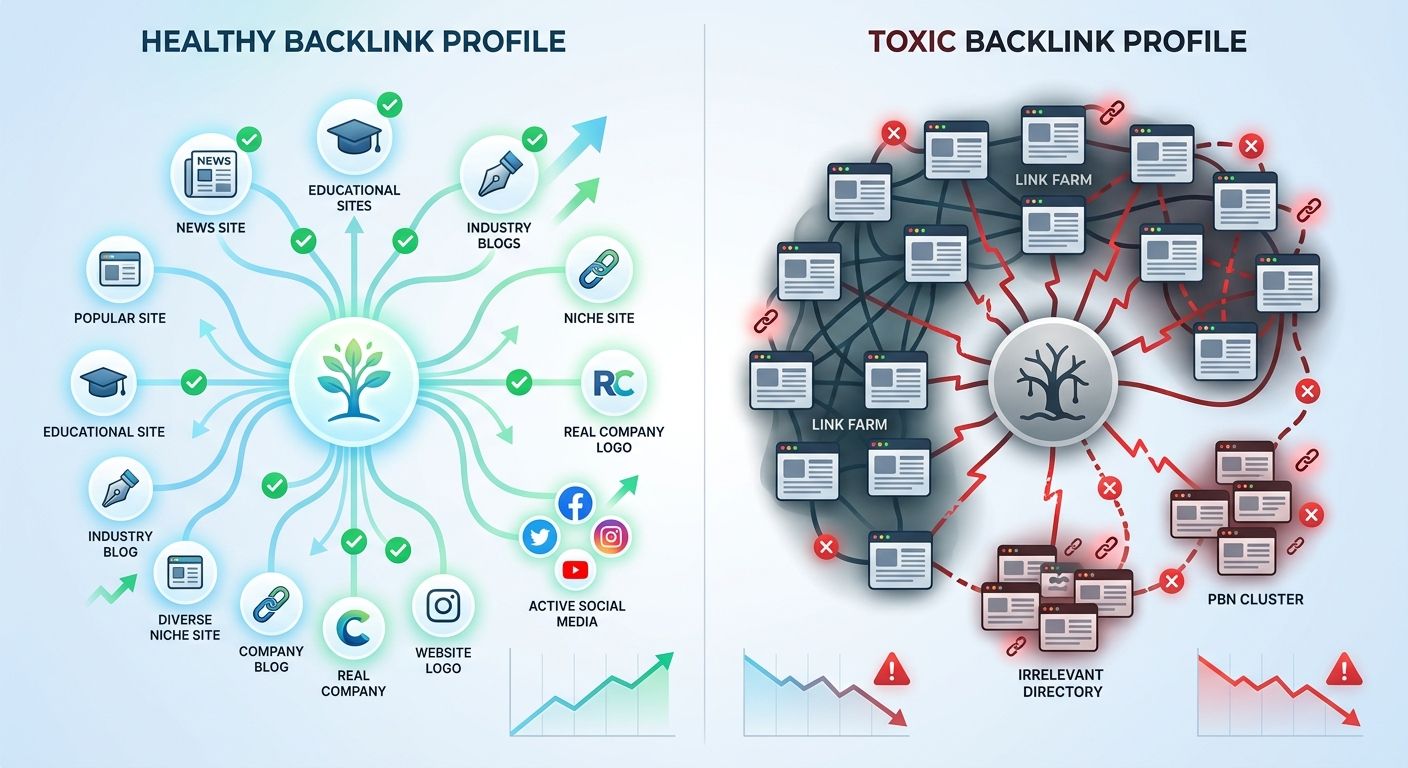
Backlink (inbound link) is a link from another website to yours. Backlinks act as votes of confidence. The quality of the linking site matters far more than the quantity of links. Our guide on white-hat link building covers how to earn these without crossing into manipulation.
Domain Authority / Domain Rating are third-party metrics (from Moz and Ahrefs respectively) that estimate a site's ranking strength based on its backlink profile. Google doesn't use these scores, but they're useful for comparative analysis.
Topical authority describes how thoroughly a site covers a subject area. Google increasingly rewards sites that demonstrate deep expertise across a topic cluster rather than sites that publish one strong article on an isolated keyword.
Link equity (link juice) is the ranking value passed from one page to another through a hyperlink. Links from high-authority pages pass more equity than links from low-authority pages.
Nofollow is a link attribute (rel="nofollow") that tells Google not to pass link equity through that link. Google now treats nofollow as a hint rather than a directive, meaning it may choose to follow or ignore the attribute.
Disavow is a process where you submit a list of links to Google asking them to ignore those links when assessing your site. It's a last resort for sites hit by spammy backlinks they can't get removed through outreach.
Black-hat SEO describes tactics that violate search engine guidelines: buying links, cloaking pages, keyword stuffing, private blog networks. These carry real risk, and we've documented what you'd actually be trading away if you go down that path.
White-hat SEO refers to practices that comply with search engine guidelines and focus on creating genuine value for users. Every strategy on this site falls into this category.
The Measurement Stack and the Terms Google's Guide Left Out
The Starter Guide tells you to set up Google Search Console. It doesn't explain half of what you'll find there.
Google Search Console (GSC) is Google's free tool for monitoring how your site performs in search. It shows which queries bring impressions and clicks, flags indexing errors, and reports on Core Web Vitals.
Impressions count how many times your page appeared in someone's search results, whether they clicked or not.
Click-through rate (CTR) is the percentage of impressions that resulted in a click. If your page shows up 1,000 times and gets 50 clicks, your CTR is 5%.
Bounce rate measures the percentage of visitors who land on a page and leave without interacting further. A high bounce rate on a blog post isn't necessarily bad (the reader may have found their answer). A high bounce rate on a product page is a different story.
Core Web Vitals are three specific performance metrics Google uses as ranking signals. LCP (Largest Contentful Paint) measures loading speed and should be under 2.5 seconds. INP (Interaction to Next Paint) measures responsiveness and should stay below 200 milliseconds. CLS (Cumulative Layout Shift) measures visual stability and should remain under 0.1.
Scroll depth tracks how far down a page visitors scroll. Moz includes this in their glossary as a behavioral metric worth monitoring, though it's not a direct ranking factor.
Organic traffic is visits that arrive through unpaid search results, as opposed to paid ads, social media, or direct navigation.
HTTPS is the secure version of HTTP. Google confirmed it as a ranking signal years ago. If your site still runs on HTTP, you're at a disadvantage.
Hreflang is an HTML attribute that tells Google which language and regional version of a page to show users in different countries. Essential for multilingual sites, irrelevant for single-language domains.
301 redirect permanently sends users and search engines from one URL to another, passing most link equity to the new destination. Our walkthrough of URL structure and redirects explains when and how to use these.
404 error means a page wasn't found. A few 404s are normal. Hundreds of them pointing to pages that used to have backlinks represent lost ranking value.
Topical cluster (content cluster) is a content strategy where a central "pillar" page covers a broad topic and links to supporting articles that cover subtopics in detail. Each supporting article links back to the pillar page. This architecture builds topical authority and helps crawlers understand how your content relates to itself.
Entity SEO refers to optimizing for Google's entity-based understanding of the web. Google doesn't just match keywords anymore. It identifies entities (people, places, organizations, concepts) and maps relationships between them. Schema markup plays a direct role in helping Google identify your entities.
Why Vocabulary Precision Keeps Showing Up in Every Audit
Every SEO audit I've read in the past three years traces at least one significant mistake back to a misunderstood term. A site owner hears "index" and assumes it means "rank." A marketing team confuses "crawl budget" with "server load." Someone disavows links they shouldn't have touched because they thought Domain Authority was a Google metric.
The SEO terminology in this glossary covers the working vocabulary of the discipline as it exists now, including terms like AEO and GEO that Ahrefs' own extensive glossary has started documenting as the search landscape shifts toward AI-mediated results. The Google Starter Guide gives you the frame. The rest of the vocabulary fills in the structure you'll actually build on. When you know what each piece is called and how it functions within the system, you stop treating SEO like a checklist and start treating it like the engineering discipline it actually is.
OrganicSEO.org Editorial
Editorial team writing about Ethical, white-hat, organic SEO education.
Frequently Asked Questions
- What is crawl budget and why does it matter for SEO?
- Crawl budget refers to the number of pages Google will crawl on your site within a given time frame. Large sites with tens of thousands of pages need to worry about this because Google won't crawl everything in one pass, while small sites rarely need to consider it.
- What's the difference between noindex and robots.txt?
- Robots.txt tells crawlers which parts of your site they're allowed to access and doesn't remove already-indexed pages, while noindex allows crawling but prevents the page from appearing in search results. These serve different purposes in controlling search engine access.
- How do featured snippets and AI Overviews differ in search results?
- Featured snippets are answer boxes pulled from indexed pages and displayed in a special format above organic results, while AI Overviews are Google's AI-generated summaries that appear at the top of certain SERPs. Over 30% of searches now involve some form of AI-generated response.
- What is search intent and why is it important?
- Search intent describes what a user actually wants when they type a query, categorized broadly as informational, navigational, commercial, or transactional. Matching search intent matters more than matching exact keywords when optimizing content.
- What is E-E-A-T and how does it affect rankings?
- E-E-A-T (Experience, Expertise, Authoritativeness, Trustworthiness) is Google's quality framework that describes qualities human quality raters look for when evaluating search results. While not a direct algorithm signal you can measure, it influences how content is rated, especially for YMYL topics where poor information could harm health, finances, or safety.
- What are Core Web Vitals and what are the recommended thresholds?
- Core Web Vitals are three performance metrics Google uses as ranking signals: LCP (Largest Contentful Paint) should be under 2.5 seconds, INP (Interaction to Next Paint) should stay below 200 milliseconds, and CLS (Cumulative Layout Shift) should remain under 0.1.
- What is a topical cluster and how does it build SEO authority?
- A topical cluster is a content strategy where a central pillar page covers a broad topic and links to supporting articles covering subtopics, with each supporting article linking back to the pillar page. This architecture builds topical authority and helps crawlers understand how your content relates to itself.
- What is the difference between white-hat and black-hat SEO?
- White-hat SEO refers to practices that comply with search engine guidelines and focus on creating genuine value for users, while black-hat SEO describes tactics that violate guidelines such as buying links, cloaking pages, keyword stuffing, and private blog networks. Black-hat tactics carry real risk of penalties.