Choosing a Domain Name for SEO: What Matters, What Does Not
.com domains receive roughly 33% higher click-through rates than newer TLD alternatives, according to GrowthBadger's research on user trust and domain extensions.
Choosing a Domain Name for SEO: What Matters and What Doesn't
.com domains receive roughly 33% higher click-through rates than newer TLD alternatives, according to GrowthBadger's research on user trust and domain extensions. That single percentage captures the core tension in every domain name SEO discussion: the ranking algorithm barely cares about your domain, but the humans clicking on search results care enormously. And since clicks feed the signals Google does measure, the domain you pick ends up mattering in ways that have nothing to do with keywords tucked between hyphens.
This disconnect between what Google measures directly and what users perceive is where most bad domain-buying decisions originate. People optimize for the algorithm (stuffing keywords into their URL) when they should be optimizing for the person scanning ten blue links on a results page.
The Exact Match Domain Question, Settled
Google's 2012 EMD update removed approximately 41 keyword-stuffed domains from top-10 results, affecting 0.6% of English-language queries according to SISTRIX analysis. The message was clear: Google didn't want "best-plumber-nyc.com" ranking above established plumbing businesses with strong content and real backlink profiles.
That was over a decade ago. The signal has only gotten louder since.
A domain like "best-cheap-shoes-online.com" tells Google nothing it can't already extract from your page titles, headers, and on-page content. SiteGuru's analysis states it plainly: your domain name isn't a ranking factor. And if you think about how search engines actually crawl and index pages, this makes sense. Googlebot reads the full text of your pages, your internal link structure, your schema markup. It doesn't need your domain to spell out your topic.
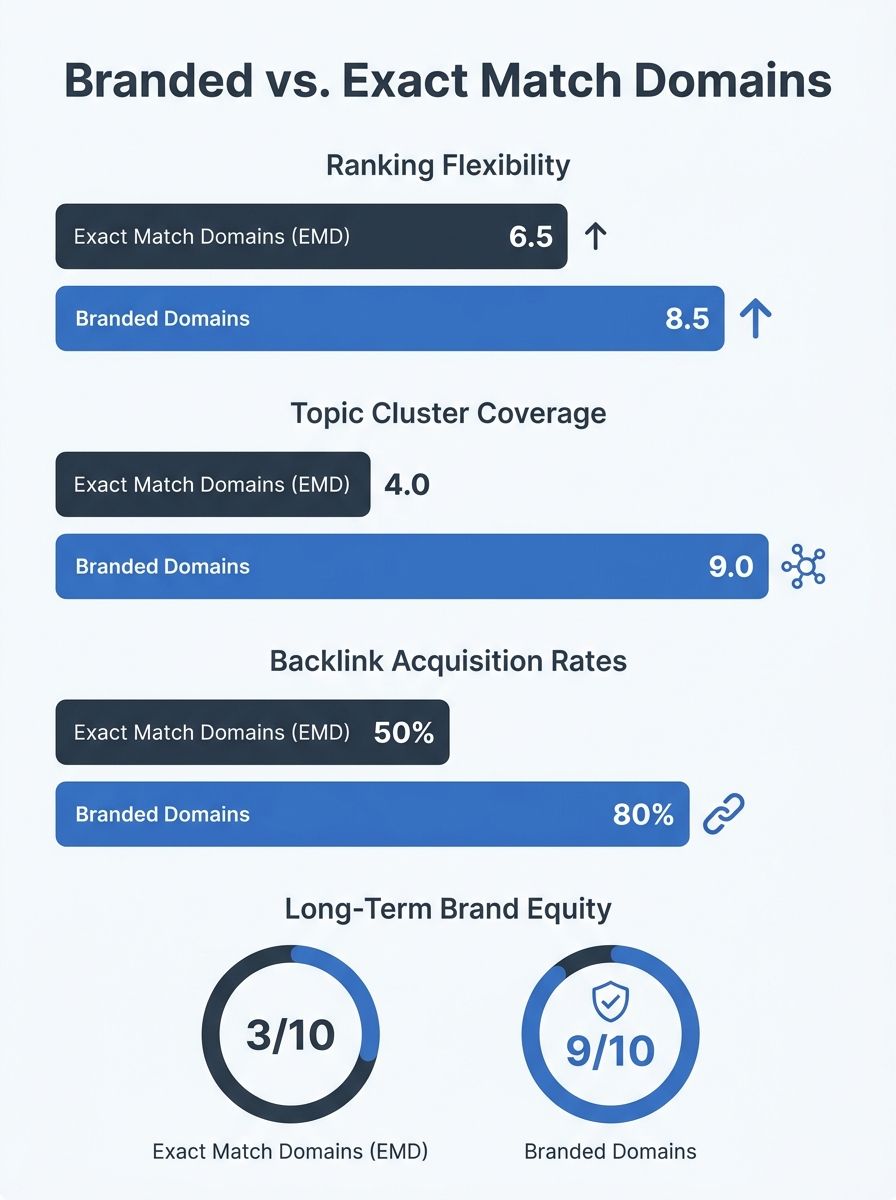
But EMDs haven't become entirely worthless. Some research suggests EMDs may require roughly 60% lower Domain Rating to crack the top 10 for their specific target keyword compared to non-keyword domains. That sounds impressive until you consider the constraint: you're locked into one keyword phrase forever. As NameSilo's comparison data shows, branded domains outperform EMDs across broader topic clusters once they've had time to build authority. If you plan to publish content across multiple related topics, a brandable domain gives you room to grow. An EMD boxes you in.
TLD Choice and Geographic Signals
John Mueller, speaking during a Google Webmaster Central office hours session, confirmed that top-level domains are not used as a Google search ranking factor. A .io domain doesn't rank worse than a .com. A .xyz doesn't get penalized. Google treats generic TLDs equally in its algorithm.
So why does TLD choice still matter?
Two reasons, both grounded in data rather than speculation.
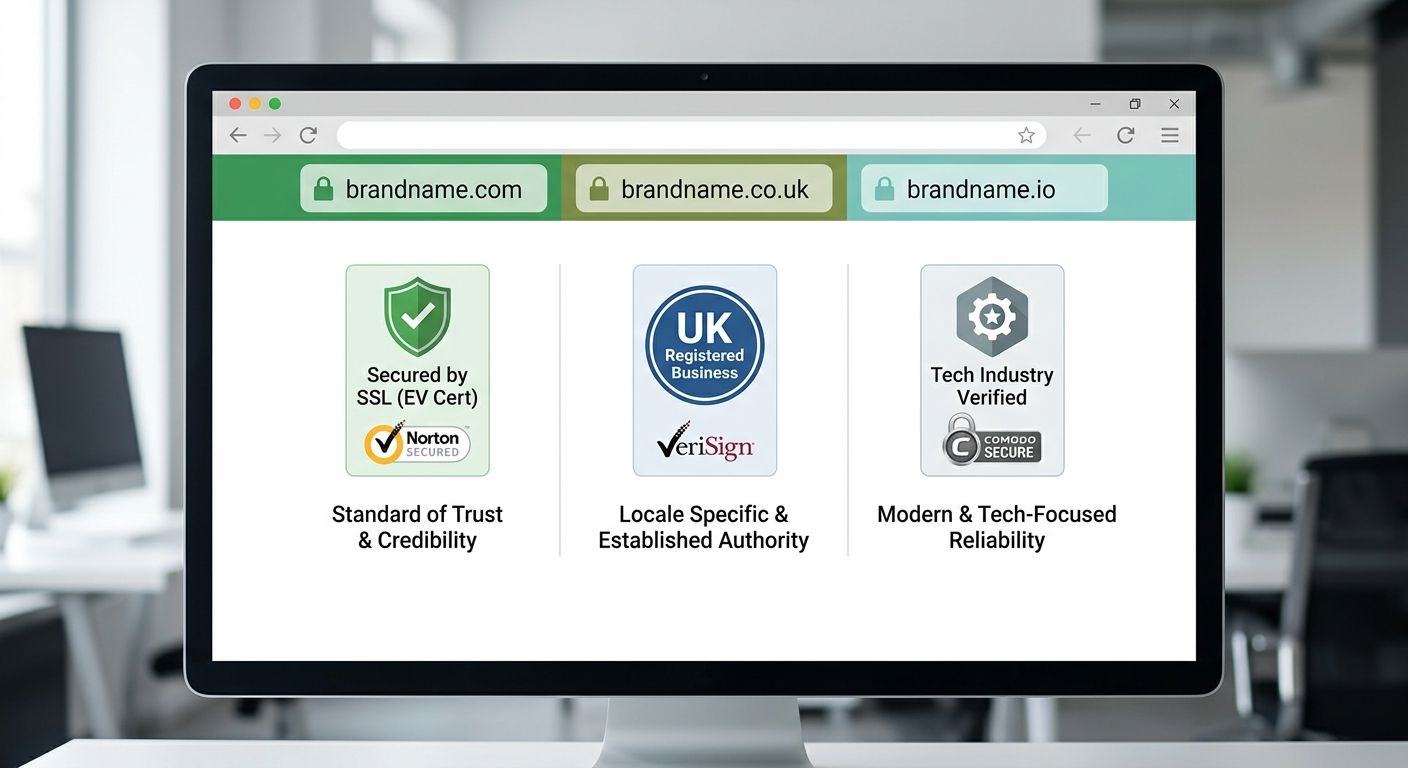
User trust is measurable and real. That 33% CTR advantage for .com exists because users have 20+ years of conditioning. When someone sees "brandname.com" next to "brandname.xyz" in search results, they click .com more often. Since CTR influences how Google evaluates result quality over time, this user preference creates a measurable downstream effect on your organic performance. The 44.4% of all registered domains sitting on .com reinforces why users default to that expectation.
Country-code TLDs carry geographic weight. A .co.uk domain automatically signals UK relevance to Google's systems. This can improve rankings for location-specific searches like "Manchester accountants" or "London restaurants" without requiring additional geo-targeting configuration in Search Console. If your business serves a specific country, the matching ccTLD gives you a real, documented advantage in local search results.
For everyone else building a broader audience, .com remains the safest choice based on user behavior data. If your ideal .com is taken and costs $50,000 on the aftermarket, a .co or .io works fine. The ranking algorithm won't punish you. But know that you're trading some user trust and memorability for a lower purchase price.
Brandability Beats Keywords Every Time
Search Engine Land's guidance on choosing a domain recommends building a brand closely associated with your products, services, or content, then letting that brand rank through quality content, technical SEO, and backlink acquisition. This is the approach that consistently wins when you look at long-term data.
Consider the practical comparison. An e-commerce site called "affordable-kitchen-gadgets-store.com" struggles with backlinks because nobody wants to type or reference that URL. A site called "ChefsPick.com" grows through word-of-mouth, natural mentions in articles, and the kind of brand searches that Google interprets as authority signals. After 18 months of identical SEO effort, the branded domain pulls ahead because real humans engage with it differently.
The keyword research process that drives your content strategy should be completely separate from your domain name decision. Your domain is a container. Your keywords belong in your pages, your titles, your headers, and your URL path structure. Conflating the two leads to domains that are hard to say, hard to spell, and hard to build a recognizable brand around.
Shopify's domain SEO guide distills the practical qualities of an effective domain: short, containing simple terms, and easy to remember. Notice what's absent from that list. There's no mention of cramming your primary keyword into the domain itself.
What "Short" Actually Means in Practice
The data on domain length is consistent across multiple studies. Shorter domains get more direct traffic, fewer typos, and more natural backlinks from people who can actually remember the URL. Hyphens compound the problem because they add characters and create confusion when spoken aloud. The "radio test" is a useful heuristic here: if someone heard your domain name on a podcast, could they type it correctly from memory two days later? If the answer involves explaining "hyphen between best and plumber," you've already lost.
For your on-page optimization to work its hardest, your domain needs to get out of the way. A clean, short, memorable domain lets every other SEO investment compound more effectively because users can find you again, journalists can cite you easily, and your brand queries grow over time.
Domain Age, Registration Length, and Other Expensive Myths
Domain age is not a ranking factor. Mueller has said this explicitly: "No, domain age helps nothing." The misconception persists because older domains tend to have accumulated backlinks, content, and brand recognition over years of existence. The age itself contributes nothing. A new domain with strong content and solid technical execution can outrank a neglected 15-year-old domain within months.
Domain registration length (paying for 5 or 10 years upfront) is similarly irrelevant. Former Google engineer Matt Cutts addressed this directly: "To the best of my knowledge, no search engine has ever confirmed that they use length of registration as a factor." Save the money and spend it on content.
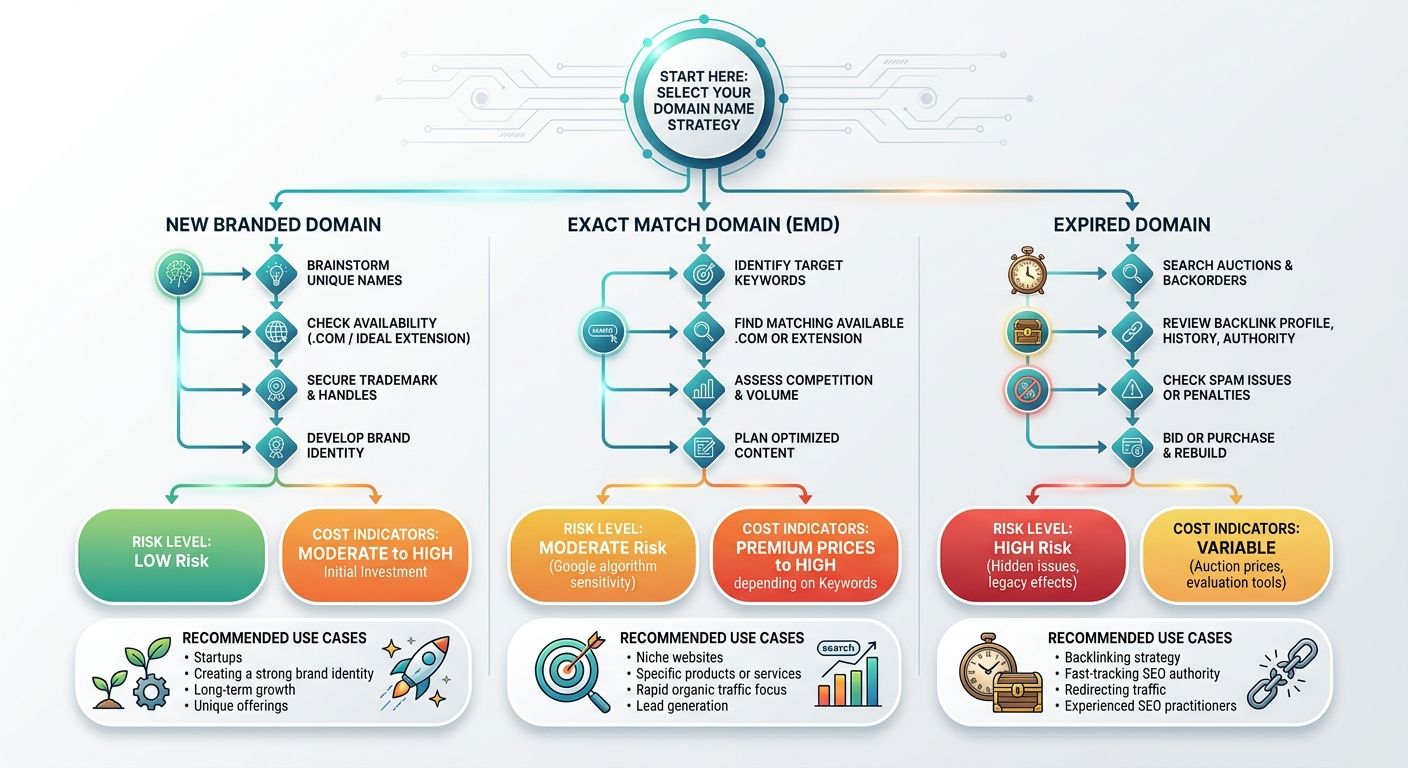
Buying expired domains for their backlink profiles is the riskiest play of all. Google's March 2024 "Expired Domain Abuse" update specifically targets attempts to transfer authority from old domains to new content. Backlinks decay at roughly 10% per year according to Ahrefs research, and many expired domains carry spam histories or manual penalties that aren't visible until you've already made the purchase. Google detects ownership changes and does not blindly transfer authority from one site to the next.
What The Numbers Still Can't Answer
The data on domain name SEO gives us clear guidance on several fronts: EMDs lost their algorithmic edge years ago, TLDs are treated equally by Google's ranking systems, .com wins on user trust metrics, shorter is better, and domain age doesn't matter. These are measurable, documented, and repeatedly confirmed by Google's own engineers.
What the numbers can't fully capture is the compounding effect of brand recognition over five or ten years. We know branded domains outperform EMDs across topic clusters, but the precise magnitude of that advantage varies wildly by industry, audience, and marketing effort. A domain name that's easy to say in a YouTube video, easy to print on a business card, and easy to recommend to a friend generates value that no current SEO metric tracks directly. The CTR data and backlink correlation studies hint at this effect, but they can't quantify it precisely.
The safest interpretation of all available evidence is this: pick a short, pronounceable, .com domain (or your country's ccTLD if you serve a local market), and then forget about your domain for the rest of your SEO career. Every hour spent debating whether to hyphenate or add a keyword to your domain is an hour better spent on content, technical performance, and earning links. The domain is the foundation you pour once. Everything built on top of it is where the real ranking power lives.
OrganicSEO.org Editorial
Editorial team writing about Ethical, white-hat, organic SEO education.
Frequently Asked Questions
- Do exact match domains still help with SEO rankings?
- No, exact match domains (EMDs) are not a ranking factor. Google's 2012 EMD update removed keyword-stuffed domains from top results, and the message has only gotten stronger since. While some research suggests EMDs may require lower domain authority to rank for their specific keyword, they box you into one keyword phrase forever, whereas branded domains can grow across broader topic clusters.
- Does .com rank better than .io, .co, or other domain extensions?
- Google treats all top-level domains equally in its ranking algorithm—a .com doesn't rank better than .io or .xyz. However, .com domains receive roughly 33% higher click-through rates than newer TLDs because users have 20+ years of conditioning to trust .com. For location-specific businesses, country-code TLDs like .co.uk automatically signal geographic relevance to Google.
- Does domain age affect SEO rankings?
- No, domain age is not a ranking factor. Google's John Mueller has stated explicitly that domain age helps nothing. Older domains tend to rank better because they've accumulated backlinks and brand recognition over time, not because of their age itself. A new domain with strong content and solid technical execution can outrank a neglected 15-year-old domain within months.
- Should I pay for a longer domain registration to improve SEO?
- No, domain registration length is not a ranking factor. Paying for 5 or 10 years upfront doesn't help SEO. Former Google engineer Matt Cutts confirmed that no search engine has ever confirmed using registration length as a ranking factor, so save that money and invest it in content instead.
- Are hyphens in domain names bad for SEO?
- Hyphens themselves don't directly hurt SEO, but they create practical problems. Hyphenated domains add characters, create confusion when spoken aloud, and fail the "radio test"—if someone heard your domain on a podcast, they'd struggle to remember and type it correctly. Shorter, simple domains get more direct traffic and more natural backlinks because people can remember and share them easily.
- Can I buy an expired domain to get its backlinks for SEO?
- Buying expired domains for their backlinks is risky and increasingly ineffective. Google's March 2024 "Expired Domain Abuse" update specifically targets authority transfer attempts, backlinks decay at roughly 10% per year, and many expired domains carry spam histories or manual penalties that persist through ownership changes. Always check the Wayback Machine and run tools like Ahrefs before purchasing.
- What makes a good domain name for SEO?
- A good domain should be short, memorable, easy to pronounce, and easy to spell—essentially, it should pass the "radio test" where someone could type it correctly after hearing it once. Branded domains outperform keyword-stuffed domains across broader topic clusters over time because they're easier to mention, cite, and build recognition around.