Keyword Research for SEO: Find Queries Real People Search For
The keyword research workflow taught in every SEO course—pick a tool, sort by volume, filter by difficulty—reliably steers you toward the wrong content.
Keyword Research for SEO: Find the Queries Real People Search For
The keyword research workflow taught in every SEO course—pick a tool, sort by volume, filter by difficulty—reliably steers you toward the wrong content.
That's a strong claim, and I'll defend it with three pieces of evidence. The process most people follow for keyword research starts with a tool dashboard, and the problem is baked into that starting point. Tools show you aggregated data about search terms. They don't show you the actual questions rattling around in a real person's head at 11 PM when they're trying to solve a specific problem. The gap between those two things explains why so many sites publish content that technically targets valid SEO keywords yet attracts almost no organic traffic.
Head Terms Account for a Fraction of Real Search Behavior
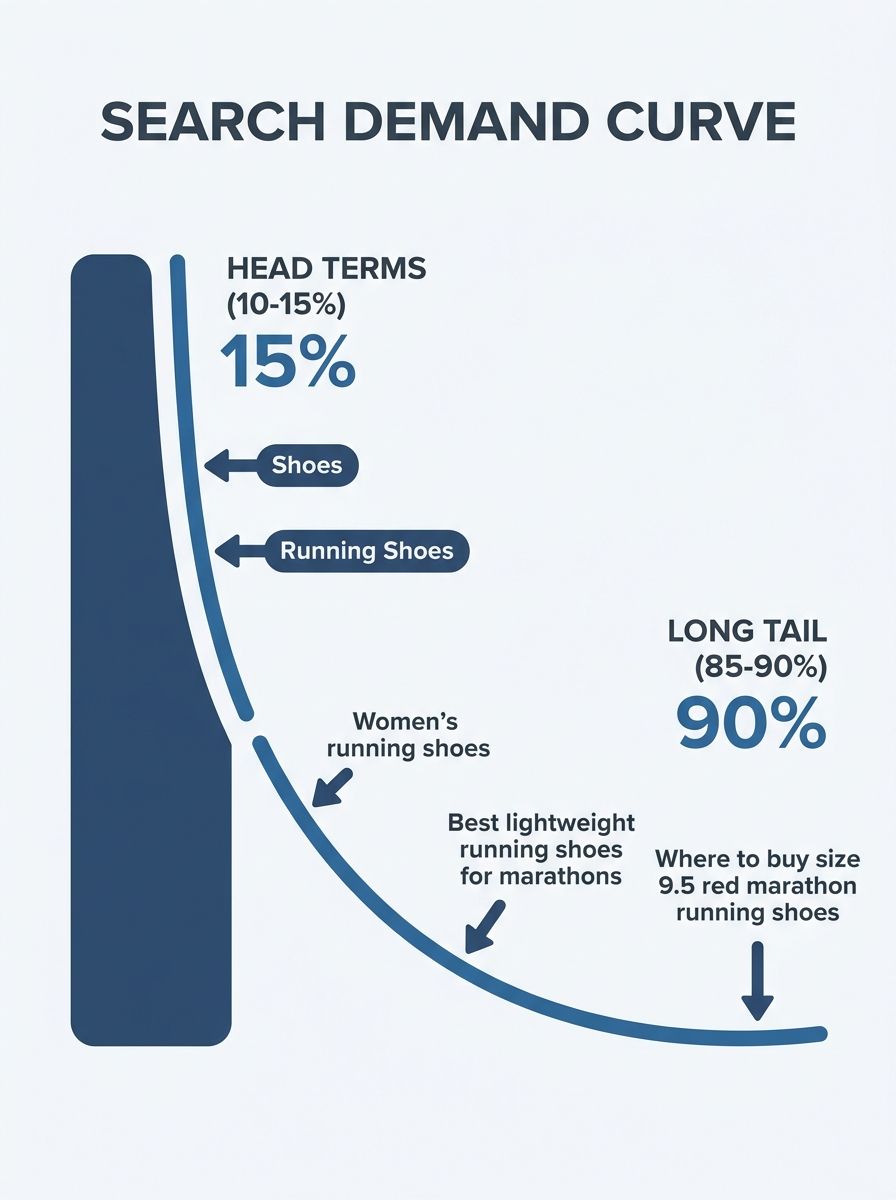
Here's where the data gets uncomfortable for volume-chasers. According to WordStream's analysis of long-tail keyword distribution, the popular "head" keyword terms—the ones with the biggest search volumes—account for roughly ten to fifteen percent of all searches. The remaining 85–90% are long-tail queries: three-word, five-word, sometimes eight-word phrases that individually look tiny in a spreadsheet but collectively represent the overwhelming majority of what people actually type into Google.
When you sit down with Google Keyword Planner or any other tool and sort by monthly volume, you're looking at that 10–15% slice. You're optimizing for the visible tip of demand while ignoring the enormous body of actual queries underneath it.
This matters because the long-tail queries are where specificity lives. Someone searching "running shoes" could want anything. Someone searching "best running shoes for flat feet on concrete" has a specific problem, a specific body type, and is probably closer to a purchase decision. The second query won't show impressive volume numbers. It will convert at a dramatically higher rate.
And this connects directly to how search engines decide what to show. If you understand how crawling, indexing, and ranking actually work, you'll see why Google has gotten better at matching long-tail queries to pages that answer them precisely, even when the page doesn't contain the exact phrase verbatim. Google's semantic understanding means a well-written page targeting a specific topic can rank for dozens of long-tail variations naturally, without you needing to stuff each one into your content.
Search Intent Is the Variable People Skip
Keyword research without intent analysis is like navigation without knowing your destination. You can gather all the data points you want, but if you don't understand why someone types a particular phrase, you'll build the wrong content for it.
Search intent breaks down into a few categories that matter in practice:
Informational: The person wants to learn something. ("how to prune tomato plants")
Navigational: They're looking for a specific site or brand. ("HubSpot login")
Transactional: They're ready to buy or take action. ("buy ceramic plant pots online")
Commercial investigation: They're comparing options before a decision. ("best drip irrigation system 2026")
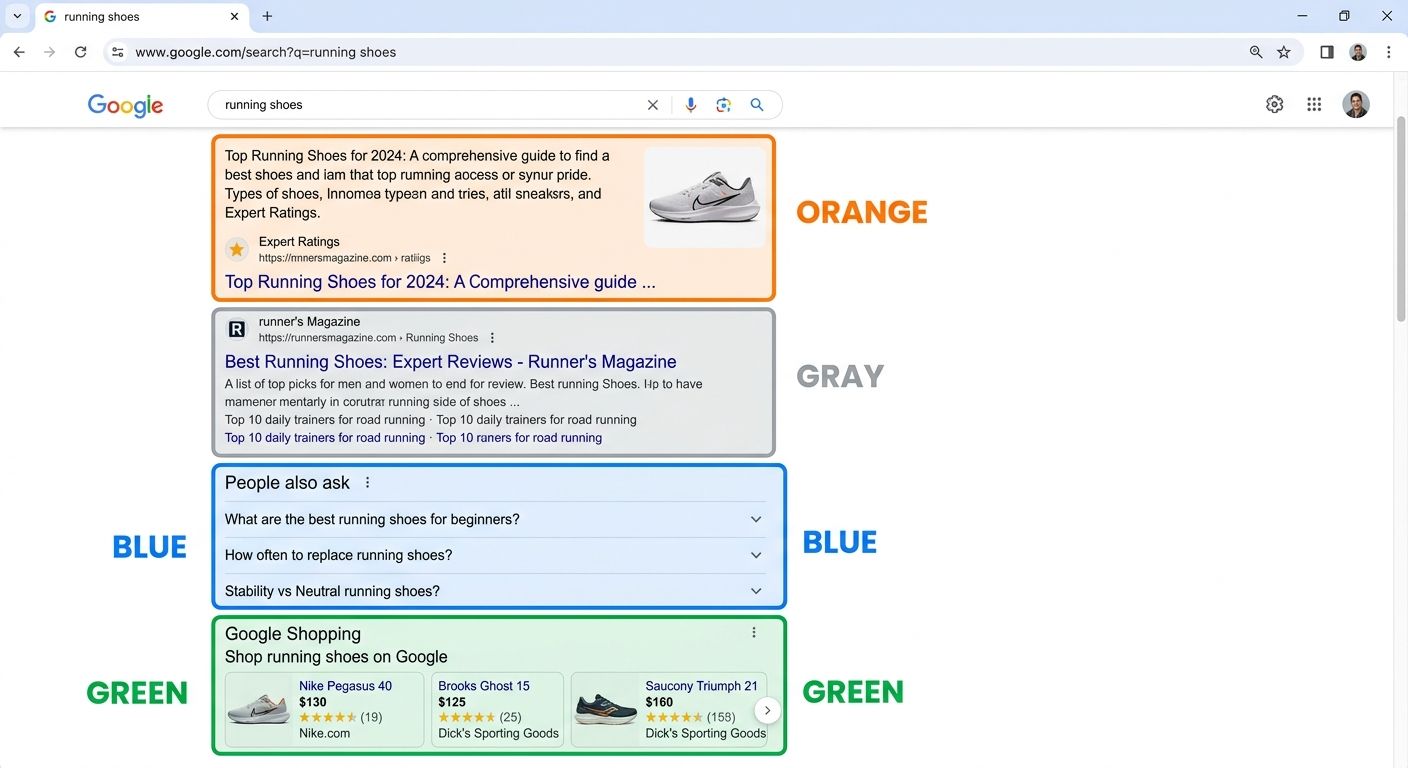
The critical step that separates effective keyword research from the default workflow is this: before you write anything for a target keyword, type that keyword into Google's search bar and look at what actually ranks. If the top ten results are all product pages and you're planning a blog post, you're fighting the SERP. Google has already decided what intent that query carries based on billions of interactions. You can disagree with that judgment, but you'll lose.
Look at the content types ranking on page one. Are they how-to guides? Comparison tables? Video results? Shopping carousels? That's your signal. The phrasing of the query itself also gives clues: words like "how to" or "guide" signal informational intent, while "buy," "price," or "discount" point toward transactional intent. Tools like SEO.ai's search intent classifier can help automate this at scale, but manual SERP analysis remains the most reliable check.
When you're dealing with thousands of SEO keywords, manually checking each one isn't realistic. Some practitioners feed batches of keywords into an LLM with structured prompts that classify intent at scale. That works, provided you've built a clear schema for what each intent category means to your specific business. Without that schema, you're automating guesswork.
The Queries Worth Targeting Live Outside Your Tool Dashboard
Here's the third piece of evidence, and it's the one I find practitioners resist the most: the best keyword research happens away from keyword tools.
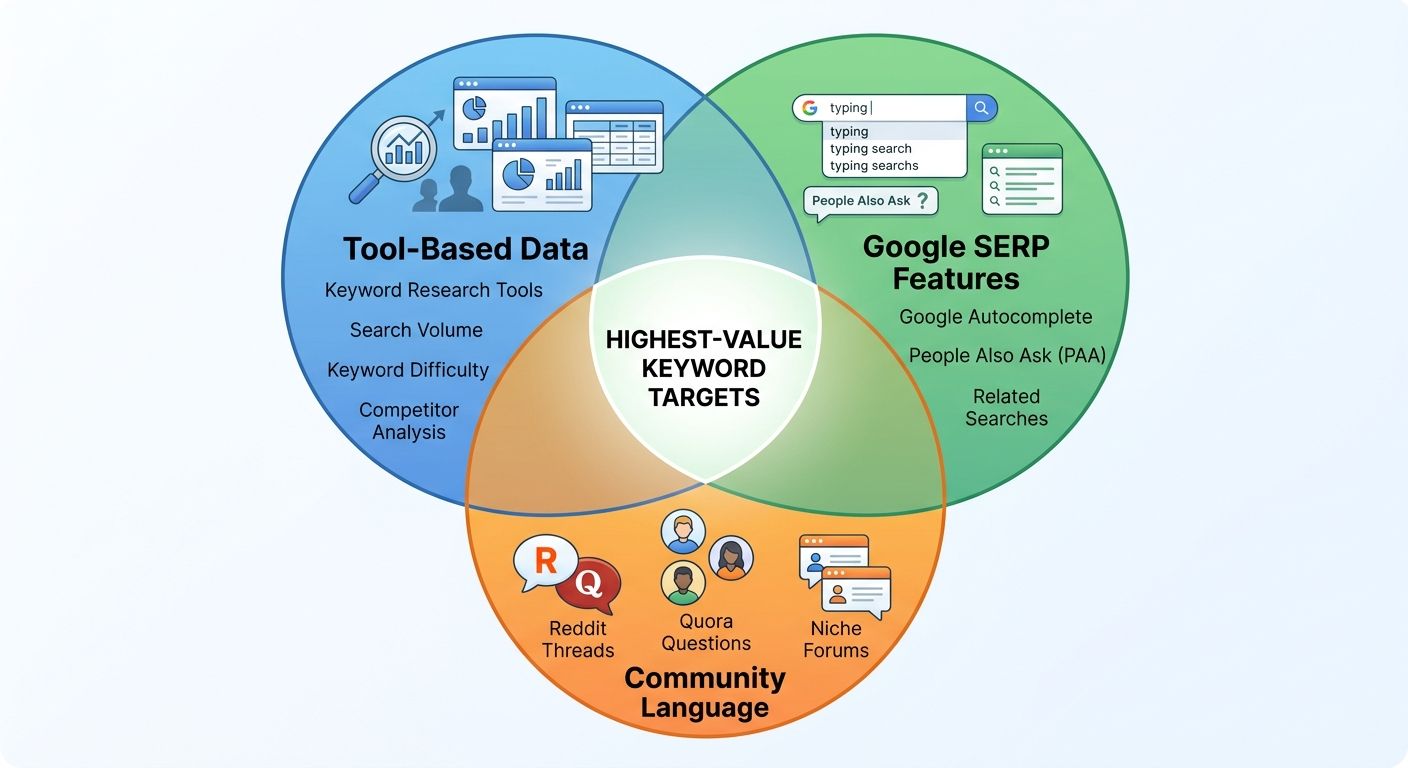
Google's own autocomplete suggestions are sourced from real search patterns. Type a seed keyword, add a space, then cycle through each letter of the alphabet. "Content marketing a," "content marketing b," "content marketing c." Each suggestion reflects something real people have actually searched for. The People Also Ask boxes work the same way. Expand them and Google loads additional related questions, giving you a direct window into user curiosity. Related searches at the bottom of the SERP round out the picture with semantically connected terms.
These features are free. They require no subscription. And they surface queries that paid tools sometimes miss entirely because tools aggregate and round data, while Google's interface reflects live patterns.
Beyond Google itself, forums are underrated for query discovery. Reddit threads, Quora answers, and niche community forums reveal how real people phrase their problems. The language there rarely matches the clean keyword phrases in a tool's database. People write things like "my site gets traffic but nobody buys anything" or "why did my rankings tank after I added new pages." These messy, natural-language queries are exactly what voice search and conversational AI have trained Google to understand. Content that mirrors this natural phrasing tends to match long-tail queries more effectively than content built around polished keyword phrases.
Competitor analysis fills in another gap. Tools like KWFinder and SpyFu let you enter a competitor's domain and see which keywords drive their organic traffic. This reverse-engineering approach—looking at what already works for sites in your niche—often surfaces keywords you'd never find through seed-keyword brainstorming alone. It's a quality-over-quantity exercise. You're not trying to build the biggest keyword list. You're trying to find the queries where your content can provide a better answer than what currently ranks.
If you're newer to all of this, understanding what organic SEO actually means gives you the right frame. Keyword research serves organic search strategy, and organic strategy is about earning visibility through relevance.
The Claim, Revisited
The standard keyword research workflow—open a tool, sort by volume, pick keywords with acceptable difficulty scores—produces a list that looks data-driven but systematically biases you toward the most competitive, least specific slice of search demand. It skips intent. It misses the 85% of queries hiding in the long tail. And it ignores the richest source of real search language: the actual words people use when they're struggling with a problem.
A better approach flips the order. Start with the questions real people ask, found in Google's own SERP features, in forums, in competitor content that's already ranking. Then use tools to validate volume and assess difficulty. Then check search intent by looking at what Google actually surfaces for each query. The tools serve the research rather than driving it.
This doesn't mean abandoning keyword tools. Google Keyword Planner, Mangools, Semrush, Ahrefs—they all have a place in the process. The problem is using them as the starting point when they work better as a checkpoint partway through. When you begin with real human language and end with tool validation, you build content around queries that people genuinely search for, phrased the way they actually phrase them. The ranking tends to follow from there, because you've aligned with the thing Google itself is trying to do: match searchers with the content that best answers their question.
OrganicSEO.org Editorial
Editorial team writing about Ethical, white-hat, organic SEO education.
Frequently Asked Questions
- What percentage of Google searches are long-tail keywords?
- Long-tail queries account for approximately 85–90% of all searches, while popular head keywords with the biggest search volumes only represent 10–15% of total search behavior. Long-tail queries are typically three to eight-word phrases that individually show small search volumes but collectively represent the overwhelming majority of what people actually search for.
- Why should I check search intent before writing SEO content?
- Search intent determines what type of content Google will rank for a given query. If you write a blog post targeting a keyword that Google has determined should return product pages, you'll be fighting against the search engine's algorithm and likely won't rank. You should always type your target keyword into Google and analyze what the top ten results actually are before creating content.
- Where can I find real search queries outside of keyword research tools?
- Google's autocomplete suggestions, People Also Ask boxes, and related searches at the bottom of SERPs all reflect real search patterns. Forums like Reddit and Quora, niche community discussions, and competitor analysis tools like KWFinder and SpyFu also reveal how people actually phrase their problems in natural language that keyword tools often miss.
- What are the main types of search intent I should know about?
- The four main types of search intent are: informational (wanting to learn something), navigational (looking for a specific site or brand), transactional (ready to buy or take action), and commercial investigation (comparing options before a decision). Understanding which type applies to your target keyword determines what content format you should create.
- Why do long-tail keywords convert better than head keywords?
- Long-tail keywords are more specific and indicate the searcher has a clearer problem and intent. For example, "best running shoes for flat feet on concrete" shows someone with a specific body type who is likely closer to a purchase decision, while "running shoes" could mean almost anything. Specific long-tail queries convert at dramatically higher rates despite lower search volume.
- How should I use keyword tools correctly in my SEO research?
- Tools like Google Keyword Planner should serve as a checkpoint partway through your research, not your starting point. Start by finding real questions people ask using Google's SERP features and forums, then use tools to validate search volume and assess difficulty. Treat tool volume numbers as directional estimates since Google rounds and groups data.
- How does Google match long-tail queries to content without exact keyword matches?
- Google's semantic understanding allows it to match long-tail queries to pages that answer them precisely, even when the page doesn't contain the exact phrase verbatim. A well-written page targeting a specific topic can rank for dozens of long-tail variations naturally without needing to stuff each keyword phrase into the content.