Geo-Modified Keyword Strategies: How to Rank for Location-Based Queries Beyond the Homepage
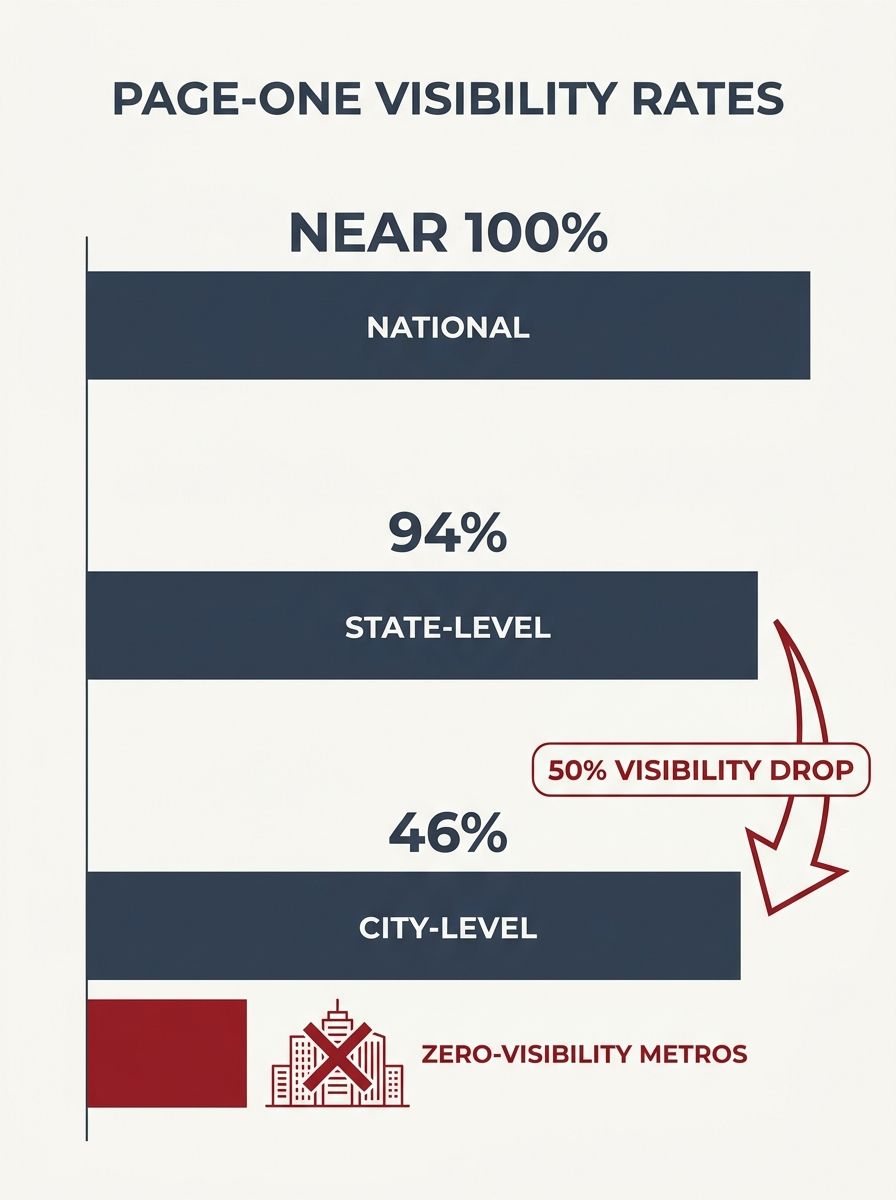
New York City, Seattle, and Billings, Montana returned zero page-one organic visibility for geo-modified queries in a Go Fish Digital analysis of 100 SERPs across all 50 U.S. states, regardless of how granular the location targeting was.
Geo-Modified Keyword Strategies: How to Rank for Location-Based Queries Beyond the Homepage
New York City, Seattle, and Billings, Montana returned zero page-one organic visibility for geo-modified queries in a Go Fish Digital analysis of 100 SERPs across all 50 U.S. states, regardless of how granular the location targeting was. Across the full dataset, page-one visibility dropped by 50% when searchers moved from state-level to city-level queries. At the state level, 94% of searches showed page-one results for the target site. At the city level, that number cratered to 46%. If your location-based SEO ranking strategy stops at the homepage, you're invisible in exactly the markets where purchase intent runs highest.
The Visibility Cliff from State to City
The Go Fish Digital findings put numbers behind something many practitioners have suspected: a single national or state-level landing page can't hold position across dozens of city-specific SERPs. Google treats "plumber in Texas" and "plumber in Austin" as meaningfully different queries with different intent signals, different competitor sets, and different local pack compositions.
In 40% of the locations studied, Google substituted the national landing page with a state-specific URL when users searched at a more granular geographic level. The algorithm actively preferred pages that matched the specificity of the query. When no such page existed, the site often disappeared from page one entirely.
This explains why three metros with intense local competition showed zero visibility. Without dedicated, city-specific content, even well-optimized national brands couldn't break through. The homepage carried no weight at the city level.
The practical conclusion: geographic keyword expansion needs to happen below the homepage. You need pages that match the specificity of how people actually search.
How Geographic Keyword Clustering Works in Practice
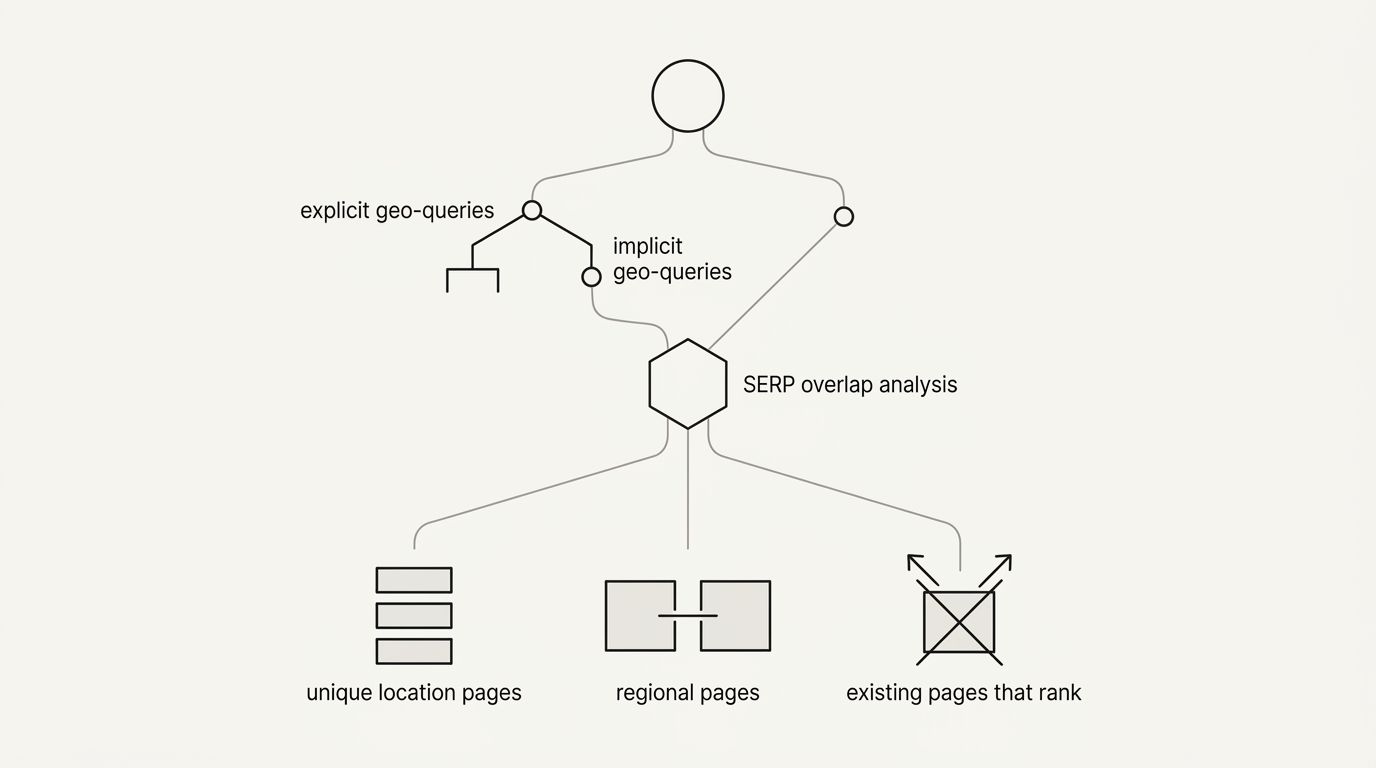
Building location pages at scale sounds straightforward until you sit down to figure out how many you actually need. As one geographic clustering guide notes, twenty cities could mean twenty pages or regional groupings, depending on service area overlap and competition levels.
A local keyword clustering strategy starts with SERP overlap analysis. Pull the top 10 results for your primary service keyword modified by each target city. If "HVAC repair Dallas" and "HVAC repair Fort Worth" return mostly different results, those cities need separate pages. If they share seven or eight of the same URLs, you can potentially serve both with a single DFW metro page.
The clustering tools available vary in accuracy for this. Practitioners on r/localseo have flagged that SERP-based clustering tools don't always group closely related geo-modified keywords in ways that reflect actual user intent. The common workaround is to start with AI-based clustering for broad groupings, then refine with manual SERP checks for each target market. If you've already built a keyword research workflow, add a geographic modifier layer to every seed term before you begin clustering.
Here's where service-keyword and geo-keyword clustering interact in ways that trip people up: service-specific geographic keywords often cluster with general service pages rather than needing their own location content. "Emergency plumber Austin" might share SERP overlap with your main Austin service page, while "drain cleaning Austin" might need its own page because Google surfaces different result types for it. You won't know until you check the SERPs.
City-Specific Pages That Earn Rankings Instead of Penalties
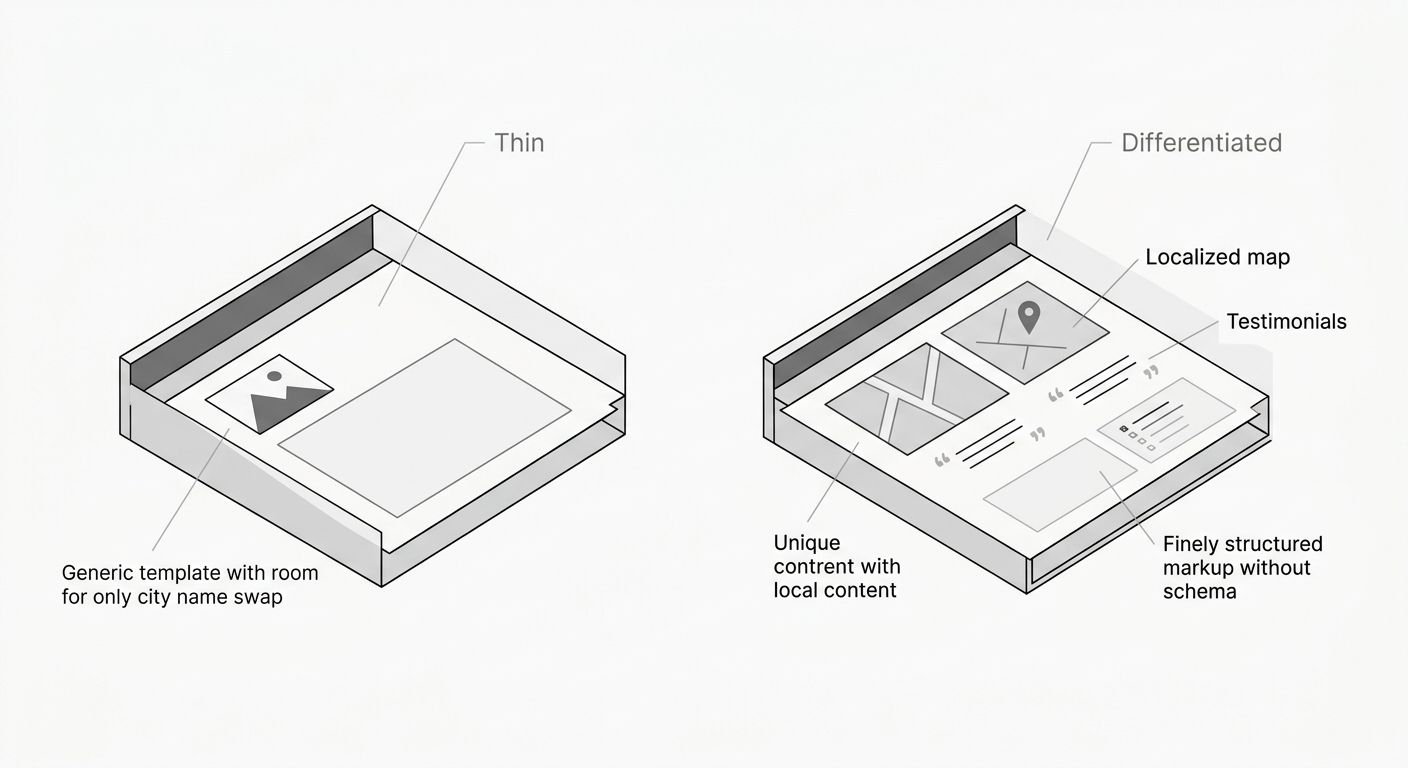
Google has seen every version of the templated location page. You know the type: swap the city name in the H1, change the embedded map coordinates, maybe swap out a stock photo of a skyline, and publish 50 of them. That approach worked around 2014. It doesn't now.
City-specific keyword optimization requires pages that contain genuinely differentiated content. What does that look like at scale without writing 50 bespoke essays?
Start with structural uniqueness per page. Each location page should include:
Localized service details that differ by market (pricing differences, service area boundaries, response times specific to that city's geography)
Neighborhood-level references that demonstrate real familiarity with the area, not just the city name
Local testimonials or case studies from actual customers in that market
Embedded maps with accurate geo-coordinates and LocalBusiness schema markup that includes name, address, phone number, and geo-coordinates for each location
Internal links to relevant service pages and to other nearby location pages where a reader might have overlapping needs
The URL structure matters. Flat paths like domain.com/locations/city-name/ perform better than deeply nested structures or subdomain approaches. If you're interested in the mechanics behind that, we've covered URL structure decisions in depth elsewhere.
According to Google's own local ranking documentation, prominence in local results depends partly on how many websites link to a business and how many reviews it has. At the page level, this means each location page benefits from earning its own backlinks from local sources: chamber of commerce listings, local sponsorships, neighborhood business associations, and local news coverage. One multi-location business reported a 40%+ increase in organic impressions within three months by combining localized content with local PR efforts.
Implicit Geo-Queries and the "Near Me" Factor
Geo-modified keywords come in two flavors, and your strategy needs to account for both. Explicit modifiers are queries where the user types the location: "dentist in Miami," "locksmith Chicago." Implicit modifiers are queries where Google infers location from the searcher's device, IP, or search history: "locksmith," "pizza delivery," "urgent care open now."
Mobile queries containing "near me now" grew by over 150% between mid-2015 and late 2017, and that trajectory has continued to accelerate. Voice search compounds this further, producing longer, conversational queries like "where's the best pizza near me right now" that blend implicit location with explicit intent.
You can't stuff "near me" into your title tags and expect results. Google ignores that kind of forced modifier. What you can do is ensure your location pages have strong local signals: consistent NAP (name, address, phone) data, geo-coordinates in schema markup, and genuine local content that demonstrates you actually serve that area.
For tracking whether this work is paying off, segment your Search Console data by query type. Filter for queries containing your target city names and monitor impressions, clicks, and average position separately for each location page. Without this segmentation, city-level gains get buried in aggregate numbers.
Preparing for AI Search and Geographic Queries
The emergence of AI-generated answers in search adds another variable. A 2026 study by researchers at Princeton, Georgia Tech, and IIT Delhi using the GEO-Bench benchmark found that adding statistics to content improved large language model citation rates by up to 41%. Keyword repetition, by contrast, performed below baseline. LLMs prioritize semantic relevance and structured data over density.
For location pages specifically, this means the content that earns visibility in AI-generated answers will be the content that contains specific, verifiable local data: service area populations, distance references, pricing unique to that market, local regulatory details. Generic descriptions of the city pulled from Wikipedia won't cut it. If you want to understand how AI search features are already affecting click-through rates, the data there gives useful context for how much traffic AI Overviews redirect.
The geo-modified keywords that perform well in traditional search and AI search share a common trait: they connect a specific service to a specific place with specific evidence that the business actually operates there.
Questions the Numbers Still Can't Answer
The Go Fish Digital data tells us that city-level visibility drops by half, but it doesn't tell us the precise tipping point at which a new location page crosses from thin content into ranking contender. We know differentiated content matters, but there's no published threshold for "how different is different enough" when you're operating across 20 or 50 or 200 cities.
We also don't know how quickly Google's mid-2024 Proximity Boost Update will continue to shift weight toward physical distance versus content quality. If proximity keeps gaining algorithmic weight, businesses without a physical presence in a target city face an increasingly steep climb. The data shows the problem clearly. The solution still requires city-by-city testing, careful measurement, and a willingness to prune pages that aren't earning their place in the index. The numbers point the direction, but they don't hand you the map.
OrganicSEO.org Editorial
Editorial team writing about Ethical, white-hat, organic SEO education.