AI-Powered Competitive Analysis in Keyword Research: Spotting Gaps Your Competitors Miss
Competitive keyword analysis tools have shipped AI features for years, but the underlying mechanism is poorly understood by the people running the reports. The common assumption: the tool finds keywords your competitors rank for, you don't, and you go build pages for those terms.
AI-Powered Competitive Analysis in Keyword Research: Spotting Gaps Your Competitors Miss
Competitive keyword analysis tools have shipped AI features for years, but the underlying mechanism is poorly understood by the people running the reports. The common assumption: the tool finds keywords your competitors rank for, you don't, and you go build pages for those terms. That's the shallow version. The actual mechanism doing useful work underneath involves intent classification, topical clustering, difficulty-weighted scoring, and gap detection across multiple ranking dimensions simultaneously. Understanding each layer changes how you read the output and, more importantly, what you do with it.
What the Tool Actually Reads
When you feed a domain into an AI keyword research tool like Semrush, Ahrefs, or RankingGap, the first thing it does is pull ranking data for both your site and the competitor URLs you've specified. This typically includes every keyword each domain appears for in the top 100 results, along with metadata: search volume, keyword difficulty, cost-per-click, SERP feature presence, and ranking position for each site.
The raw data set can be enormous. A mid-sized e-commerce site might rank for 15,000 to 40,000 keywords. A competitor in the same space might rank for a partially overlapping set of similar size. The AI layer's job is to make that overlap (and the lack of it) legible.
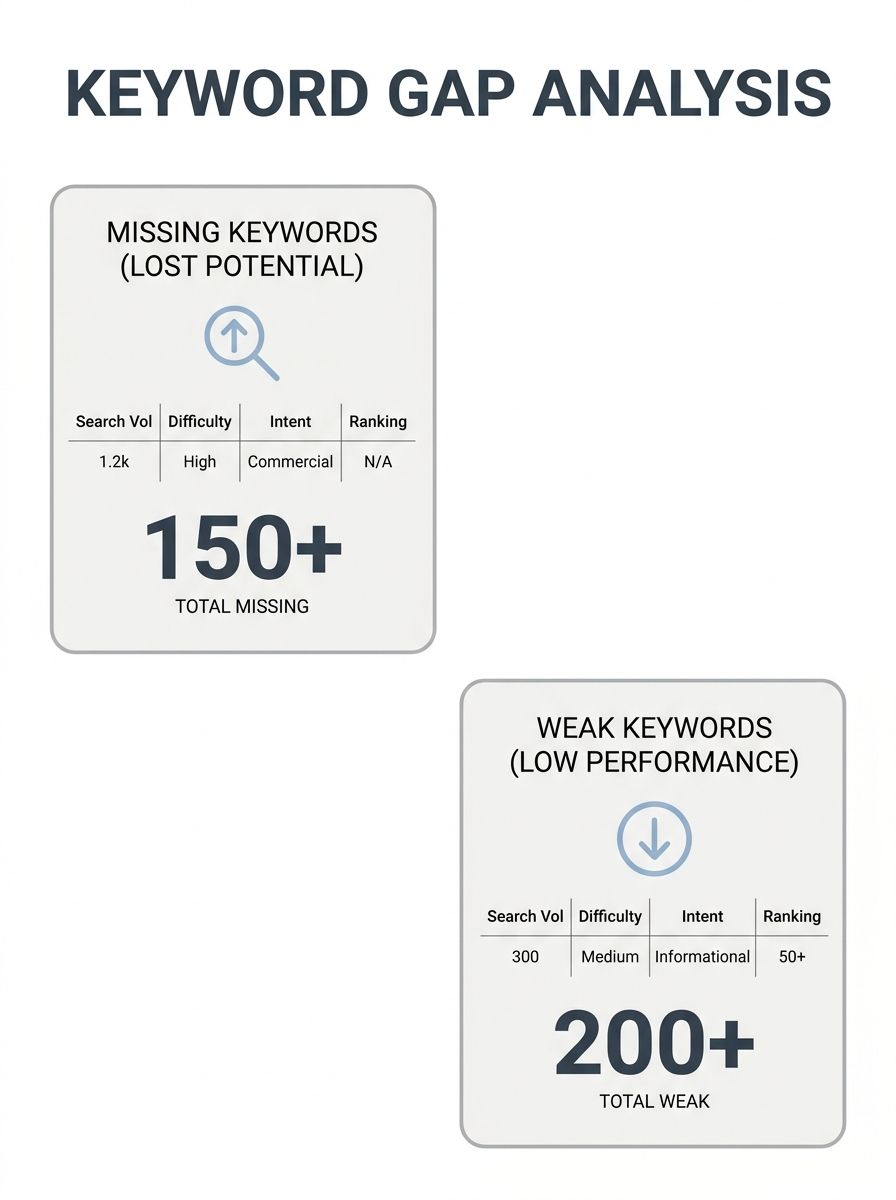
As described in a practical walkthrough of AI-assisted competitor analysis on Search Engine Land, the output splits into two buckets. The first is missing keywords: terms where competitors rank and your site doesn't appear at all. The second is weak keywords: terms where your site does rank, but competitors outrank you. Each row includes intent tags, search volume, keyword difficulty, CPC, and the ranking position for each site.
This two-bucket structure is where competitive keyword analysis begins, but the raw lists aren't useful on their own. A list of 217 missing keywords with combined monthly volume of 49,700 means nothing if you don't know which ones match your business, which ones you can realistically win, and which ones reflect search intent gaps you're actually equipped to fill.
Gap Detection vs. Keyword Copying
The most common mistake people make with competitive analysis is treating it like a shopping list. Competitor ranks for "best hiking boots for flat feet," so you write a page targeting the same phrase. That's copying, and it rarely works because you're chasing pages with established authority and backlink profiles.
Genuine keyword opportunity identification works differently. The AI layer scans for patterns across the gap data and surfaces terms where the competitive landscape is thin or where existing content poorly serves the query. A competitor might rank #14 for a keyword with difficulty 22 and monthly volume of 1,200. That's a signal worth investigating. The competitor's page is barely hanging on to page two, the difficulty is low, and there's real volume there.
If you've already built a foundation with solid keyword research practices, competitive gap analysis becomes the second pass. Your initial research captures the queries you already know about. The gap analysis reveals the ones you didn't think to look for because they exist in your competitors' content universe, not yours.
AI tools can now analyze large datasets, identify keyword patterns and related terms, and suggest high-opportunity keywords based on search intent, competition, and SERP data. The speed advantage is significant. What used to take 12 to 20 hours of manual spreadsheet work can be completed in under an hour.
Intent Classification at Scale
Here's where the mechanism gets interesting. Traditional keyword research treats intent as a four-bucket system: informational, navigational, commercial, transactional. AI models trained on actual query behavior paint a more nuanced picture.
A study of over 50 million ChatGPT prompts found that informational queries accounted for 52.7%, navigational for 32.2%, commercial for 14.5%, and transactional for only 0.6%. Those numbers come from conversational AI usage rather than traditional search, but they reveal something useful: the distribution of intent is heavily skewed toward informational and navigational. If your competitor gap analysis turns up mostly transactional keywords, you're looking at a small slice of the opportunity.
AI-powered search tools now interpret user intent conversationally, going beyond exact keyword matching to understand the context behind a query. A search for "running shoes knee pain" carries a different intent than "best running shoes for bad knees," even though a human might conflate them. The first is problem-aware. The second is solution-aware. Your content strategy for each should differ.
When the AI layer tags intent across your competitor gap report, it lets you filter for the search intent gaps that matter most to your business. If you sell running shoes, commercial and transactional keywords in your gap report are gold. Informational keywords like "why do knees hurt when running" are worth pursuing for authority-building, but they belong in a different tier of your content plan.

From Raw Lists to Weighted Clusters
A flat keyword list, even one filtered by intent, still presents problems. You might have 150 keyword opportunities, and many of them overlap thematically. "Best trail running shoes," "trail running shoes for beginners," and "lightweight trail running shoes reviews" all belong to the same content cluster. Building three separate pages for those terms would be wasteful and could create internal ranking conflicts where your own pages compete against each other.
The clustering step is where AI tools earn their keep. They group semantically related keywords into thematic clusters and let you assign priority tiers:
Tier 1 (Core commercial): Keywords directly tied to your products or services, with clear buying intent
Tier 2 (Adjacent commercial): Keywords related to your market but one step removed from a purchase decision
Tier 3 (Authority builders): Informational keywords that build topical authority and capture top-of-funnel traffic
This tiering matters because volume alone is misleading. A keyword with 8,000 monthly searches and difficulty 78 is a worse opportunity than one with 900 searches and difficulty 19, especially if the lower-volume term sits in your Tier 1 cluster. AI scoring helps you make that distinction systematically rather than by gut feel.
The Striking Distance Filter
One of the most tactically useful outputs from AI gap analysis is what practitioners call the "striking distance" list. These are keywords where your site already ranks between positions 4 and 20. You're visible, but you're not winning clicks.
Why does this matter mechanically? Moving from position 15 to position 5 requires far less effort than going from unranked to position 5. The page already exists. Google already associates it with the query. You might need better on-page optimization, a few quality backlinks (built the right way), or updated content that better matches the current SERP landscape.
AI tools surface these opportunities by cross-referencing your current rankings against competitor positions for the same keywords, then filtering by difficulty and volume. If a competitor ranks #3 for a keyword where you sit at #11, and the keyword difficulty is moderate, that's a concrete opportunity with a realistic path to improvement.
AI-based tools reportedly uncover 95% more long-tail keyword opportunities than manual methods. Long-tail queries are particularly interesting in the striking distance context because they tend to have lower competition and higher conversion rates. A page ranking #12 for a long-tail commercial query might need only modest updates to break into the top five.
AI Visibility as a New Gap Dimension
A newer layer of competitive analysis has emerged alongside AI-generated search results. When platforms like Google's AI Overviews, ChatGPT, or Perplexity answer a query, they cite specific sources. If your competitors get cited in those AI-generated answers and you don't, that's a visibility gap that traditional SERP analysis wouldn't catch.
Monitoring this requires a different approach. Tools are beginning to track which domains get mentioned in AI responses for specific queries. AI platforms tend to favor content with structured data, clear headings, tables, and factual detail. If you're building content to fill gaps identified through competitive analysis, structuring it for AI citation eligibility is worth the extra effort. Understanding how search engines process and rank content provides the foundation for this, but the AI citation layer adds new considerations around format and specificity.
Where the Model Breaks
The mechanism described above has real limitations, and ignoring them leads to bad strategy.
Accuracy of volume estimates. Every keyword tool estimates search volume using clickstream data, Google Ads API samples, or proprietary models. These estimates can be off by 30% to 50% for lower-volume terms. When you're making decisions based on a keyword's estimated 480 monthly searches, you might be looking at 250 or 720 in reality. AI doesn't fix this underlying data problem; it just processes the same imperfect inputs faster.
Competitor selection bias. The gap analysis is only as good as the competitors you choose. If you compare yourself against three direct competitors and miss the niche blog that dominates informational queries in your space, your gap report has a blind spot. AI can't tell you which competitors to analyze. That judgment call is yours.
Intent misclassification. AI intent tagging is probabilistic, not deterministic. A keyword tagged as "informational" might carry strong commercial intent in certain contexts. The model doesn't understand your specific business the way you do. Human review of the intent tags, especially for Tier 1 keywords, is non-negotiable.
Temporal decay. Keyword data ages quickly. Rankings shift weekly. A gap that existed when you ran the report might close before you publish your content. Tools using data exports older than 90 days are working with stale inputs, and AI processing of stale data produces confident-sounding recommendations built on outdated foundations.
Overfitting to competitors. The deepest risk is strategic. If your entire content roadmap is dictated by gaps relative to three competitors, you end up building a site that looks like a composite of those competitors rather than something with its own editorial identity. Competitive gap analysis should inform your strategy, not replace it. The best keyword opportunities are often the ones no one in your competitive set has found yet, and those won't show up in a gap report by definition.
AI-powered competitive analysis is a strong diagnostic tool. It tells you where you're underperforming relative to known competitors and where search demand exists without adequate supply. But it operates on historical data, estimates, and pattern recognition. The decisions about what to build, how to position it, and which gaps are worth pursuing still require someone who understands the business, the audience, and the limits of the data they're reading.
OrganicSEO.org Editorial
Editorial team writing about Ethical, white-hat, organic SEO education.