The Three-Month Keyword Research Refresh Cycle: When and How to Re-Audit Your Rankings
Search intent classifications for tracked keywords now refresh automatically every 30 days inside Advanced Web Ranking's detection algorithm, regardless of other update schedules.
The Three-Month Keyword Research Refresh Cycle: When and How to Re-Audit Your Rankings
Search intent classifications for tracked keywords now refresh automatically every 30 days inside Advanced Web Ranking's detection algorithm, regardless of other update schedules. The engineering team behind that change recognized something practitioners have been feeling for two years: the intent behind a keyword can shift detectably in a single month. An informational query becomes transactional. A comparison query starts returning product pages. A branded query sprouts an AI Overview that swallows the entire first screen.
If intent can drift that fast, a keyword list you built in January and haven't revisited by April is operating on stale assumptions. And stale assumptions in SEO don't announce themselves. They just quietly bleed traffic until the quarter-over-quarter report makes the damage obvious.
This is a walkthrough of how a keyword research refresh cycle actually runs at 90-day intervals, what specific signals trigger it, and where most teams get the sequencing wrong. The case I'm dissecting is the content decay pattern that keyword.com documented in their seasonal audit framework, combined with the decay detection methodology from Wellows. Both describe the same underlying phenomenon from different angles, and together they show exactly why the 90-day window works.
The Drift That Doesn't Show Up in Weekly Reports
Weekly rank tracking gives you noise. Positions fluctuate by two or three spots constantly, and chasing those movements will burn your time on non-problems. The meaningful signal lives in the 60-to-90-day trend line, where individual fluctuations smooth out and directional patterns emerge.
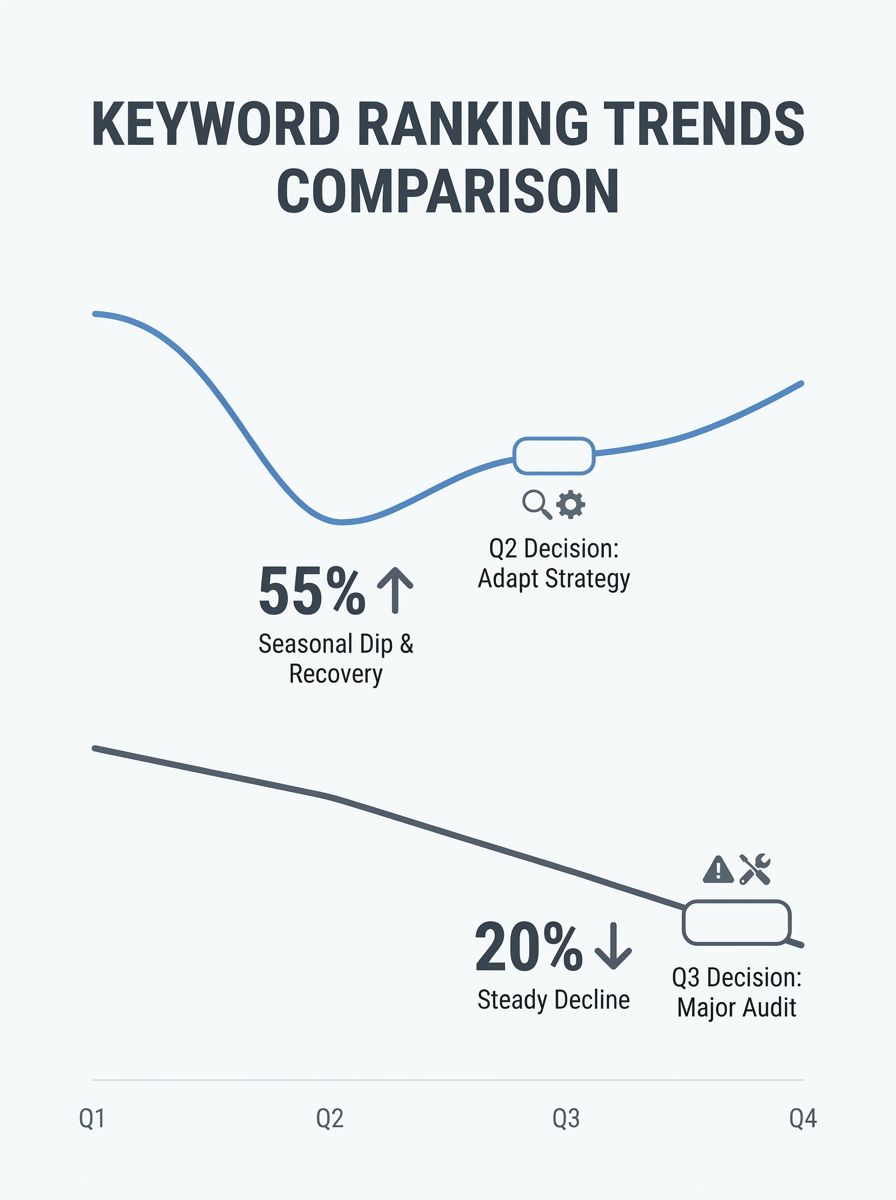
The keyword.com seasonal checklist framework puts it plainly: compare your organic traffic, keyword rankings, and click-through rates from the past three months against the previous quarter and the same period last year. That dual comparison is the core of the cycle. Quarter-over-quarter tells you what's changing. Year-over-year tells you whether the change is seasonal or structural.
Here's why this matters in practice. Say you run a site about personal finance. Your "best savings accounts" page drops from position 4 to position 9 between January and March. If you only compare to the prior quarter (October through December), you might panic. But if the same page dropped from 4 to 8 during the same window the previous year and recovered by May, you're looking at seasonal keyword trends tied to post-holiday financial behavior shifts. The fix isn't a content overhaul. The fix is patience and maybe a date refresh.
Without the year-over-year comparison, you can't distinguish seasonal dips from genuine erosion. And that distinction determines whether you rewrite a page, redirect it, or leave it alone.
Seasonal Noise vs. Structural Erosion
Search Engine Land's seasonality guide defines the phenomenon clearly: SEO seasonality is the predictable, recurring fluctuation of search behavior, keyword volume, and website traffic at specific times of year. The word "predictable" is doing the heavy lifting in that sentence. Predictable means you can baseline it, which means you can subtract it from your data and see what's left.
The keyword.com framework suggests identifying your previous season's top-performing pages as the starting point for every quarterly audit. Not your current top performers. Your previous ones. The pages that were strong and now aren't are where the signal lives.
When you pull that list, you're looking for three categories:
Pages that declined and are following a seasonal pattern you've seen before. These need light touch-ups: update date references, swap in current statistics, confirm the page still matches the SERP layout for its target query.
Pages that declined without a seasonal explanation. These are your true keyword decay signals, and they need deeper investigation.
Pages that held steady while surrounding pages declined. These are your most durable content, and understanding why they held up teaches you what to replicate.
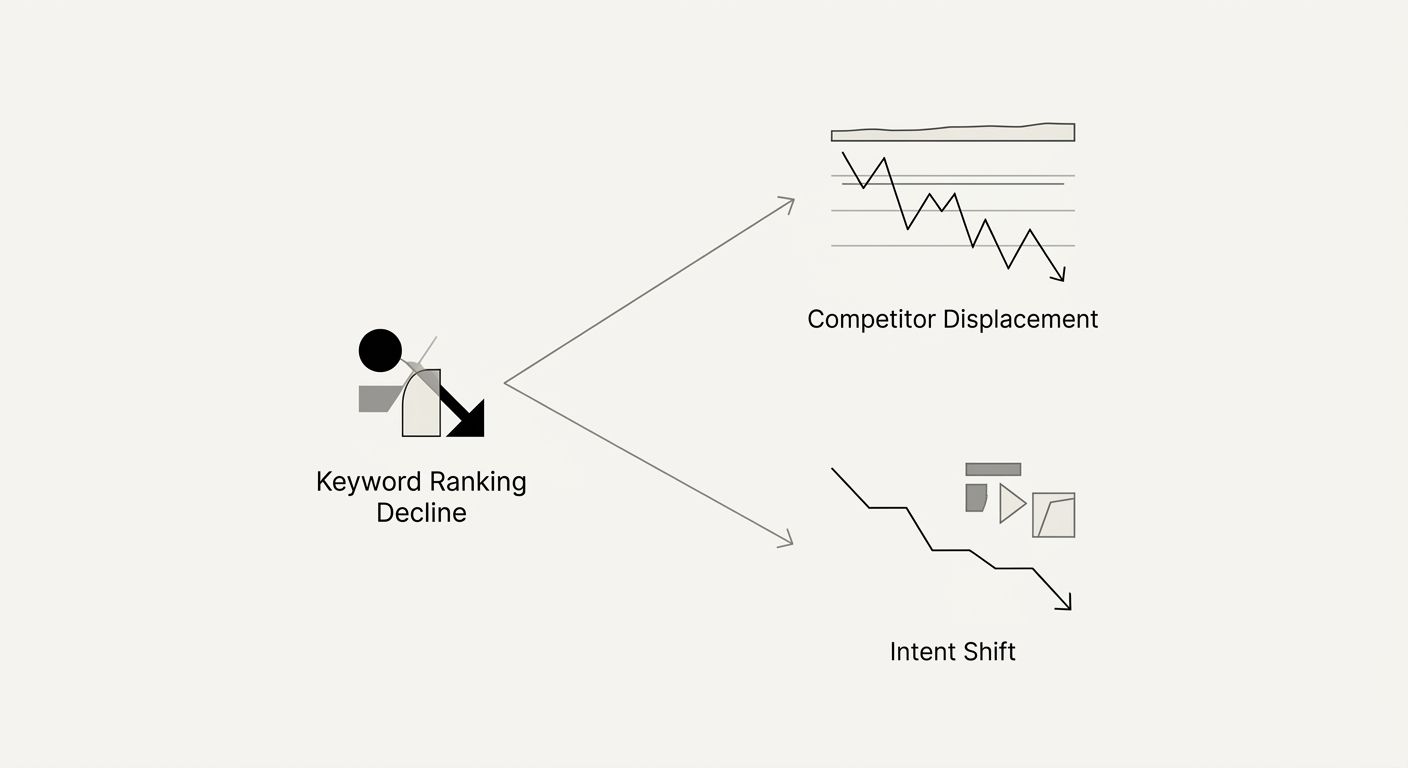
The second category is where teams spend most of their audit time. When a page loses rankings outside of seasonal patterns and outside of any documented algorithm update, the explanation almost always traces back to one of two things: competitor displacement or search intent evolution.
If you've set up the right performance KPIs, you can separate these quickly. Competitor displacement shows up as stable impressions but declining position. Intent evolution shows up as declining impressions altogether, because Google is now serving a different type of result for that query.
The Intent Shift Problem Inside Quarterly Audits
Google's core updates have been explicitly reshaping rankings by prioritizing user intent and content quality. Some sites gain because they align better with the updated model. Others lose visibility because their content doesn't match how Google now interprets the query. This is search intent evolution in action, and it's the hardest type of decay to catch because your content hasn't changed at all.
Consider what happens to a "how to invest in crypto" article written with informational intent in mind. If a core update shifts Google's understanding of that query toward transactional intent (showing exchange signup pages, comparison tools, and brokerage platforms), your well-written educational piece gets pushed to page two. Your content is the same quality it was before. The query just doesn't mean what it used to mean.
The Wellows methodology for detecting content decay early focuses on monitoring impressions, keyword rankings, CTR, and engagement trends before waiting for traffic to actually drop. This is the right instinct. By the time organic traffic declines visibly, the underlying ranking erosion has usually been underway for four to six weeks.
Here's the practical sequence for catching intent shifts during a quarterly SEO audit:
Pull your tracked keywords and sort by impression change (quarter over quarter).
For any keyword where impressions dropped more than 20%, manually search that query and study the current SERP. What types of pages are ranking now? Has the format shifted from articles to tools, from listicles to videos, from guides to product pages?
Compare what you see against what your page offers. If there's a mismatch, that's your decay source.
Decide whether to restructure the existing page, create a new page targeting the shifted intent, or consolidate the content into a broader piece.
This is also where competitive keyword gap analysis earns its keep. When competitors start ranking for queries you've lost, their content tells you what the new intent looks like.
Running the 90-Day Comparison Step by Step
The actual audit takes a morning, not a week. Here's the sequence that produces the most signal in the least time, drawn from the documented approaches in the keyword.com and Wellows frameworks.
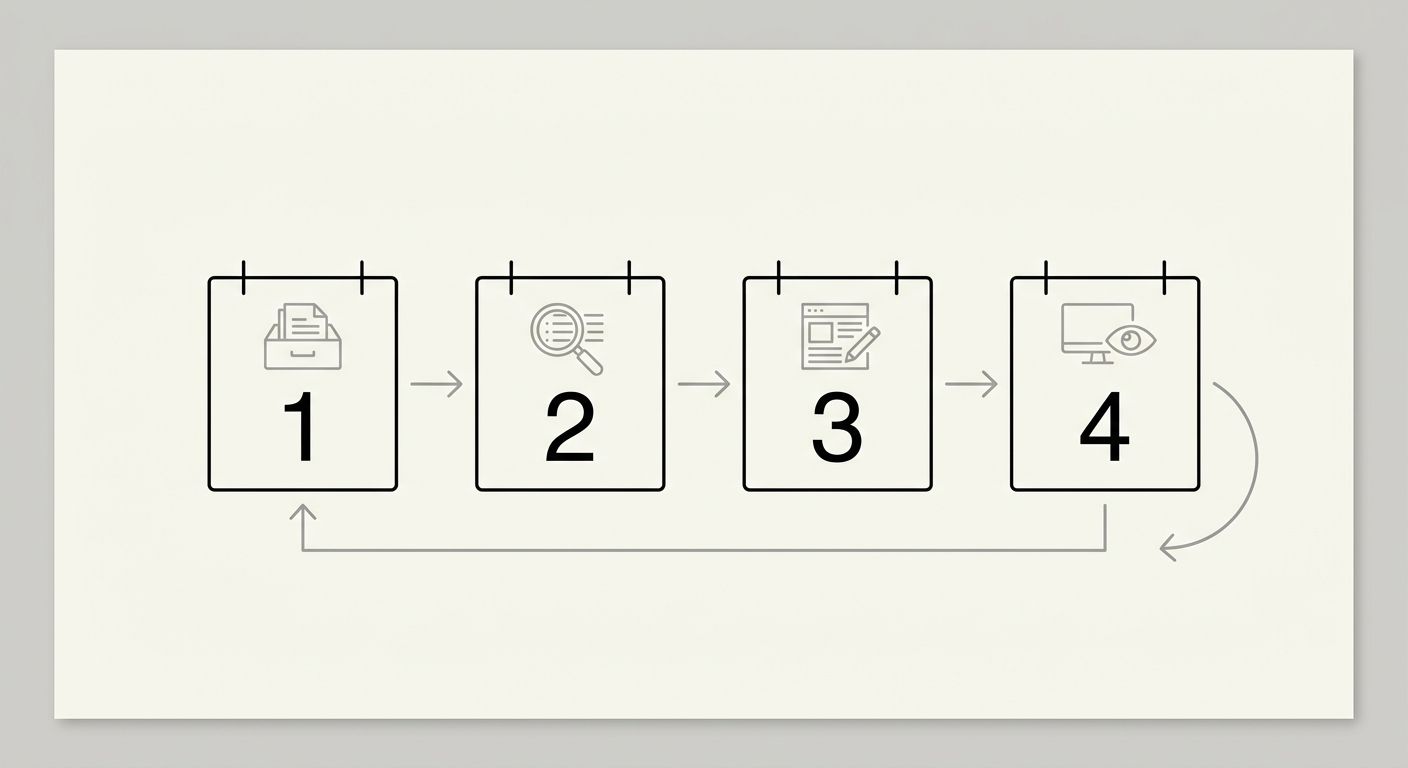
Week 1 of the quarter: Pull and compare the data. Export your Search Console performance data for the last 90 days. Export the same for the previous quarter and the same quarter last year. You're comparing three columns: impressions, clicks, and average position at the page level. Sort by pages with the largest negative impression change. These are your priority investigation targets.
Week 1 still: Classify each declining page. Is the decline seasonal? Check last year. Is it algorithm-related? Cross-reference against known Google algorithm update timelines. Is it competitor-driven? Check who's now ranking for your target queries. Is it intent drift? Manually inspect the SERP.
Week 2: Refresh the keyword targets themselves. Your original keyword research for a given page may have missed queries that have since grown in volume, or it may target terms whose volume has collapsed. Pull fresh keyword data for each priority page. Look specifically at the "queries" tab in Search Console for each URL. Often a page is attracting impressions for queries you never optimized it for, and those queries represent an opportunity to expand or refocus the page.
This is the step where most teams realize they need to revisit their core keyword research process, not just update a spreadsheet.
Week 3: Execute updates. Rewrite intros and conclusions with updated data. Replace outdated statistics. Adjust headings to match the queries the page is actually appearing for. Confirm internal links still point to the right destinations. If intent has shifted significantly, consider whether the page needs a structural rewrite or whether you need a new page entirely.
Week 4: Monitor re-indexing and early response. After publishing updates, track whether Google recrawls the updated pages within two weeks. If recrawl hasn't happened by day 14 for high-priority pages, submitting them through Search Console's URL inspection tool can help. The rest of the quarter, you're watching the trend lines to see if the corrections are taking hold.
Why 90 Days Keeps Being the Right Interval
There's a reason the industry has converged on three months rather than two or six. Wellows recommends reviewing competitive topics every three to six months, with fast-moving industries (AI, finance, tech) needing review as often as every one to three months. Thankstom.co.uk's analysis recommends reviewing keywords every three to six months with a deeper annual audit. The consensus isn't coordinated. It's just where the math lands.
The 90-day window is long enough that trend data separates from noise, and short enough that decay hasn't compounded into a recovery problem. When you let a declining page sit for six months, the page often drops far enough that recovery requires significant new backlinks and promotion on top of the content update. At three months, a content refresh alone is usually sufficient to reverse the slide.
There's a psychological benefit too. Quarterly cadence aligns with how businesses already plan. You can tie the keyword research refresh cycle to the same review cadence as your content calendar, your reporting cycle, and your strategic planning. When the audit is a standing calendar event rather than a reaction to a traffic emergency, it actually gets done.
The sites that struggle most with this process are the ones doing keyword research as a one-time project. They build a keyword map, create content against it, and then treat the map as settled. But search behavior is a moving target. Queries emerge, spike, shift in meaning, and sometimes disappear entirely. The SEO teams that handle this well treat keyword research as a living document, and the quarterly audit is the mechanism that keeps it alive.
If you're dealing with declining click-through rates that don't trace to ranking drops, the issue may be SERP feature changes like AI Overviews rather than keyword decay. Both problems surface during the same quarterly audit, but they require very different responses. Knowing which one you're looking at saves you from applying the wrong fix to the wrong problem.
The 90-day cycle isn't elegant. It's maintenance work. But the alternative is discovering six months of accumulated keyword decay in a single alarming report, and by then, you've already lost the traffic that a quarterly catch would have preserved.
OrganicSEO.org Editorial
Editorial team writing about Ethical, white-hat, organic SEO education.