Social Media and SEO: How Social Signals Actually Affect Rankings (Hint: Indirectly)
Google's John Mueller, Gary Illyes, and Matt Cutts have each stated, on the record, that social signals do not directly influence organic rankings. Three different Googlers, across different years, all landing on the same answer.
Social Media and SEO: How Social Signals Actually Affect Rankings
Google's John Mueller, Gary Illyes, and Matt Cutts have each stated, on the record, that social signals do not directly influence organic rankings. Three different Googlers, across different years, all landing on the same answer. And yet a CognitiveSEO analysis of 23 million shares found a clear correlation between social engagement and higher SERP positions. Both things are true at the same time, which is exactly why this topic stays confusing.
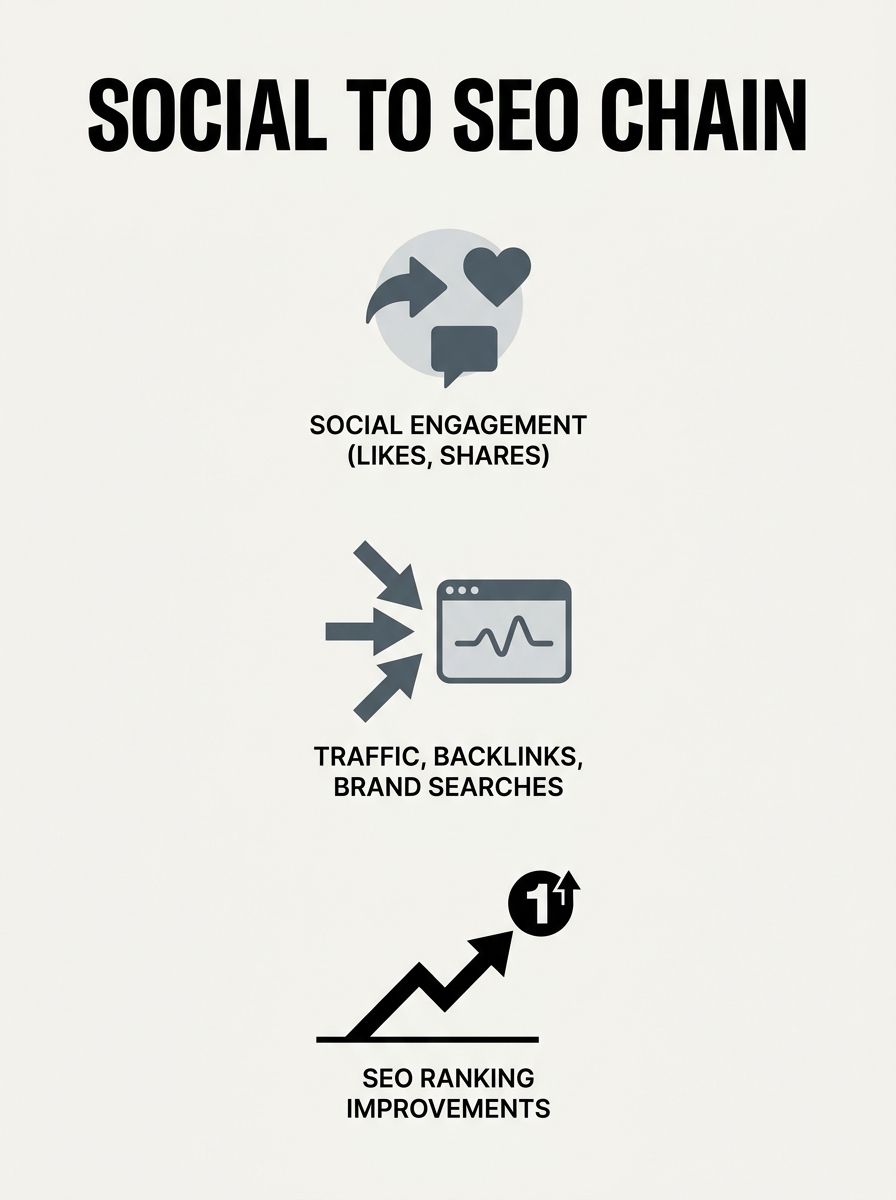
The distinction that matters is the word "directly." Social shares, likes, and comments don't feed into Google's ranking algorithm the way backlinks or page speed do. But the downstream effects of social activity create conditions that Google does care about: more traffic, more backlinks, stronger brand signals, faster content discovery. The social media indirect SEO impact is real. It's the mechanism that's misunderstood.
What "Indirect" Means in Practice
When SEO practitioners say social signals affect rankings indirectly, they're describing a chain reaction. A post gets traction on LinkedIn. Some of the people who see it write about the topic on their own blogs and link to the original source. Those backlinks are what Google counts. The social activity itself was the catalyst, but the ranking signal was the link.
Google's own framing supports this reading. As Primary Position documented from years of Google statements, the reasoning goes like this: an awesome piece of content gets shared on Facebook a lot because it's awesome. The sharing is a symptom of quality, not a cause of ranking. Google doesn't need to read Facebook's engagement data when it can measure the quality signals (links, traffic patterns, content depth) that the sharing produces.
This matters because it changes where you invest your effort. Chasing vanity metrics on social platforms won't move your rankings. But building a social presence that consistently drives real humans to your site, where they engage with your content, share it elsewhere, and link to it from their own properties, will compound over time into measurable SEO gains.
Four Mechanisms That Connect Social Activity to Search Performance
The indirect relationship between social media SEO and organic rankings operates through specific, measurable channels. Here's how each one works.
Traffic and behavioral signals
Social platforms send visitors to your site. Those visitors generate behavioral data that search engines can observe. According to YouScan's research on engagement metrics, social media doesn't directly impact search rankings, but the behavioral signals from engaged audiences, like longer time on site and lower bounce rates, do influence SEO performance.
This aligns with what the 2024 Google API leaks revealed about user engagement metrics. Click-through rate, dwell time, and pogo-sticking patterns all appear to factor into how Google evaluates content quality. When social media sends highly targeted visitors who actually read your content, those engagement patterns look very different from bot traffic or accidental clicks.
Backlink generation
Every link from a social media platform itself is nofollow. Twitter, Facebook, LinkedIn, Pinterest: they all tag outbound links as nofollow, which means they pass no PageRank. But that's only half the picture.
The more your target audience encounters your links on Twitter or LinkedIn, the higher the chances of gaining organic backlinks from other website owners who discover your content through those platforms. A piece that goes viral on social media sits in front of thousands of potential linkers: bloggers, journalists, newsletter authors, forum contributors. If you're building a white-hat link profile, social distribution is one of the most effective ways to earn editorial links without outreach emails.
Brand search volume
When people repeatedly see your brand on social media, some percentage will search for it by name on Google. Branded search volume is a trust signal. It tells Google that real humans associate your brand with a topic, which strengthens your authority for related queries. This is one of the quieter benefits of consistent social posting, and it's hard to attribute in analytics because the user doesn't arrive via a social referral.
Faster indexing and content discovery
Content shared on platforms like Twitter/X and Reddit gets crawled and indexed more quickly by search engines. Google's crawlers are active on these platforms, and a URL that appears in high-engagement social posts can get discovered faster than one sitting on a new page with no inbound links. Understanding how crawling and indexing work makes this easier to appreciate: Googlebot follows links wherever it finds them, and social platforms are link-dense environments.
How Each Platform Contributes Differently
Do social shares affect SEO equally across platforms? They don't. Each platform creates different types of downstream value.
Twitter/X
Twitter SEO value comes primarily from content discovery and amplification. Tweets get indexed by Google and can appear in search results, especially for branded queries and trending topics. The real SEO benefit is exposure to journalists, bloggers, and content creators who might link to your work from their own sites. Twitter is also where breaking news and commentary travel fastest, so timely content can pick up editorial links within hours of posting.
LinkedIn SEO works differently because the platform's audience skews toward professionals and decision-makers. Long-form posts and articles on LinkedIn tend to generate higher-quality referral traffic: visitors who spend more time on your site and are more likely to reference your work in professional contexts. For B2B content, LinkedIn often outperforms other platforms in driving the kind of engagement that translates into backlinks from industry publications.
Pinterest SEO has a unique advantage that other platforms lack: longevity. A tweet has a half-life measured in minutes. A Pinterest pin can drive traffic for months or years because the platform functions more like a visual search engine than a social feed. For content with strong visual elements, like the topics we cover in our guide to image optimization, Pinterest creates a durable traffic stream that compounds over time.

Reddit deserves special mention because Google has increasingly indexed Reddit discussions and surfaced them in search results. Participating authentically in relevant subreddits, not dropping links but actually contributing to conversations, can put your brand in front of audiences who create content themselves. Reddit's community-driven moderation means that low-effort promotion gets removed, but genuine expertise gets upvoted and seen.
Bing Plays by Different Rules
While Google maintains that social signals aren't direct ranking factors, Bing has explicitly confirmed the opposite. Bing's ranking algorithm incorporates social engagement, including shares and likes, as part of its evaluation. Given that Bing powers Microsoft's Copilot and several other AI-powered search experiences, this is worth paying attention to even if your primary focus is Google.
The practical implication: if you're optimizing for multiple search engines (and you probably should be, given the fragmentation of search through AI tools), social signals carry direct weight on at least one major platform. Your on-page SEO work and social strategy aren't separate workstreams in a multi-engine world.
The Correlation Trap
Here's where the conversation usually goes sideways. Studies consistently show that pages with high social engagement tend to rank well. A Hootsuite study found that articles with the highest social shares experienced an average 22% boost in their SEO results during the testing period. That's a striking number.
But as Search Engine Journal notes, higher engagement often correlates with higher-performing content. Correlation does not automatically imply causation. The content that earns lots of social shares tends to be the same content that earns lots of backlinks, gets high engagement metrics, and covers topics thoroughly. It would be surprising if well-promoted, high-quality content didn't rank well, with or without the social activity.
This doesn't mean social promotion is useless for SEO. It means you can't isolate the social signal from the quality signal. The two travel together. A mediocre blog post won't rank better because you bought 10,000 retweets. But a genuinely useful piece of content that reaches the right audience through social channels will accumulate the real ranking signals (links, traffic, engagement) that move it up in search results.

The AI Search Angle
AI-powered search features, including Google's AI Overviews, pull from a wide range of sources when generating answers. Public discussions on Reddit, expert commentary on LinkedIn, and reviews across social platforms all contribute to the corpus that AI systems reference. Brands' own websites represent a small fraction of the sources used in AI-generated answers, which means your social media presence shapes how AI tools perceive and present your brand.
This is a newer dimension of social media SEO that didn't exist a few years ago. If your brand has a visible, authoritative presence across social platforms with consistent messaging and genuine expertise, AI systems have more positive signals to draw from when generating responses about your industry. If your brand is invisible on social media, you're leaving that representation to competitors, customers, and anyone else who happens to mention you.
What Remains Unsettled
Several questions in the social signals ranking debate don't have clean answers yet.
Google's public position hasn't changed in years, but the 2024 API documentation leaks showed that Google tracks far more signals than it publicly acknowledges. Whether some form of social engagement data feeds into ranking algorithms through indirect proxy metrics remains genuinely unknown outside Google's search quality team.
The role of social platforms as content distribution channels continues to shift as algorithms change. Twitter's reach for organic content has declined significantly under its current ownership. LinkedIn's algorithm now favors certain post formats over others. These platform-level changes directly affect how much SEO value you can extract from social activity, and they shift without warning.
There's also the open question of how social presence will factor into E-E-A-T assessments as Google continues refining its quality evaluation systems. A strong social media presence with genuine engagement from real professionals in your field is exactly the kind of real-world authority signal that E-E-A-T is designed to reward. Whether Google formalizes this connection or keeps it as an emergent property of other signals is something the industry will be watching closely.
The practical takeaway is straightforward even if the theoretical questions aren't resolved: social media activity creates the conditions for better search performance. It does this through well-understood mechanisms like link earning, traffic generation, and brand building. Treating social and SEO as disconnected strategies leaves value on the table, regardless of whether Google ever adds a "social signals" line item to its ranking algorithm.
OrganicSEO.org Editorial
Editorial team writing about Ethical, white-hat, organic SEO education.
Frequently Asked Questions
- Do social media signals directly affect Google rankings?
- No, Google has explicitly stated through multiple representatives that social signals like shares, likes, and comments do not directly influence organic rankings the way backlinks or page speed do. However, social activity creates indirect effects that Google does care about, such as increased traffic, backlinks, and stronger brand signals.
- How do social media shares indirectly impact SEO rankings?
- Social shares create a chain reaction that affects rankings indirectly: content gets shared on social platforms, which exposes it to potential linkers like bloggers and journalists who then create editorial backlinks, generate referral traffic with better engagement signals, and increase brand search volume. These downstream effects—not the shares themselves—are what Google measures.
- Which social media platform is best for SEO?
- Different platforms create different SEO value: LinkedIn drives high-quality B2B referral traffic and backlinks from industry publications, Twitter excels at content discovery and attracting editorial links, Pinterest provides long-lasting traffic streams for visual content, and Reddit increasingly influences Google search results through indexed discussions.
- Does buying social media shares help with SEO rankings?
- No, buying shares or engagement won't improve rankings because the ranking benefit comes from genuine quality signals like real backlinks and authentic user engagement, not the social activity itself. A mediocre post won't rank better just from paid shares, but genuinely useful content that reaches the right audience through social will accumulate real ranking signals.
- How does social media traffic impact Google rankings?
- Social media drives visitors to your site, and those visitors generate behavioral signals like click-through rate, dwell time, and bounce rates that influence how Google evaluates content quality. When social sends highly targeted, engaged visitors who actually read your content, these engagement patterns signal quality to search engines.
- Why do high social share counts correlate with better SEO rankings?
- The correlation exists because high-quality, well-promoted content tends to earn both social shares and backlinks simultaneously, along with better engagement metrics. This is correlation, not causation—the quality and reach of the content produce both the social engagement and the ranking signals Google actually measures.
- Does Bing use social signals for rankings differently than Google?
- Yes, Bing has explicitly confirmed it incorporates social engagement including shares and likes directly into its ranking algorithm, unlike Google. This distinction matters because Bing powers Microsoft's Copilot and other AI search experiences, making social signals worth considering for multi-engine search optimization.