Web Directories and SEO: Which Ones Still Matter (Most Don't)
Lists of 350+ free SEO directories still circulate on marketing blogs, each one promising easy backlinks for anyone willing to fill out a submission form. The reality is less generous.
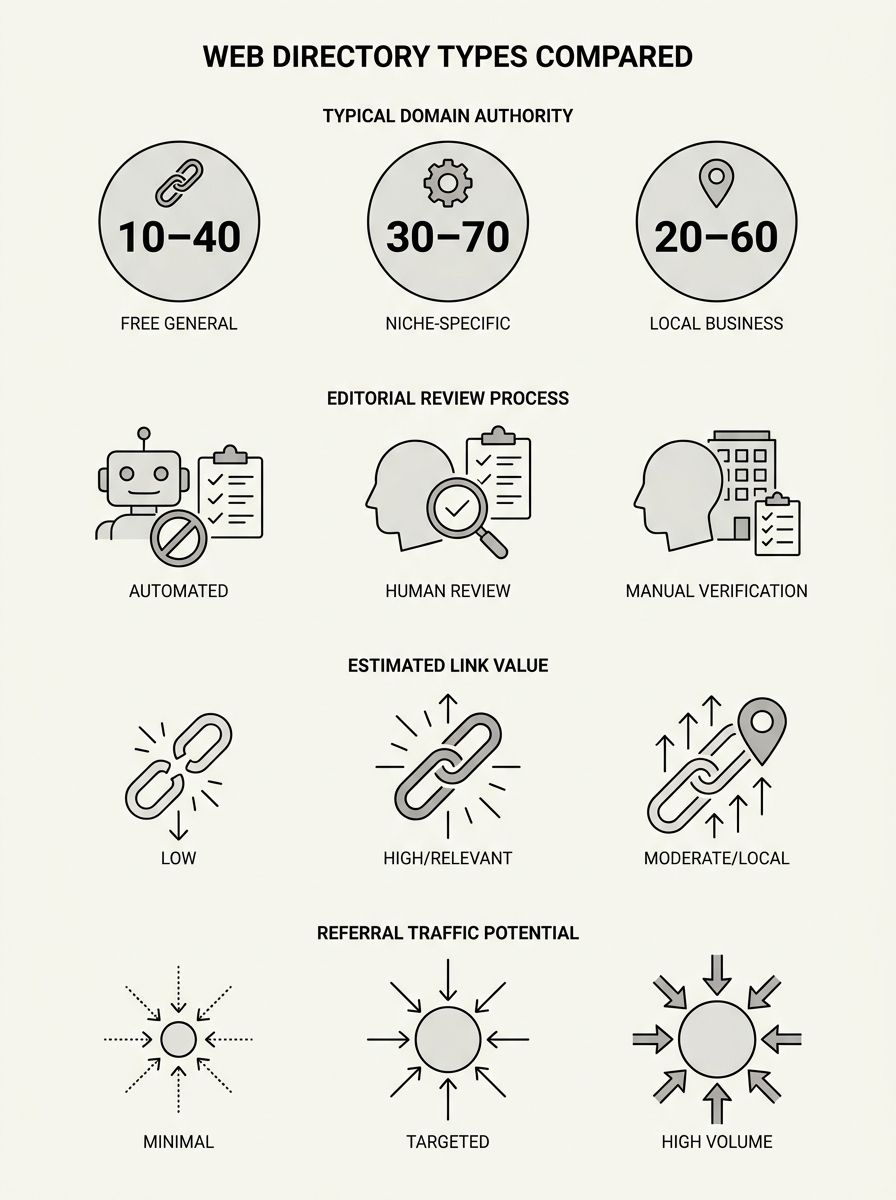
Web Directories and SEO: Which Ones Still Matter (Most Don't)
Lists of 350+ free SEO directories still circulate on marketing blogs, each one promising easy backlinks for anyone willing to fill out a submission form. The reality is less generous. DMOZ, which once powered directory data for AOL Search, Netscape Search, and even Google Directory, shut down in 2017. Yahoo Directory closed three years before that. The two directories that defined the category for a decade are both gone, and most of what replaced them is noise.
But a handful of directories still carry weight. The question is which ones, and whether the time you spend on directory submission actually returns anything measurable. The answer depends almost entirely on which of three categories you're targeting: general free directories, niche industry directories, or local business platforms.
Free General Directories and the Bulk Submission Trap
The pitch from directory submission services usually goes like this: submit your site to hundreds of directories at once, collect backlinks, watch rankings climb. Tools that automate this process advertise cost savings compared to manual link building. One vendor calculates the ROI against $600–$1,200 in manual labor costs for the same volume of submissions.
The math looks appealing until you consider what those links are worth. CognitiveSEO's analysis found that web directories probably still have a small impact on rankings, similar to any site that passes PageRank. The key word there is "small." And that's for directories that actually pass PageRank in the first place. Most general free directories don't clear that bar.
Here's what a typical free general directory looks like in practice:
No editorial review process. Every submission gets approved.
Hundreds or thousands of outbound links per page, diluting whatever authority the directory has.
Domain Authority below 20, often below 10.
No real human traffic. Nobody browses these directories to find businesses.
Google has penalized sites that abuse directory submissions as a link-building tactic. If a directory accepts everyone without vetting, the link carries almost zero value. As Linkio's research puts it: if they accept everyone, they're not worth your time. Submitting to spam directories can actively hurt your site, because search engines penalize websites associated with poor-quality link networks.
The best web directories for SEO share a common trait: selectivity. They reject submissions, charge editorial fees, or require detailed information before listing a site. The ones that let anyone in are the ones that don't matter.
If you've already submitted to dozens of general directories through an automated tool, don't panic. Those links are unlikely to help, but a handful of truly low-quality ones probably won't sink your site either unless you've gone to extremes. The bigger risk is the opportunity cost. Time spent on bulk directory submission is time not spent on approaches that actually move the needle, like the white-hat link building strategies that consistently outperform directory campaigns.
Niche Directories Do the Heavy Lifting
Niche directories link building is where the calculus changes. A legal directory that lists only verified law firms, a medical directory curated by healthcare professionals, or a SaaS directory with editorial standards carry a fundamentally different signal than a general web directory.
The difference comes down to topical relevance. Google's algorithm updates over the past several years have pushed relevancy to the front of link evaluation. A backlink from a directory that covers your specific industry tells Google something meaningful about what your site is and who it serves. A backlink from a directory that lists plumbers, dentists, SaaS products, and pet groomers on the same page tells Google almost nothing.
Search Engine Journal's overview of directories worth using acknowledges that general SEO value from directories has diminished, but calls out specific niche platforms that continue to deliver real benefits. Those benefits include:
Topical authority signals. A niche-specific backlink reinforces what your site is about. For startups especially, niche directory submissions can significantly boost topical authority when other backlink sources are thin.
Qualified referral traffic. People actually use industry directories. A developer looking for project management tools will browse a curated SaaS directory. A patient looking for a specialist will check a medical directory. This is real traffic from people already interested in what you offer.
Trust signals for human visitors. Being listed in a respected industry directory functions as a form of social proof, similar to a professional association membership.
The criteria for evaluating a niche directory are straightforward. Look for Domain Authority of 30 or higher (use Moz or Ahrefs to check). Confirm there's an editorial review process. Check whether the directory generates its own organic search traffic. If Google sends visitors to the directory itself, that's a strong quality indicator. And verify that the listings are genuinely limited to your industry or a closely related field.

Are web directories still useful for SEO? For niche directories that meet these criteria, yes, clearly. The backlink value is real, the referral traffic is measurable, and the topical relevance signal aligns with how modern search algorithms evaluate links. If you're doing keyword research around your vertical, you'll often find that the top-ranking pages in your niche already have listings in these directories.
Local Business Directories Operate Under Different Rules
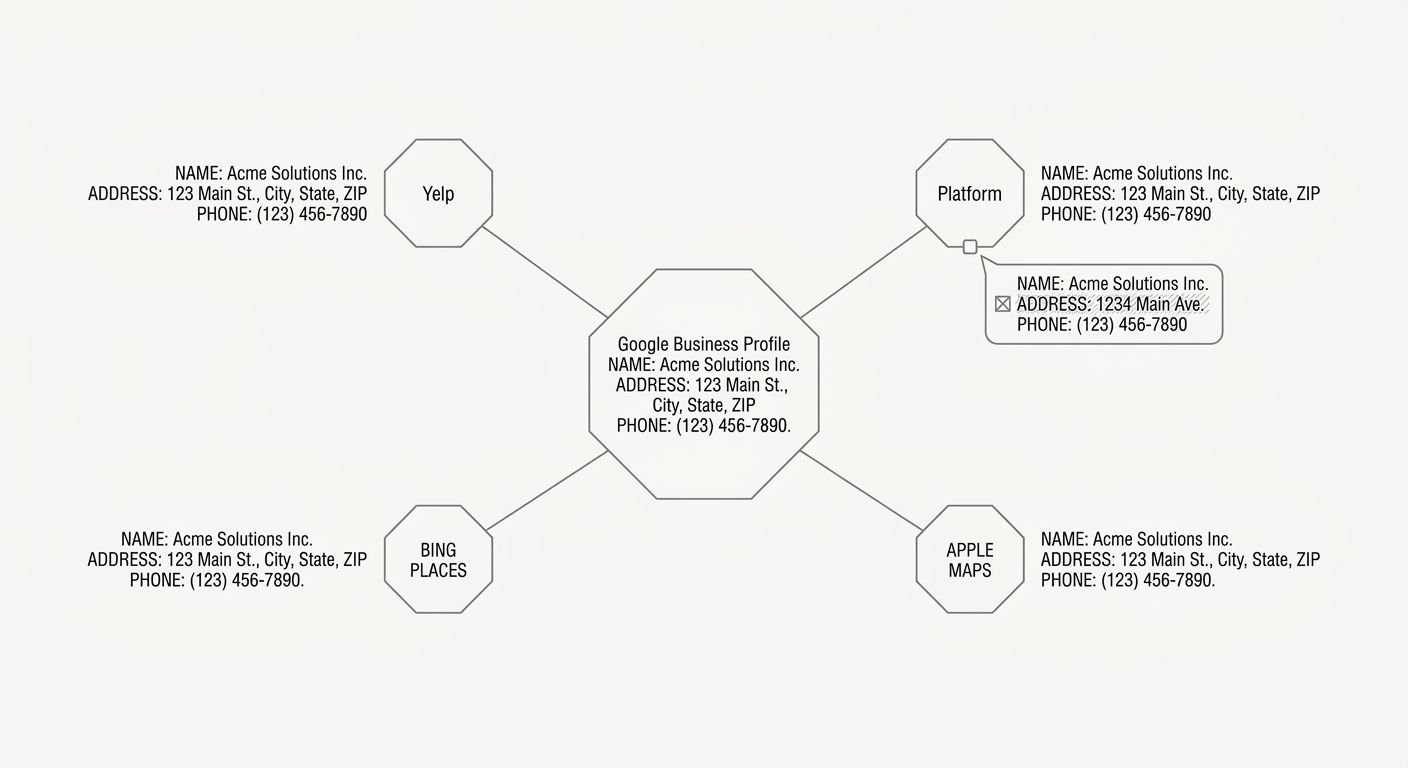
Local directories deserve their own section because they don't work the same way as either general or niche directories. Google Business Profile, Yelp, Bing Places, Apple Maps, and your local Chamber of Commerce listing aren't backlink plays. They're citation sources.
For local SEO, consistent NAP (Name, Address, Phone number) information across directories remains a confirmed ranking factor. Google cross-references your business information across multiple platforms to verify that your business exists, operates at the address you claim, and serves the area you target. Inconsistencies between platforms actively hurt local rankings: a different phone number on Yelp than on your website, an old address on a forgotten directory listing.
This makes local directory submission less about link building and more about data hygiene. The directory itself might have a nofollow link. The PageRank passed might be negligible. None of that matters because the value comes from citation consistency, not from the backlink.
The platforms worth prioritizing for local businesses:
Google Business Profile. Non-negotiable. This is the foundation of local SEO visibility.
Yelp. High domain authority, heavy user traffic, and Google frequently pulls review data from Yelp into search results.
Bing Places. Especially relevant now that ChatGPT uses Bing's index for real-time answers. Understanding how search engines discover and index content helps explain why Bing visibility matters more than it used to.
Apple Maps / Apple Business Connect. Increasingly important as Siri and Apple search features expand.
Industry-specific local directories. TripAdvisor for hospitality, Healthgrades for medical practices, Avvo for attorneys.
A mid-sized law firm case study from 2025 showed a 27% increase in qualified leads after listing in seven carefully chosen directories: three legal-specific, two local, one university resource, and one general high-authority directory. Seven listings total, with complete and consistent information in each one.
The risk with local directories is the opposite of the general directory problem. Instead of building too many low-quality links, businesses often have too many inconsistent listings scattered across platforms. Old addresses, defunct phone numbers, duplicate profiles on the same platform. Cleaning up existing listings frequently delivers faster results than creating new ones. If you're still thinking about submission as a discovery tactic, the same principle applies: the quality of what you submit matters far more than the volume.
Who Should Pick Which
The three categories of directories serve fundamentally different purposes, and conflating them leads to wasted effort.
General free directories: Skip them. The rare exception is a general directory with genuine editorial standards and a Domain Authority above 40. Best of the Web (BOTW) is one of the few remaining examples. Bulk submission services and automated tools that promise hundreds of directory links are selling you something Google learned to ignore years ago. If a tactic sounds like it belongs on a list of black-hat risks, it probably does.
Niche industry directories: Invest time here. Identify three to ten directories specific to your field, verify their authority metrics and editorial process, and submit complete, detailed listings. These links carry topical relevance signals that general directories can't match, and they often send real visitors to your site.
Local business directories: Treat these as infrastructure. Claim your profiles on the five or six platforms that matter for your region and industry. Keep NAP information consistent across all of them. Audit existing listings before creating new ones.
The web directory SEO question comes down to precision. A targeted listing in the right niche directory is worth more than a thousand automated submissions to free directories nobody visits. And for local businesses, the directory game is really a data accuracy game where consistency across a small number of trusted platforms drives the results. Directory submission still has a role in a broader SEO strategy, but only when you're selective enough about where you show up.
OrganicSEO.org Editorial
Editorial team writing about Ethical, white-hat, organic SEO education.
Frequently Asked Questions
- Are web directories still good for SEO in 2024?
- Web directories have minimal SEO value overall, with most general free directories carrying almost no weight. However, niche industry directories and local business directories still matter when they have editorial standards, high domain authority (30+), and genuine traffic.
- Should I use bulk directory submission services?
- No, bulk directory submission services are ineffective and potentially harmful. Submitting to hundreds of low-quality directories can actually hurt your site because search engines penalize websites associated with poor-quality link networks, and the time is better spent on proven link-building strategies.
- What makes a good niche directory worth submitting to?
- A quality niche directory should have a Domain Authority of 30 or higher, an editorial review process, its own organic search traffic from Google, and listings genuinely limited to your specific industry. These directories provide topical relevance signals and send qualified referral traffic.
- How important is directory consistency for local SEO?
- Directory consistency is critical for local SEO because Google uses Name, Address, and Phone number (NAP) information across directories to verify your business exists and operates where you claim. Inconsistencies between platforms actively hurt local rankings.
- Which local business directories should I prioritize?
- The most important platforms are Google Business Profile (essential for local visibility), Yelp (high authority with user traffic), Bing Places (increasingly relevant with ChatGPT integration), and Apple Maps. Industry-specific directories like TripAdvisor, Healthgrades, or Avvo matter depending on your business type.
- Why did DMOZ and Yahoo Directory close down?
- DMOZ shut down in 2017 and Yahoo Directory closed in 2014. These were once major directory sources for AOL Search, Netscape Search, and Google Directory, but they became obsolete as search engines evolved and could discover content without relying on human-curated directories.
- How many directories should a business submit to?
- Quality matters far more than quantity. Successful businesses submit to 7-10 carefully chosen directories with complete, consistent information rather than hundreds of low-quality listings. For local businesses, focus on 5-6 major platforms in your region and industry.