The Keyword Research Tool Accuracy Crisis: Building Your Own Verification System Without Buying Five Platforms
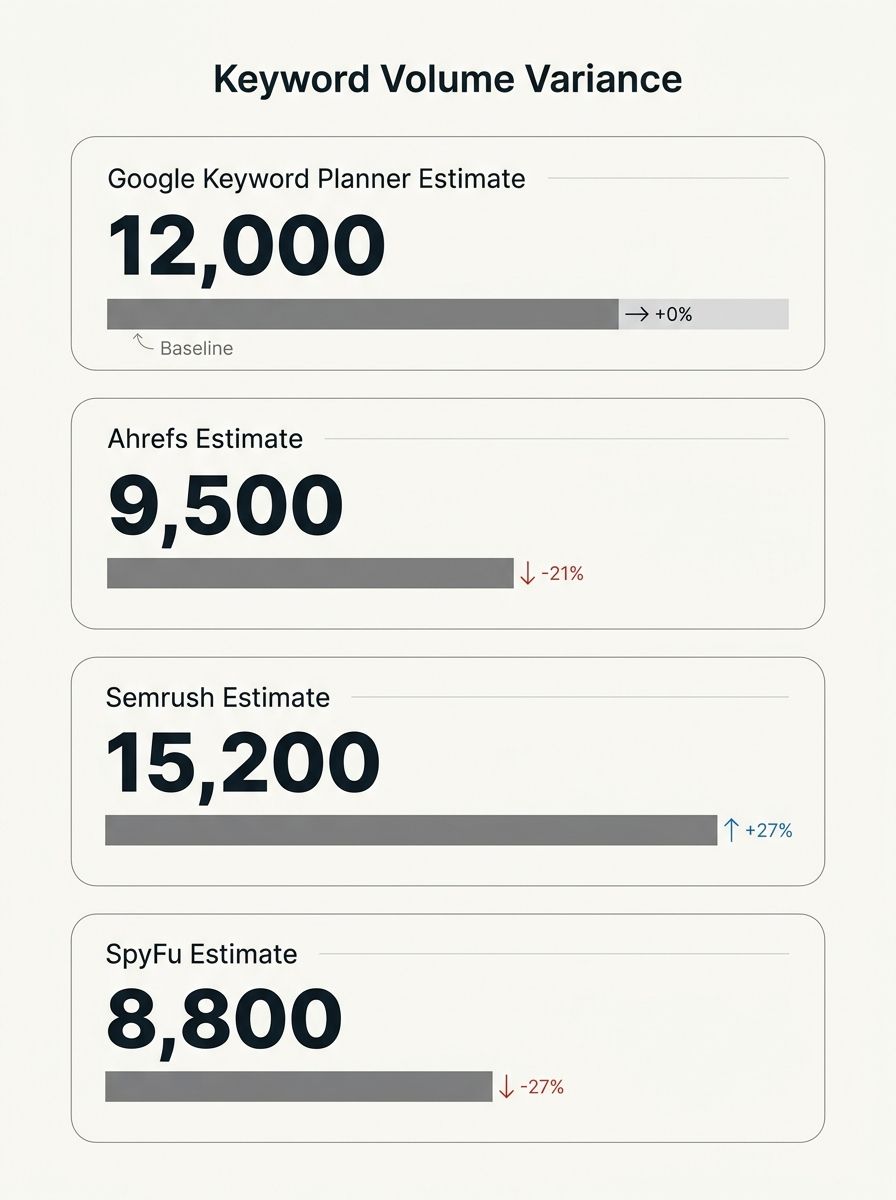
Keyword research tool accuracy is directional, not precise. The same query entered into Google Keyword Planner, Ahrefs, Semrush, and SpyFu produces four different volume numbers, sometimes varying by 5x or more. You don't need five paid subscriptions to sort signal from noise.

The Keyword Research Tool Accuracy Crisis: Building Your Own Verification System Without Buying Five Platforms
Keyword research tool accuracy is directional, not precise. The same query entered into Google Keyword Planner, Ahrefs, Semrush, and SpyFu produces four different volume numbers, sometimes varying by 5x or more. You don't need five paid subscriptions to sort signal from noise. You need a verification system built on first-party data from Google Search Console, cross-referenced against free tools and Google Trends.
Where the Numbers Actually Break Down
Tool data discrepancies run wider than most SEOs realize, and understanding the root cause matters more than picking a "winner" among platforms. Backlinko's own keyword research documentation acknowledges the issue directly: "You plug the same keyword into different tools and get wildly different numbers." Real-world testing confirms this with concrete examples. The query "homemade chocolate pie" returns volume estimates ranging from 1,000 to 10,000 searches per month in Google Keyword Planner's broad bucket, while third-party tools report figures between 1,900 and 2,400 per month for the same term. That's a potential 10x spread on a single, unambiguous keyword.
Why does this happen? Each tool uses a different data pipeline. Google Keyword Planner pulls from Google Ads auction data and rounds volumes into wide buckets (1K–10K is a single tier for non-spending accounts). Ahrefs and Semrush use clickstream panels of varying sizes, proprietary crawl data, and different smoothing algorithms to estimate monthly averages. The Stellar Content blog makes the practical recommendation that you should "compare keywords within a tool and not across platforms," because relative comparisons inside one system stay internally consistent even when the absolute numbers are wrong. You wouldn't check "picture frames" in Ahrefs and "wall art" in Semrush to decide between the two topics. But the within-tool advice only helps you prioritize. It can't tell you whether the underlying estimates reflect reality.
The real problem surfaces when you make content investment decisions based on absolute volume. If you're choosing between writing a 3,000-word guide for a keyword that one tool says gets 200 monthly searches and another tool says gets 2,000, you're operating on fundamentally different business cases. We've explored why keyword tools disagree on search volume in depth before, so the question here is what you actually do about it when your budget doesn't include $400 per month for multiple platforms.
Google Search Console as Your Ground Truth
The cheapest and most accurate way to validate search volume data is a tool you already have access to: Google Search Console. GSC reports actual impressions and clicks for queries your site already ranks for. These aren't estimates derived from clickstream panels or ad auction proxies. They're first-party measurements from Google itself, covering 100% of the search traffic Google sends your way across a rolling 16-month window.
Here's how to turn GSC into a verification layer. Export your Performance report filtered to a specific query. GSC shows you impressions (how many times your page appeared in results) and clicks (how many users came through). If you rank in positions 1 through 3 for a given keyword, your impression count closely approximates the actual search volume for that term, because top-3 results appear for nearly every search. For a query where your average position is 1.2 and you received 850 impressions in 30 days, that keyword gets roughly 850 to 1,000 searches per month. Compare that to the tool estimate. If Semrush says 3,000 and your GSC impressions at position 1 show 900, you have a concrete data point showing the tool overstates volume by approximately 3.3x for that specific term.
This approach has limits. You can only validate keywords you already rank for, and queries where you sit in positions 8 through 20 will undercount impressions because Google doesn't always render those results. But for your top 50 to 100 keywords, GSC gives you a calibration dataset that no paid tool can match for raw accuracy. We've written about setting up reliable attribution in GA4 and GSC if you need help extracting clean data from these platforms.
Building the Verification Loop with Free Tools
Once you have GSC as your baseline for known keywords, you need a way to validate search volume data for keywords you haven't ranked for yet. This is where cheap keyword research verification gets practical. The system works in three layers, and none of them require a paid subscription beyond already-available free tiers.
The first layer is Google Keyword Planner itself. Even with a non-spending Google Ads account, GKP shows you bucketed volume ranges. A keyword bucketed at 100–1K is categorically different from one bucketed at 10K–100K. You're not getting precision, but you're getting a sanity check. If a third-party tool claims a keyword gets 15,000 monthly searches but GKP puts it in the 1K–10K bucket, someone's math is off. The Outrank.so guide on checking keyword volume confirms that GKP combined with Google Trends forms a reliable free baseline for volume verification.
The second layer is Google Trends. Trends doesn't show absolute volume, but it shows relative interest over time and across geographies. Enter your target keyword alongside a keyword you've already validated through GSC. If your validated keyword gets 900 real monthly searches and Google Trends shows both keywords at similar interest levels, you can reasonably estimate the new keyword sits in the 700 to 1,100 range. This comparative approach aligns with Backlinko's recommendation to "focus on relative volume trends rather than exact numbers" and "cross-reference with Google Trends for validation."
The third layer is a single free or low-cost tool used for relative comparison. WordStream's free keyword tool, SE Ranking's free volume checker, or Keyword Tool's search volume lookup each provide a second opinion without a subscription. The point is calibration, not truth. You're comparing the free tool's estimate against your GKP bucket and your Trends-based relative estimate. When all three signals converge within a reasonable band, say within 40% of each other, you can move forward with confidence. When they diverge by 3x or more, the data is unreliable and you should weight your decision toward intent analysis and SERP review rather than volume projections. This connects directly to understanding when ranking data conflicts with volume estimates, where intent signals predict traffic better than any volume number.
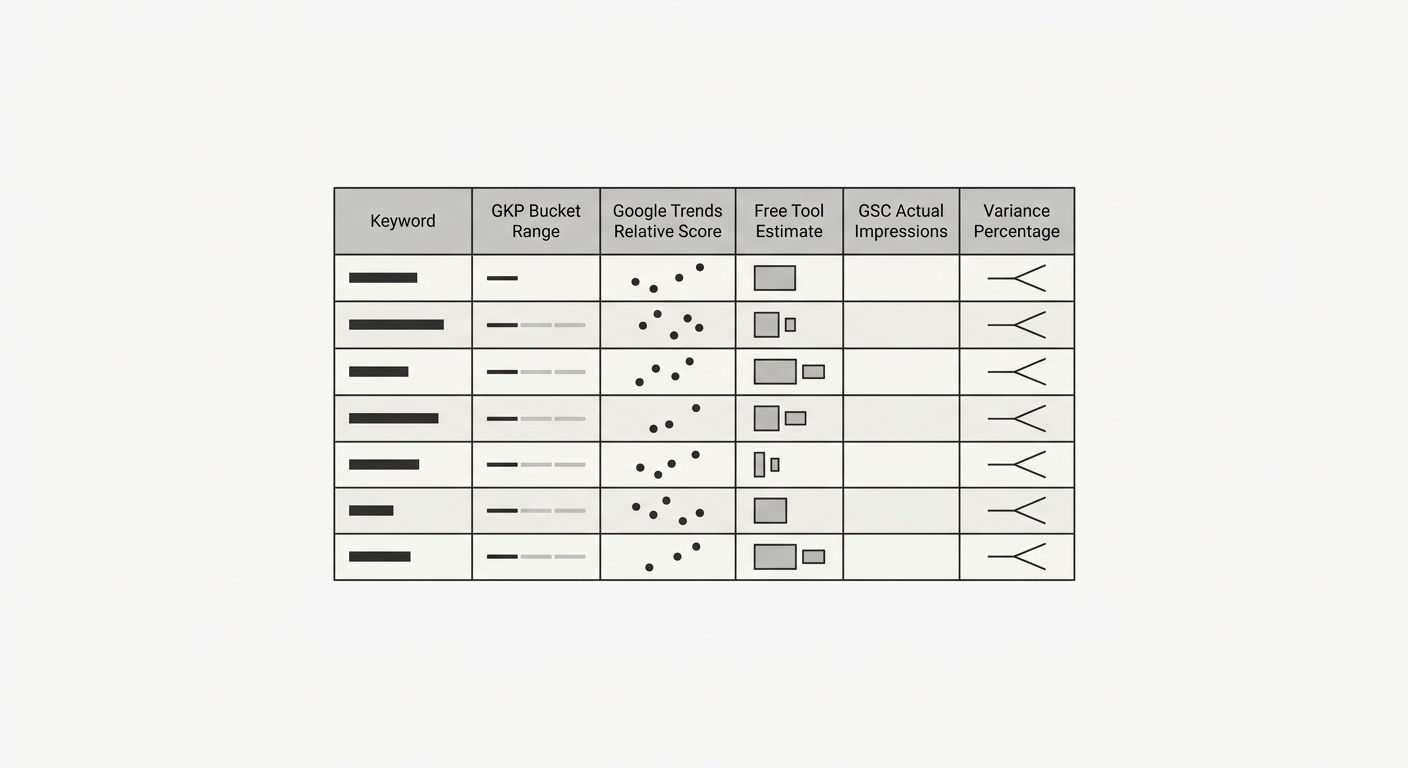
The practical output is a simple spreadsheet with columns for your target keyword, the GKP bucket, the Trends-relative estimate, the free tool estimate, and (where available) your GSC-validated actual. Run 20 to 30 keywords through this process and you'll see how much each tool skews for your specific niche. Some niches track closely across tools; others show persistent 2x to 5x gaps. That niche-specific calibration factor becomes your permanent correction coefficient, one you refine every quarter as you accumulate more GSC data for more terms.
The Uncertainty That Remains
Building a verification system solves the most dangerous version of the keyword research tool accuracy problem, which is making high-confidence decisions on low-confidence data. But it doesn't eliminate uncertainty, and pretending otherwise would be dishonest.
The biggest gap is new-topic validation. For keywords you've never ranked for and that have no close proxy in your GSC data, you're still relying on triangulation between imperfect sources. Your calibration factor helps, but it's derived from your existing keyword set, which may not transfer cleanly to a different topic cluster or search intent category. A keyword in your core niche might track within 30% of GSC actuals across all tools, while a keyword in an adjacent topic area could be off by 200% because the clickstream panels those tools rely on sample that audience differently.
There's also the temporal problem. Search volume is an average, usually smoothed over 12 months. Seasonal keywords, trending topics, and queries driven by news cycles will look wildly different depending on when the tool last refreshed its data. Google Trends helps here, but only directionally. If you're deciding whether to invest in content for a keyword that spiked in March and you're checking in July, every tool tells a different story about what "normal" looks like. The quarterly keyword refresh approach helps catch these shifts over time, but it requires ongoing attention rather than a one-time setup.
And perhaps the most uncomfortable reality: even with perfect volume data, volume alone is a weak predictor of traffic outcomes. A keyword with 5,000 monthly searches where Google displays a featured snippet, four ads, a People Also Ask box, and a knowledge panel above the fold delivers far fewer organic clicks than a keyword with 1,000 monthly searches and a clean SERP of ten blue links. Your verification system tells you whether 5,000 is actually 5,000 or actually 1,500. It doesn't tell you how many of those searchers will ever reach your page. That question requires a different kind of analysis, one rooted in understanding your market's subtopics and the actual SERP layout rather than any volume number in any tool's database.
The honest conclusion is that no verification system makes keyword volume data trustworthy in absolute terms. What it does is make your relative prioritization decisions defensible and your investment thesis grounded in first-party evidence rather than a single third-party estimate. For most organic strategies, that's enough. A three-layer verification approach using free tools gets you to a confident prioritization decision with more reliability than any single $200-per-month platform provides alone, and it forces you to confront the messy, imperfect nature of the data you're building a business on.
OrganicSEO.org Editorial
Editorial team writing about Ethical, white-hat, organic SEO education.
Related Articles
Keyword Research Data Conflicts in 2026: Why Ahrefs, Semrush, and Google Keyword Planner Give Different Numbers (And What to Do About It)
Ahrefs, Semrush, and Google Keyword Planner report different search volume numbers for the same keywords because each tool collects, models, and categorizes search data through fundamentally different methods.
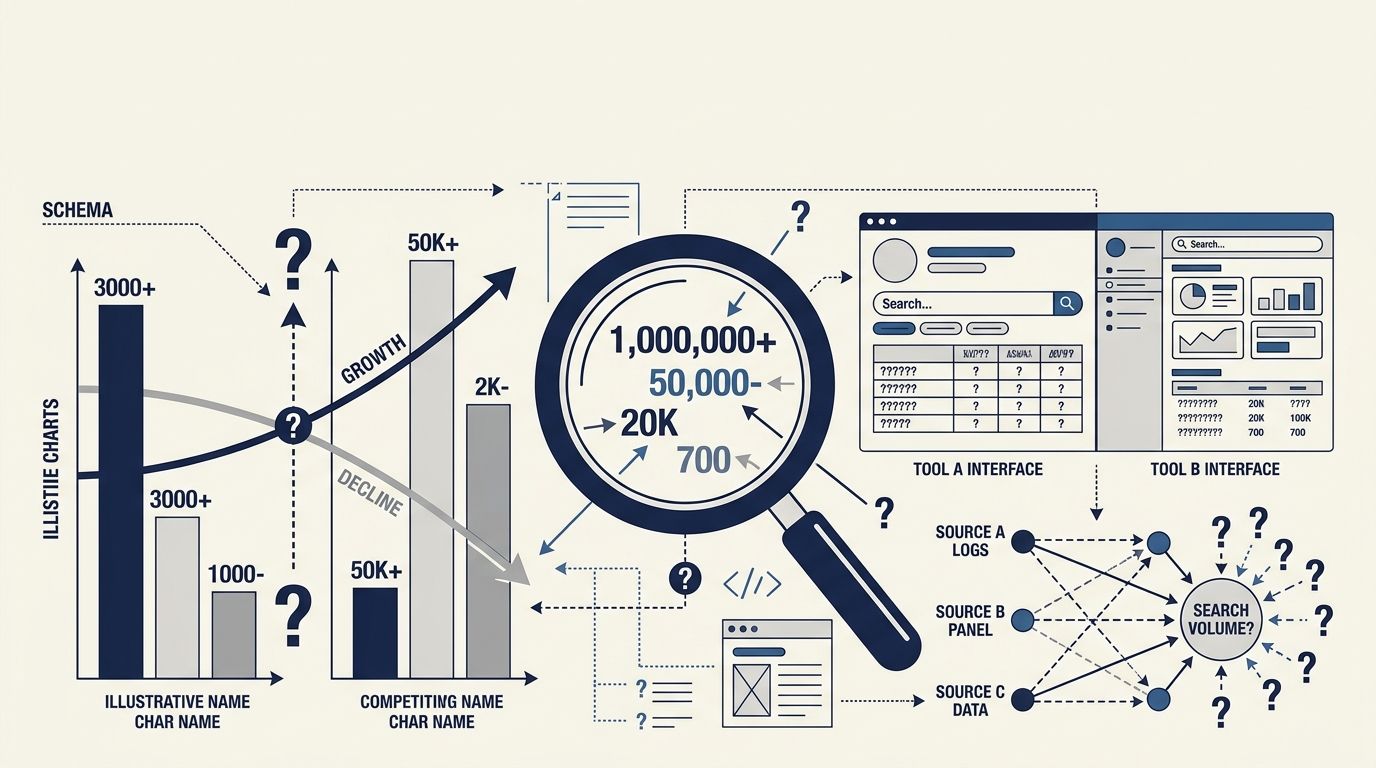
Why Your Keyword Research Tools Disagree on Search Volume (And How to Break the Tie)
Store Growers tested 10 commercial keywords across Google Keyword Planner, Semrush, Ahrefs, and SpyFu and found that no two tools agreed on volume for a single term.
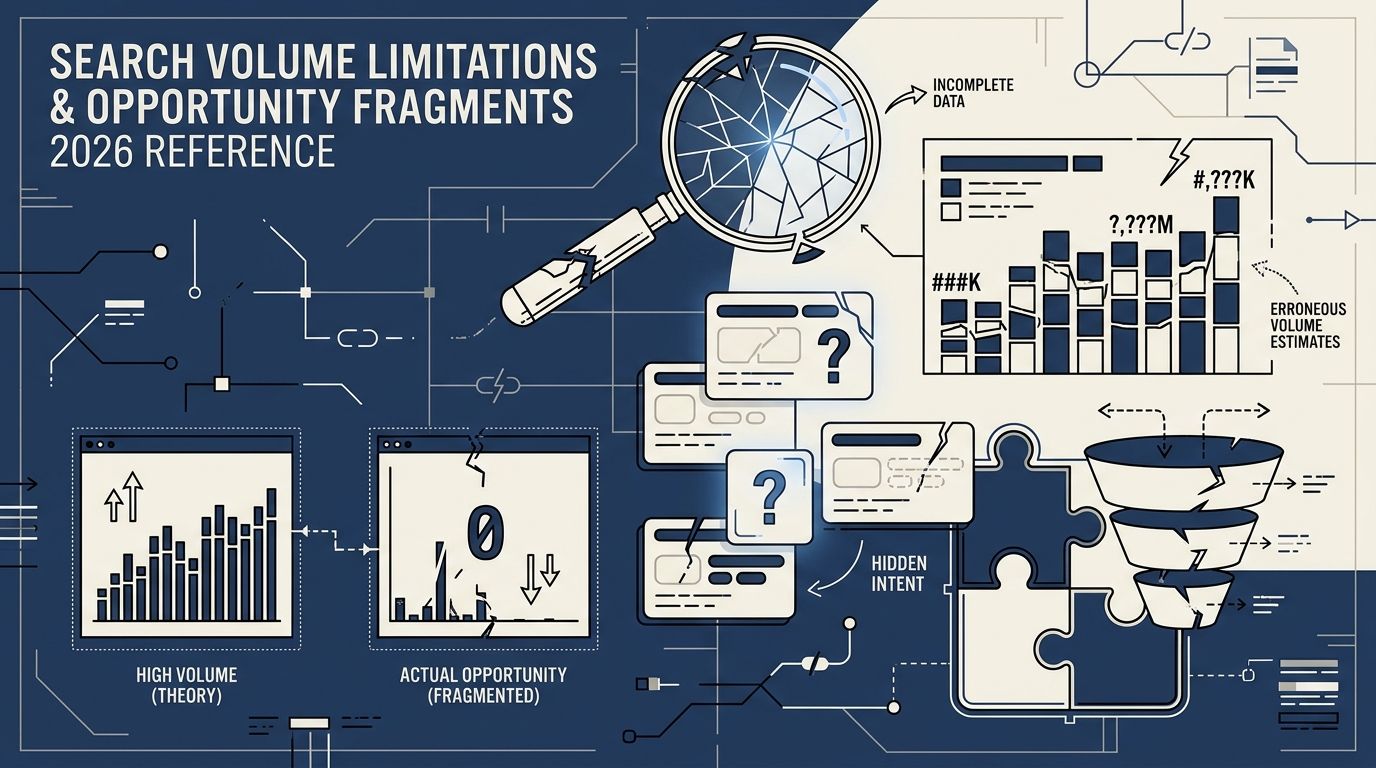
Beyond Search Volume: Why Keyword Research Tools Miss Half Your Opportunity in 2026
Roughly 15% of the queries Google processes each day have never appeared in any keyword research tool's index. That figure represents the floor of what volume-based research misses, before accounting for the queries tools do track but measure with wildly conflicting numbers across platforms.