Niche-First Keyword Research: Why Understanding Your Market's Sub-Topics Matters More Than Search Volume
Underserved niche markets convert at 3–5x the rate of high-volume keyword targets, according to UniK SEO's analysis of low-volume search segments. The mechanism is specificity: low-volume high-intent keywords filter out casual browsers and pull in users who are already close to a purchase decision.

Niche-First Keyword Research: Why Understanding Your Market's Sub-Topics Matters More Than Search Volume
Underserved niche markets convert at 3–5x the rate of high-volume keyword targets, according to UniK SEO's analysis of low-volume search segments. The mechanism is specificity: low-volume high-intent keywords filter out casual browsers and pull in users who are already close to a purchase decision.
The default keyword research workflow in every major SEO tool still sorts results by monthly search volume, descending. That ordering buries the terms most likely to generate revenue. Ahrefs' own research into its keyword database confirms that nearly all indexed keywords receive negligible monthly search volume, which means a volume-first strategy systematically ignores the overwhelming majority of the queries people actually type. The search volume vs relevance trade-off SEO professionals face is real, but the data on which side wins has become increasingly one-sided. A niche-specific keyword research strategy built around your market's sub-topics produces fewer pageviews on paper and more conversions in practice. This article argues for that inversion, traces why sub-topic depth compounds authority signals that isolated high-volume pages can't replicate, and proposes a keyword relevance evaluation framework that doesn't rely on volume as its primary input.
Volume Sorts the Wrong List
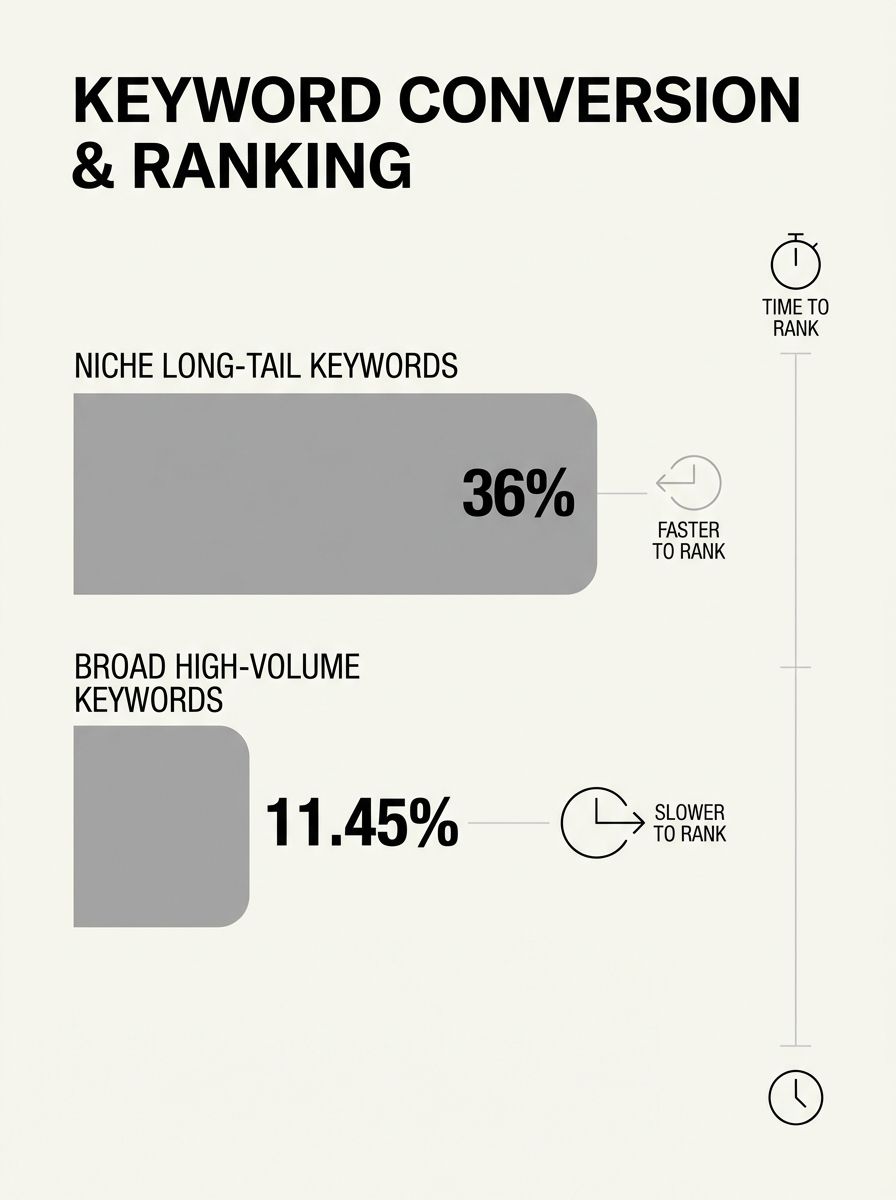
Every SEO tool presents the same interface: enter a seed keyword, receive a list ranked by estimated monthly searches. The implicit promise is that higher volume means higher value. But 91.8% of all search queries are long-tail keywords, and the conversion data splits sharply along that line. Niche long-tail terms convert at an average rate of 36%, while broad-term landing pages average 11.45%. That 3x gap represents the cost of optimizing for the wrong column in your spreadsheet.
The issue runs deeper than conversion rates. High-volume keywords attract competition from sites with massive link profiles and decade-old domain histories. Niche keywords with a keyword difficulty between 0 and 30 can reach page one within weeks to two months, while broad terms require 6 to 12 months or longer, and even then the outcome is uncertain for most sites. When you factor in the opportunity cost of those months spent chasing a single high-volume term, the math tilts further. As Shopify's keyword research guide puts it, low-volume niche keywords offer "high user intent and minimal competition, which makes them perfect for targeting highly specific audiences," and ranking well for them delivers steady, compounding traffic over time.
The reflex to chase volume also ignores how CPC data signals commercial intent. A keyword with 50 monthly searches and a $14 CPC carries far more buying intent than a keyword with 5,000 monthly searches and a $0.40 CPC. The cost-per-click metric reflects what advertisers are willing to pay for a click, which is a direct proxy for how often that click turns into revenue. If you've experienced the frustration of ranking well for a high-volume term that sends traffic but no conversions, the explanation is usually an intent mismatch hiding behind seemingly strong rankings. Volume got you visitors. Relevance would have gotten you customers.
Sub-Topics Compound Where Single Keywords Can't
A single page targeting a single keyword, no matter how well-optimized, sends a limited signal to Google about your authority on a subject. A cluster of related pages covering a topic from multiple angles sends a cumulative relevance signal that no individual page can match. This is the logic behind topic clustering, and the evidence supporting it traces back to Anum Hussain and Cambria Davies' 2015 Topics Over Keywords research at HubSpot, which demonstrated that internally linked topic clusters outperformed isolated keyword-targeted pages in organic visibility. A deeply covered cluster gives a site more indexed, relevant pages eligible to surface across related sub-queries.
The principle applies with particular force in niche markets. A site about commercial espresso equipment doesn't need to rank for "espresso machine." It needs to own the sub-topics: grinder burr alignment for commercial grinders, water pressure profiling for multi-group heads, maintenance schedules for high-throughput café environments. Each of those pages targets a low-volume high-intent keyword individually, but together they build an authority signal that Google's E-E-A-T evaluation framework rewards. Depth, as Search Engine Land's guide to topic clusters emphasizes, demonstrates experience, expertise, authoritativeness, and trustworthiness in a way that keyword density never could.

Passionfruit's SEO team summarized this dynamic concisely: "The agencies and brands that win at this go deep on a small number of topics rather than shallow across hundreds. Specificity compounds." That compounding effect shows up in AI search results too. Google's AI Overviews now trigger on approximately 48% of tracked queries, up 58% year-over-year, and content that answers precise niche queries boosts AI visibility by up to 40%. If you're expanding from seed keywords into semantic clusters the right way, each new sub-topic page strengthens every other page in the cluster. The network effect is the strategy.
A Different Way to Score Keywords
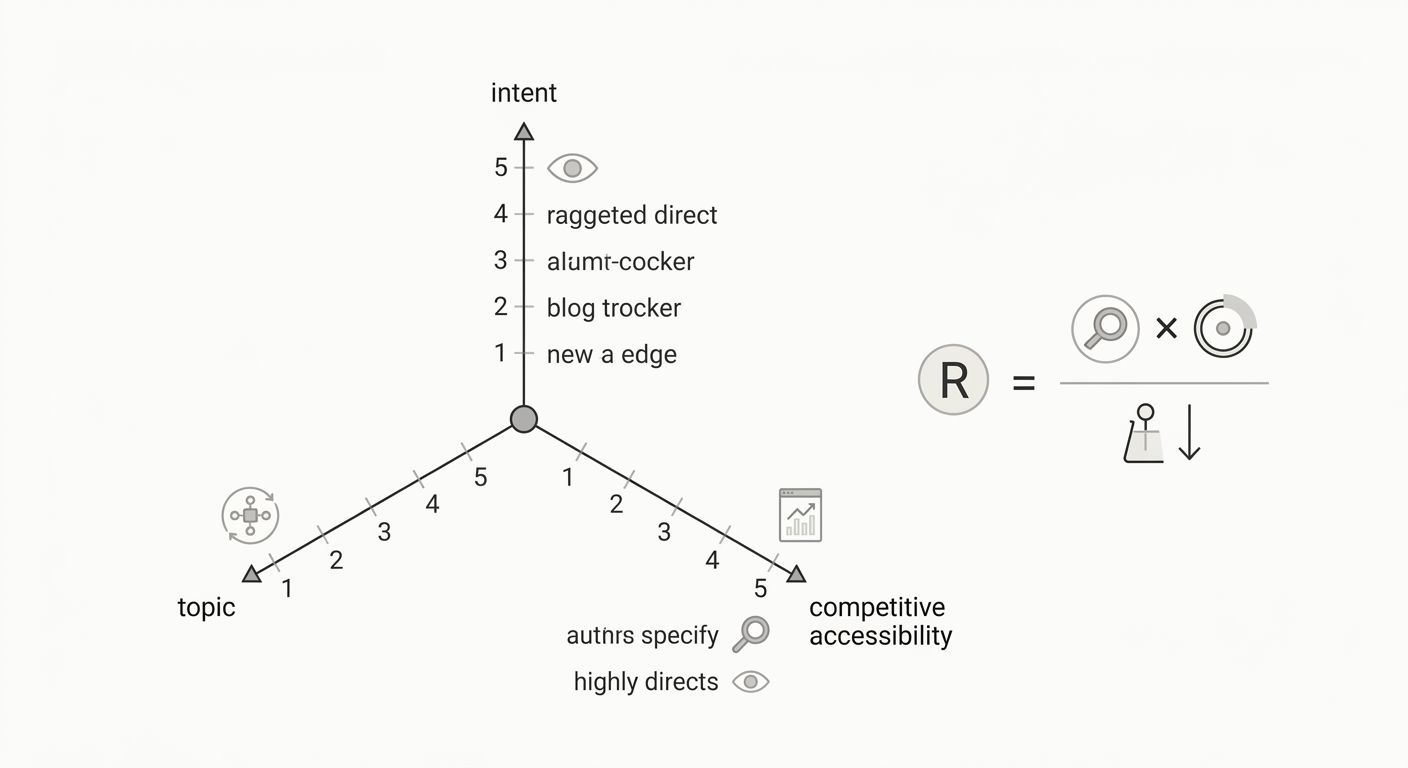
Dropping volume as the primary ranking criterion in your keyword research spreadsheet creates an obvious question: what replaces it? The answer requires a keyword relevance evaluation framework built around three axes that volume-first research ignores. I'd call these axes topic fit, intent specificity, and competitive accessibility.
Topic fit asks whether the keyword belongs to a sub-topic your site has genuine authority to address. If you sell accounting software for freelancers, "best accounting software" is a topic-adjacent keyword, but "how to track quarterly estimated tax payments as a freelance designer" is a topic-fit keyword. The distinction matters because Google evaluates whether your site's overall content corpus supports the claim you're making on any individual page. A page about quarterly tax tracking, surrounded by 15 other pages about freelance financial management, carries more weight than the same page on a generic business blog.
Intent specificity measures how close the searcher is to an action your business can fulfill. Users have evolved past generic queries. As Search Engine Land documented, a modern searcher types "best running shoes for marathons under $100" rather than "best shoes." SERP analysis validates intent: before creating content, check whether the top 10 results for a keyword match the format you plan to publish. If the SERP shows product pages and you're planning a blog post, the intent doesn't align, regardless of how relevant the keyword looks on paper. Mining "People Also Ask" boxes uncovers specific questions your audience asks, revealing demand that standard keyword tools miss because of low sample sizes.
Competitive accessibility replaces keyword difficulty scores (which vary wildly between tools, as anyone who's compared the numbers across platforms knows) with a direct question: can you realistically rank for this term within 90 days given your current authority? The 65–75% of markets classified as underserved by UniK SEO's research represent exactly this opportunity. These are sub-topics where larger competitors haven't bothered to publish because the volume numbers looked unattractive. Your content doesn't need to be better than a Fortune 500 site's content. It needs to exist where theirs doesn't.
The practical starting point is your own customer conversations. Support tickets, sales call transcripts, and CRM notes contain the exact language your market uses to describe their problems. That language maps directly to sub-topic keywords your competitors haven't thought to target. If you're not already mining your CRM for search intent, you're leaving your most specific keyword data untouched while paying monthly fees for tools that report volume estimates bucketed into ranges spanning 10x.
The Tension That Remains
There's an honest objection to everything above: some businesses need volume. A venture-backed SaaS company burning $200,000 per month on growth can't build its entire organic strategy around keywords with 40 monthly searches, no matter how well those keywords convert. Brand awareness campaigns, top-of-funnel content marketing, and market category creation all require reaching audiences who don't yet know they have a problem. Volume serves those goals in ways that niche sub-topic targeting cannot.
The framework I've described works best for businesses where each conversion has meaningful revenue attached, where the addressable market is defined enough that sub-topics actually exist in sufficient density, and where the timeline allows for 90-day measurement cycles. DashClicks' research showing that low search volume keywords generate higher conversion rates holds across industries, but "higher conversion rate" and "sufficient total conversions" are different claims. A 36% conversion rate on 20 monthly visitors produces 7 conversions. Whether that number justifies the content investment depends entirely on what each conversion is worth.
What I can't resolve is the emotional pull of big numbers. Keyword research tools display volume prominently because it feels like certainty. A keyword with 12,000 monthly searches looks like an opportunity in a way that a keyword with 30 monthly searches never will, even when the 30-search keyword would generate more revenue per page. That psychological bias toward visible scale over invisible conversion quality shapes how teams allocate budgets, how agencies report results, and how executives evaluate SEO performance. Changing the default sort order in a spreadsheet takes seconds. Changing the mental model that treats traffic volume as a proxy for business value is a harder project, and one that data alone hasn't settled.
OrganicSEO.org Editorial
Editorial team writing about Ethical, white-hat, organic SEO education.
Related Articles

When Keyword Research Data Conflicts With Ranking Reality: The Intent-Volume Paradox
Every major keyword tool defaults to sorting results by search volume descending. That single UX decision has trained an entire generation of SEOs to build content around the metric least predictive of whether a page will actually rank, earn clicks, convert visitors, or hold its position over time.

From Seed Keyword to Search Intent: Building a Keyword Research Framework That Scales Beyond Tool Suggestions
Every keyword tool on the market outputs the same four columns: search volume, keyword difficulty (a score from 0 to 100), CPC, and a one-word intent label.

Beyond Search Volume: Why Keyword Research Tools Miss Half Your Opportunity in 2026
Roughly 15% of the queries Google processes each day have never appeared in any keyword research tool's index. That figure represents the floor of what volume-based research misses, before accounting for the queries tools do track but measure with wildly conflicting numbers across platforms.