Keyword Research Data Conflicts in 2026: Why Ahrefs, Semrush, and Google Keyword Planner Give Different Numbers (And What to Do About It)
Ahrefs, Semrush, and Google Keyword Planner report different search volume numbers for the same keywords because each tool collects, models, and categorizes search data through fundamentally different methods.
Keyword Research Data Conflicts in 2026: Why Ahrefs, Semrush, and Google Keyword Planner Give Different Numbers (And What to Do About It)
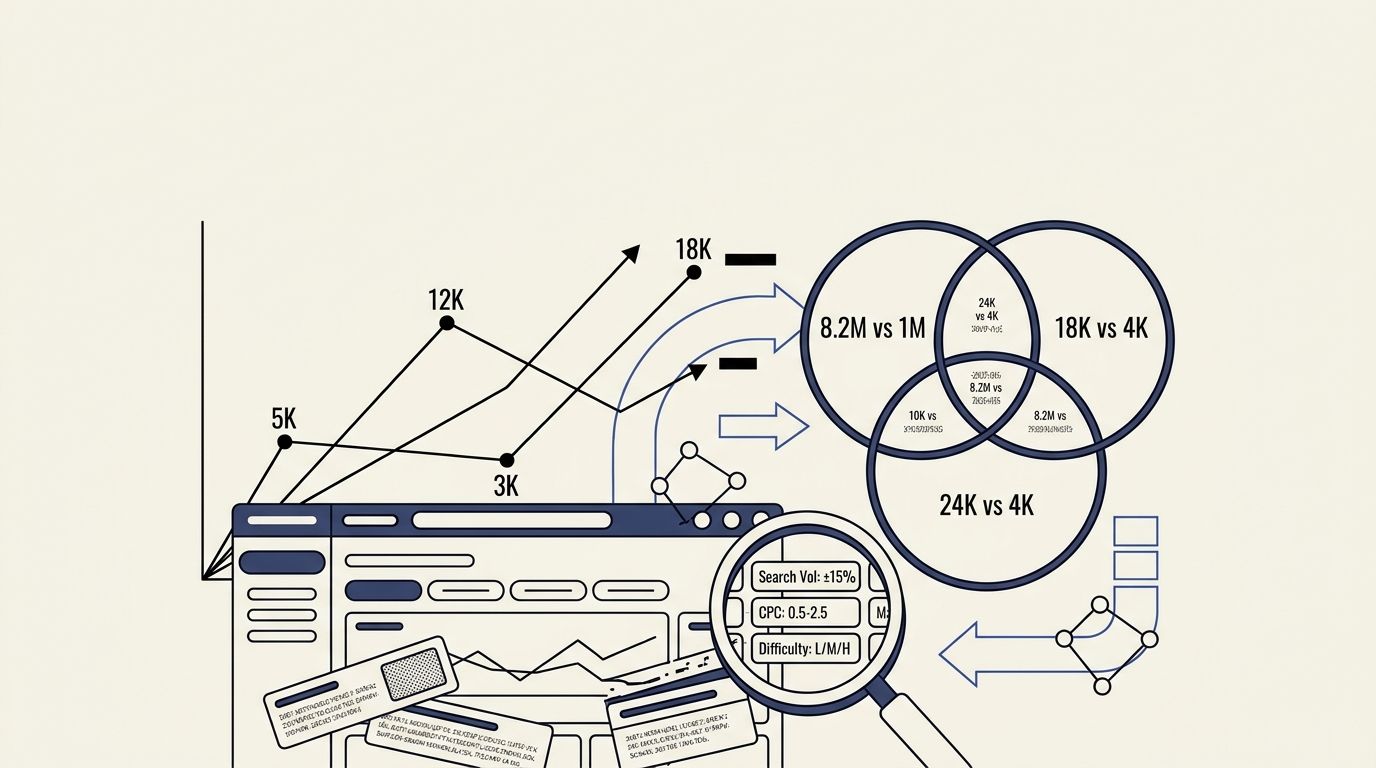
Ahrefs, Semrush, and Google Keyword Planner report different search volume numbers for the same keywords because each tool collects, models, and categorizes search data through fundamentally different methods. According to Backlinko's tool accuracy study, volume estimates vary 15-30% between tools, with individual keywords showing discrepancies of 5-60%. The disagreement is structural, and resolving keyword metric conflicts means understanding why these gaps exist rather than picking a "winner."
Three Pipelines, Three Answers
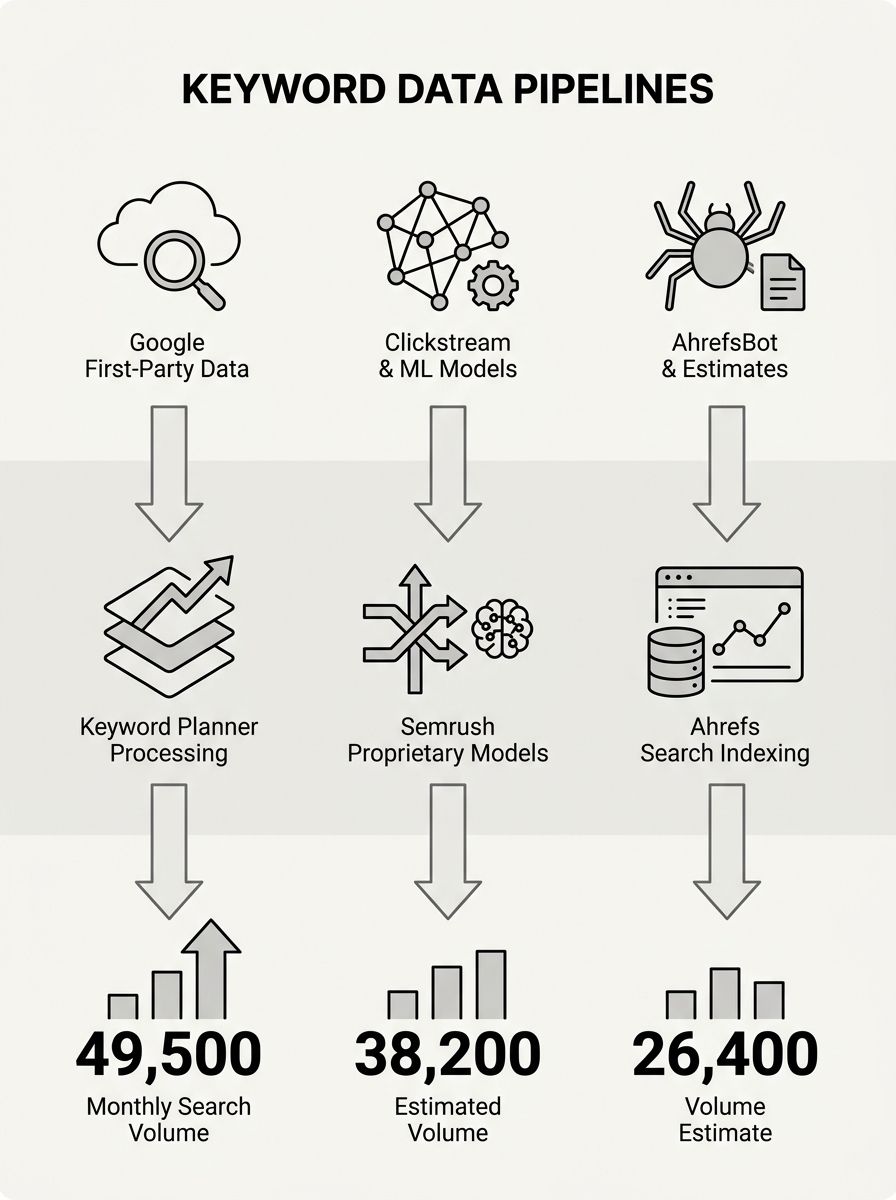
Why do ahrefs vs semrush data differences exist at all if both tools claim to measure the same thing? The answer starts at the data source layer, where each platform pulls from different inputs, processes them through proprietary models, and outputs numbers that look comparable but aren't.
Google Keyword Planner draws from Google's own first-party search query data, which should make it the most authoritative source. But GKP was built for advertisers, not SEOs. It returns volume in bucketed ranges (think "1K–10K" instead of "3,400"), and those ranges can span a full order of magnitude. As one contributor in a Moz community discussion explained, "I believe the Adwords tool. Because lots of people are using it to plan their spending on Google it is in Google's best interest to provide useful data." That's a fair point, but the data is designed to guide ad spend decisions, not to provide the granular monthly estimates SEOs want. The accuracy is real; the precision is deliberately limited.
Semrush blends machine learning models with third-party clickstream data providers, then reconciles those signals against its own crawl data. This approach gives it broad coverage across markets, and Semrush has integrated AI-powered predictive keyword trends into its 2026 platform, according to an analysis of current tool capabilities. The tradeoff is that modeled data inherits the biases of whatever clickstream panels feed it, and those panels skew toward certain demographics and geographies.
Ahrefs takes a different path. Its proprietary AhrefsBot crawler generates its own dataset, and the platform supplements this with third-party volume estimates. Ahrefs also provides a "traffic potential" metric that Semrush lacks, estimating the total organic clicks a top-ranking page could earn across all keyword variations, as noted in Style Factory's 2026 comparison. And then there's the categorization problem: each tool handles keyword variants (plurals, misspellings, reordered phrases) differently. Kishan Singh, a practitioner writing on search volume divergence, observed that "every tool utilizes different ways to define and categorize keywords," which means a search for "seat belt" versus "seatbelt" versus "seat belts" gets de-duplicated or separated differently depending on which platform you check.
These aren't minor implementation details. A 2026 case study surfaced in search industry data showed Ahrefs reporting 64,913 organic traffic for a particular site while Google Analytics recorded only 7,086, and Semrush's estimate landed at 24,295. Three tools, three numbers, and the gap between the highest and lowest was nearly 10x. Search volume discrepancies between tools at that scale make it clear: you're looking at the predictable outcome of three different measurement philosophies applied to the same underlying phenomenon.
When the Discrepancy Matters (And When It Doesn't)
Understanding keyword research tool accuracy in 2026 requires distinguishing between two use cases that get conflated constantly. If you're comparing relative volumes within a single tool (is keyword A bigger than keyword B?), the discrepancies across tools are mostly irrelevant. The internal ranking of keywords within any one platform tends to be directionally consistent. A keyword that Ahrefs shows at 5,000 monthly searches and Semrush shows at 8,200 will almost always rank higher than a keyword both tools place under 500. The ratios hold even when the absolutes don't.
The discrepancy starts to matter when you're using absolute volume numbers to make business decisions: forecasting traffic, sizing a content investment, or promising a client specific outcomes. A keyword that GKP buckets at "1K–10K" could mean 1,200 searches or 9,800 searches, and those two scenarios justify very different resource allocations. If you're building a keyword allocation strategy tied to site architecture, the difference between a 1,200-search keyword and a 9,800-search keyword changes which pages deserve the most internal linking equity and the most content depth.
The team at Fuerte Developers addressed this directly on Ryan Robinson's blog, noting that they've "seen many cases where pages rank and convert well even for keywords that tools show as 'low volume' or 'no data,'" and that relying more on audience understanding and real performance data makes more sense than trusting any single tool's volume estimate. This observation points to a deeper keyword research tool limitation: the tools measure search demand signals, but they don't measure conversion potential, purchase intent, or the actual value of the traffic behind a query. A keyword with 200 monthly searches and a 12% conversion rate is worth more than a keyword with 10,000 searches and a 0.3% conversion rate, and no volume estimate captures that.

When you're doing competitive gap analysis and running the same competitor URL through both tools, keyword research tool limitations compound further. We've written about extracting intent signals from competitor content gaps, and one consistent finding is that the keyword overlap between what Ahrefs and Semrush surface for the same URL can be surprisingly low. You're often looking at different slices of the same site's visibility, which means relying on a single tool gives you an incomplete picture. The conflict between tools, paradoxically, becomes useful information: if a keyword shows high volume in both Ahrefs and Semrush, your confidence in that signal is much stronger than if only one tool flags it.
Treating Tool Conflict as Signal, Not Noise
The instinct when facing conflicting data is to find the "right" number. But for resolving keyword metric conflicts, a better frame is to treat each tool's output as one vote in a consensus model. When all three platforms agree that a keyword sits in a particular volume tier, you can plan with higher confidence. When they diverge dramatically, that's information too: the keyword's search behavior may be volatile, seasonal, or dominated by a variant that one tool captures and another doesn't.
Google Search Console serves as the closest thing to ground truth for your own site's keywords. GSC shows actual impressions and clicks from Google's index, which means it reflects real search behavior rather than modeled estimates. Cross-referencing your GSC impression data against what Ahrefs or Semrush report for the same queries gives you a calibration point. If GSC shows 2,000 impressions for a query where Semrush reports 5,000 monthly volume, and you're ranking in position 3, the math doesn't add up, and Semrush's number is probably inflated for that term. If you've already set up proper attribution in GA4 and Search Console, you have the data to run this calibration exercise across dozens of keywords and develop a feel for how much each tool inflates or deflates in your specific niche.
Building a working approach means accepting three realities embedded in how these tools function. Use relative volume within a single tool for prioritization, not absolute numbers across tools. Treat convergence across tools as a confidence multiplier. And validate against GSC for any keyword where the stakes are high enough to justify the extra step. This approach acknowledges keyword research tool limitations without abandoning the tools entirely, which would mean giving up on demand signals altogether. When you're expanding from seed keywords into semantic clusters, volume precision matters less than topical coverage anyway, because the cluster's aggregate traffic potential determines whether the content investment pays off.
Where the Uncertainty Stays
Even with a disciplined cross-referencing workflow, genuine uncertainty remains about keyword research tool accuracy in 2026, and it probably will for the foreseeable future. Google has no incentive to release precise search volume data publicly. That data is the foundation of its advertising business. Every third-party tool is, at some level, making estimates. The estimates are sophisticated, informed by massive datasets and advanced modeling, but they're estimates. Nobody outside Google knows the exact monthly search volume for any given query, and Google itself may define "volume" differently from how SEOs use the term.
The rise of AI Overviews and answer engines introduces a new layer of ambiguity. A keyword might register 10,000 monthly searches according to Semrush, but if 40% of those searches now receive an AI-generated answer directly in the SERP, the clickable demand for organic results is substantially lower than the raw volume suggests. No tool has fully solved for this yet. Ahrefs' traffic potential metric gets closer by estimating clicks rather than raw searches, but it's still modeling behavior that changes month to month as Google adjusts how and where AI Overviews appear. And the keyword difficulty scores that both tools provide carry their own version of this same problem: as BlackHatWorld forum contributors have noted, "Ahrefs undervalues while Semrush overvalues the SEO KD," a pattern that experienced practitioners have confirmed across many keyword sets.
The tools we have are genuinely useful for what they measure. The honest answer to "which tool gives the right number" is that none of them do, and the right response is to build a workflow where no single number needs to be precisely correct. You triangulate, you validate against first-party data, and you make decisions based on directional confidence rather than false precision. The people who get this wrong are the ones who screenshot a Semrush volume number, paste it into a client deliverable, and treat it as fact. The people who get it right treat every volume figure as a hypothesis with a wide confidence interval, and they structure their keyword research around intent and topical coverage rather than chasing a specific number that was never as solid as it looked.
OrganicSEO.org Editorial
Editorial team writing about Ethical, white-hat, organic SEO education.
Related Articles
Why Your Keyword Research Tools Disagree on Search Volume (And How to Break the Tie)
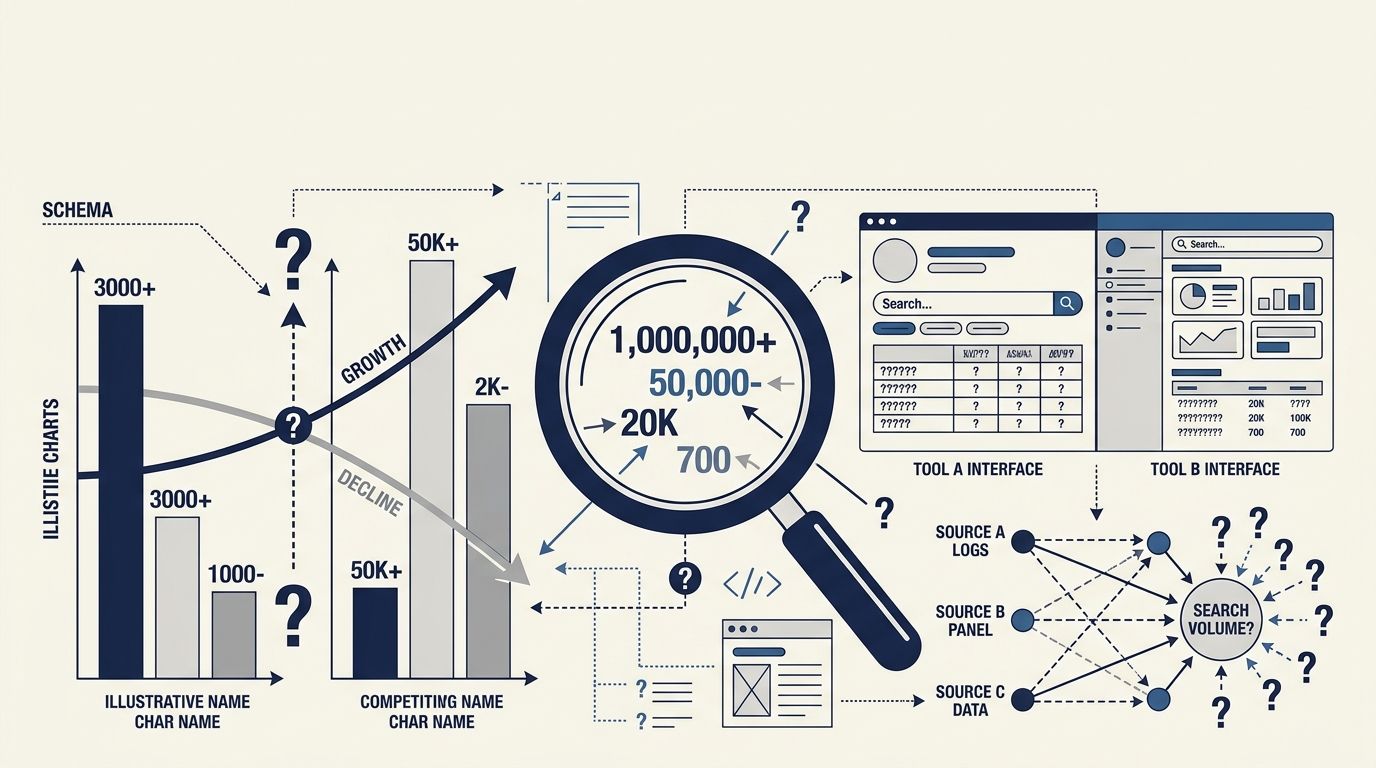
Store Growers tested 10 commercial keywords across Google Keyword Planner, Semrush, Ahrefs, and SpyFu and found that no two tools agreed on volume for a single term.
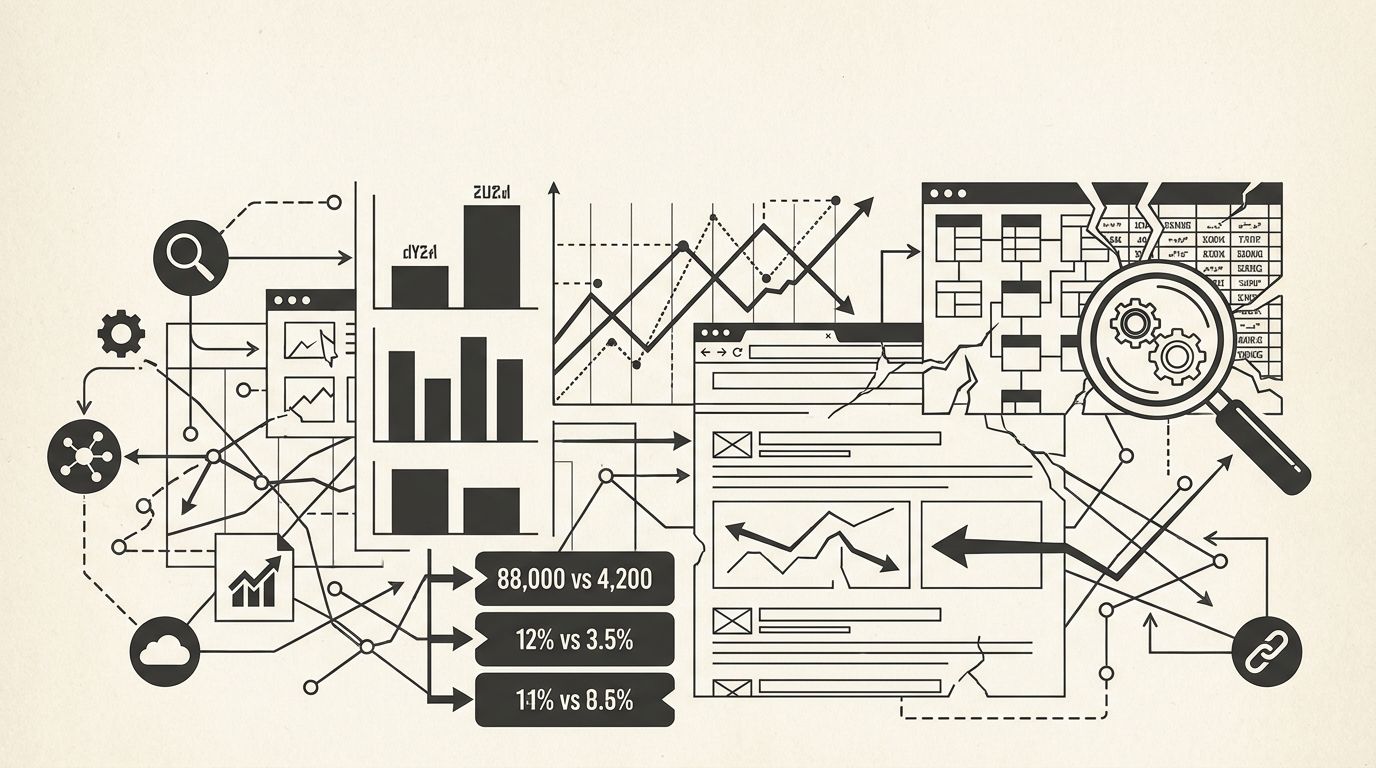
The Keyword Research Data Trap: Why Multiple Tools Contradict Each Other and How to Resolve Conflicts
Google Ads Keyword Planner API, the single upstream source feeding search volume data into Ahrefs, Semrush, Moz, and nearly every other SEO platform, returns estimates bucketed into ranges that can span 10x.
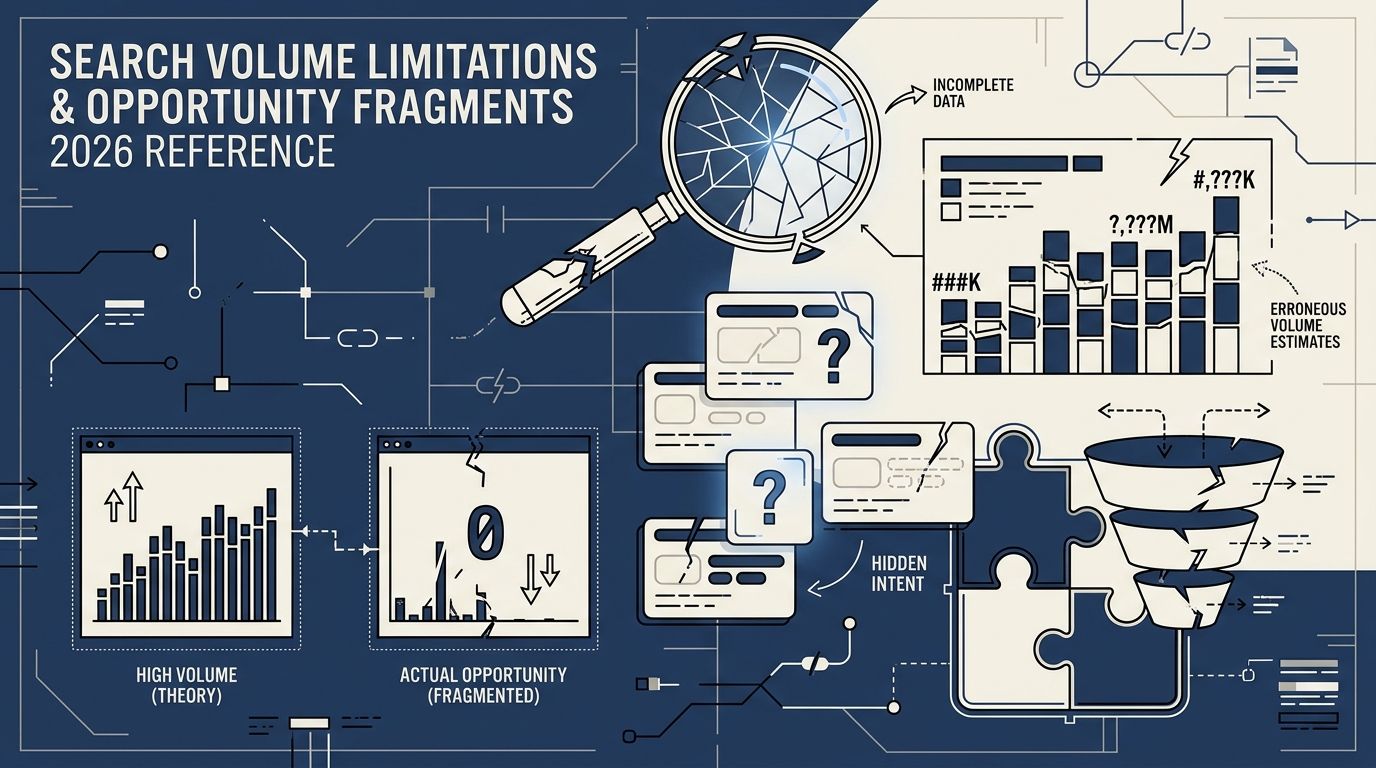
Beyond Search Volume: Why Keyword Research Tools Miss Half Your Opportunity in 2026
Roughly 15% of the queries Google processes each day have never appeared in any keyword research tool's index. That figure represents the floor of what volume-based research misses, before accounting for the queries tools do track but measure with wildly conflicting numbers across platforms.