Why Your Link Building Outreach Gets Ignored: 6 Fixable Mistakes Killing Your Response Rate
Sending more outreach emails will make your link outreach response rate worse.
Why Your Link Building Outreach Gets Ignored: 6 Fixable Mistakes Killing Your Response Rate
Sending more outreach emails will make your link outreach response rate worse. Every one of the six email outreach mistakes below traces to the same root: treating link acquisition as a volume game when the actual failure sits in positioning, targeting, and the value exchange you're offering (or aren't).
The conventional wisdom says scale is the answer. Send 200 emails a day, A/B test two subject lines, track open rates, repeat. That playbook worked in 2019. By 2026, every editor, blogger, and site owner with a domain rating above 30 receives dozens of identical pitches weekly. As Hunter.io's link building outreach guide puts it, "when a particular offer works well, everyone in the industry copies it. Within months, prospects start hearing the same pitch from dozens of people, and response rates drop."
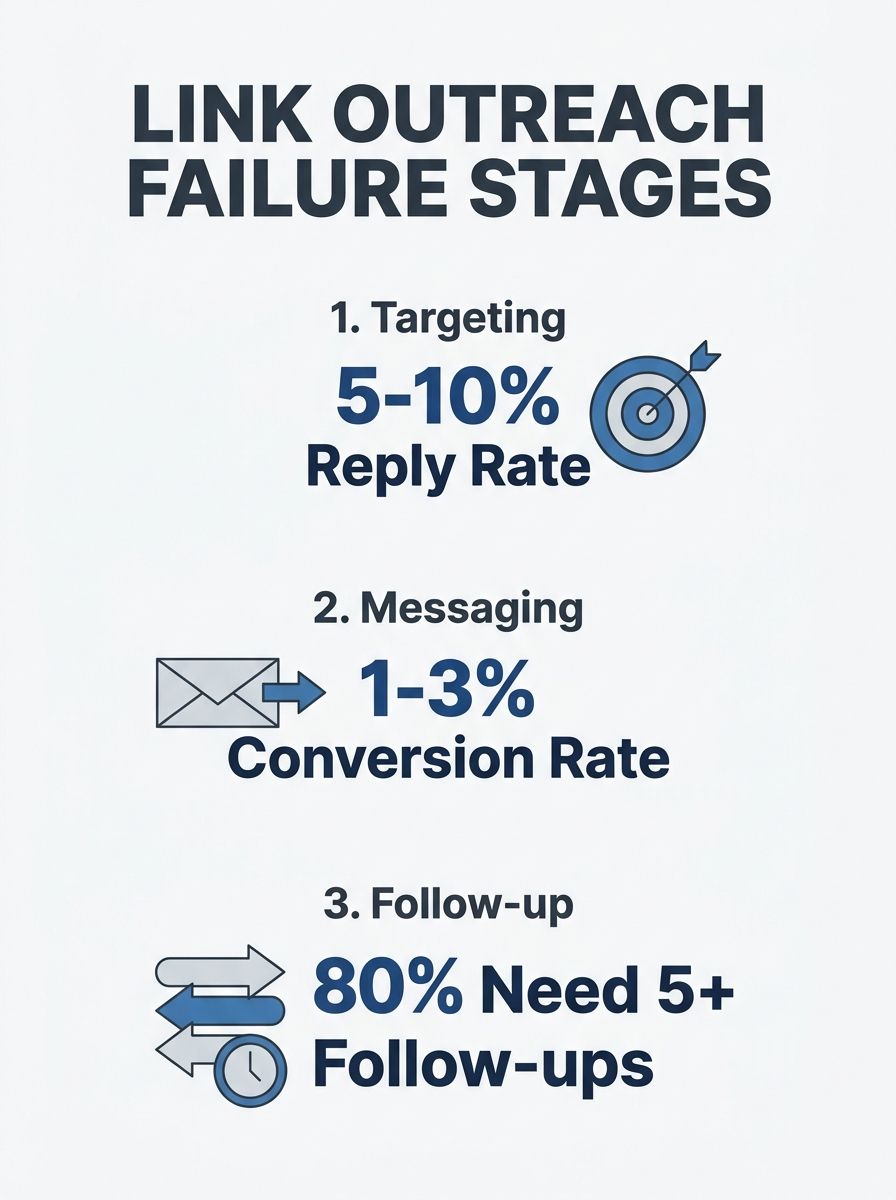
The average well-targeted link outreach campaign now sees a 5–10% reply rate and a 1–3% actual link conversion rate. Those numbers get worse when any of the six mistakes below are present. They get significantly better when all six are fixed. Here's the defense for that claim, organized around the three stages where outreach breaks.
Broken Prospecting Lists Doom Everything Downstream
Why does link prospecting quality matter more than email volume? Because contacting 200 irrelevant sites produces fewer links than contacting 30 relevant ones. The targeting stage contains two distinct mistakes that compound each other.
Mistake 1: Targeting Sites With No Logical Reason to Link
The most common prospecting failure is building lists based on domain authority scores alone. A DA 60 site in enterprise accounting software has zero reason to link to your guide about home renovation budgets. This sounds obvious when stated plainly, but automated scraping tools make it disturbingly easy to generate 500-row spreadsheets of "high authority targets" that share no topical overlap with your content.
SalesHive's research on outreach quality recommends a sales-development approach: "tighten the list, refine positioning, and adjust offers until you see consistent positive responses." That means qualifying each prospect against three criteria before they enter your spreadsheet: topical relevance (does their content overlap yours?), linking behavior (have they linked to similar resources in the last 12 months?), and audience alignment (would their readers genuinely benefit from your content?).
Sites that've linked to comparable content from competitors in the past 6 months are 4–7x more likely to respond to your pitch than cold targets with no linking history in your niche. If your list doesn't filter for this, you're burning sends.
Mistake 2: Emailing the Wrong Person
Even a perfectly relevant site won't respond if your email lands in a generic info@ inbox or goes to someone who doesn't control editorial decisions. On a 10-person content team, only 1–2 people typically have authority to add outbound links to published articles. Sending to the founder, the social media manager, or a catch-all address wastes 80% of your effort, according to multi-channel outreach benchmarks compiled across B2B campaigns.
The fix takes 5–10 minutes per prospect: check the site's about page, look for bylines on the specific article you're referencing, and cross-reference with LinkedIn to confirm the author is still at that organization. That small investment per-prospect changes your hit rate dramatically. If you've built a systematic approach to SEO troubleshooting, apply the same rigor here.

Generic Templates and Self-Serving Pitches
The message itself is where most senders fail hardest. According to Digital Domination's analysis of failed outreach campaigns, the single most common error is "sending generic, mass emails that lack personalization and relevance to the recipient's website or content." These emails get ignored or flagged as spam before a human even reads them.
Mistake 3: Surface-Level Personalization
Adding someone's first name and website URL to a mail-merge template doesn't count as personalization anymore. Every outreach tool on the market does this automatically. Recipients recognize the pattern instantly: "Hi [FirstName], I was reading [SiteName] and loved your article on [Topic]..." followed by a generic ask. This template was effective around 2018. It's now the fastest way to get deleted.
Genuinely personalized outreach templates follow what I'd call a Three-Layer Personalization model:
Layer | What It Includes | Time Investment | Impact on Reply Rate |
|---|---|---|---|
Surface | Name, site name, article title | 30 seconds | Negligible in 2026 |
Context | Specific reference to a recent point they made, a gap in their article, or a dataset they cited | 3–5 minutes | 2–3x improvement |
Intent | Clear explanation of what their audience gains from your resource, tied to the gap you identified | 2–3 minutes | 3–5x improvement |
Personalized email campaigns produce higher engagement than generic ones across every metric, per Mailchimp's research on email personalization. But the key finding is that personalization works at the Context and Intent layers, not at the Surface layer. Adding someone's name lifts open rates by a small margin. Referencing a specific paragraph in their article and explaining why your resource fills a gap they left open changes the entire nature of the exchange.
Mistake 4: Making It All About You
LinkyJuice's analysis of outreach failures identified that "making the message all about you" kills response rates faster than almost any other variable. Your company, your content goals, your latest blog post, your metrics. None of this matters to the recipient.
The recipient's core question is always the same: "What does my audience get out of this?" If your email doesn't answer that question in the first two sentences, it's over. Successful pitches lead with the value to their readers, not with your desire for a backlink. Offer exclusive data, a complementary resource that fills a documented gap in their existing article, or an expert perspective their coverage is missing.
When you think about how this connects to broader white-hat link building principles, the pattern is consistent: relationships built on genuine value exchange produce durable links. Transactional asks produce silence.
The Follow-Up Gap
Here's where the data gets uncomfortable. According to Growleads' research on B2B outreach cadence, successful outreach requires "at least five follow-ups 80% of the time." And yet, 44% of senders give up after a single attempt. That gap between required persistence and actual behavior explains a massive share of failed campaigns.
Mistake 5: Sending One Email and Moving On
A single email with no follow-up leaves 70–80% of potential positive responses on the table. People are busy. Inboxes are crowded. Your first email arrived while the editor was in a meeting, got buried under 40 other messages, and was forgotten by Tuesday. That doesn't mean they weren't interested.
The discipline required here is straightforward: build follow-up into your workflow as a non-negotiable step, not an optional add-on. If you wouldn't pitch a single prospect in a sales pipeline and then walk away, don't do it in link outreach either.
Mistake 6: Wrong Follow-Up Cadence
The opposite failure is equally damaging. Sending three follow-ups in three days reads as aggressive and desperate. The research on optimal outreach follow-up cadence points to spacing messages 2–5 days apart, with each follow-up adding new information rather than simply restating the original ask.
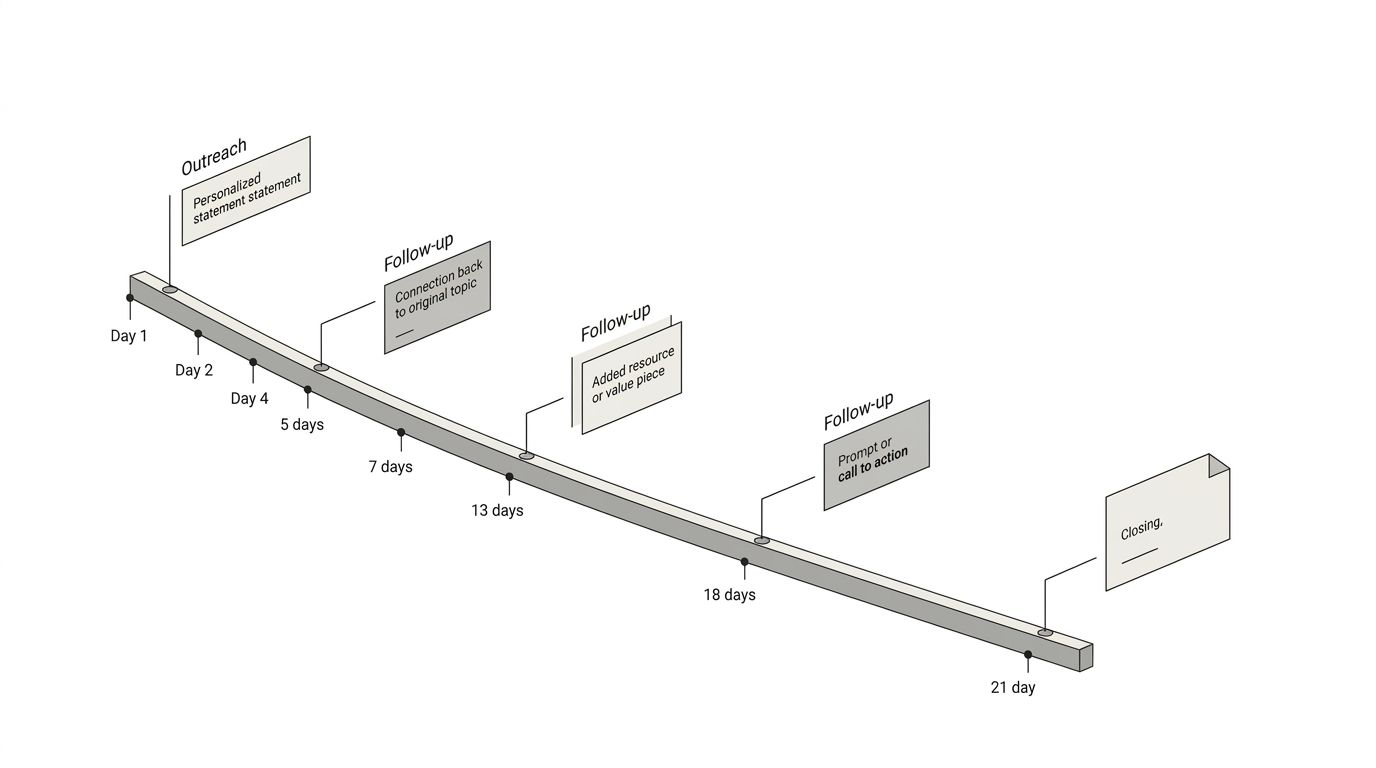
A productive 5-touch sequence over 3 weeks looks like this: initial pitch (day 1), value-add follow-up with a specific data point (day 4), brief social proof reference such as a recent mention or placement (day 9), alternative angle or different article suggestion (day 14), and a clean close that gives them an easy out (day 21). That's 5 emails across 21 days. Most senders either compress this into 5 days or never get past email 2.
Combining email with LinkedIn engagement before and during the sequence increases response rates by 3–5x, because the prospect recognizes your name when the email arrives. Engaging with their posts, sharing their content, or commenting something substantive 7–10 days before your first email creates familiarity without feeling transactional. This multi-channel approach pairs well with the kind of community-based trust building that produces lasting relationships.
Where the Volume Myth Breaks Down
The thesis holds up under pressure. Every one of these six mistakes gets worse at scale. A 500-person list with poor link prospecting quality means 500 irrelevant contacts. A generic template sent 500 times means 500 identical pitches hitting inboxes of people who've already seen the same structure from 12 other senders this month. One email with no follow-up, multiplied by 500, means 500 missed opportunities for a conversation that needed a second or third touch to convert.
The math points the other direction. A list of 40 well-qualified prospects, each contacted with a Context-and-Intent personalized pitch, followed up with 5 touches over 3 weeks that add new value at each step, will reliably produce a 5–10% reply rate and 1–3% link placement rate. That's 2–5 real conversations and 1–2 earned links from 40 sends. The 500-email blast with broken fundamentals will often produce zero.
Volume masks the signal. When you send 500 emails and get 2 links, you can convince yourself the 0.4% conversion rate is "normal for outreach." It isn't. The benchmark for a properly executed campaign is 3–7x higher than that. And the difference comes entirely from the six fixes above: better lists, correct contacts, three-layer personalization, recipient-first pitches, persistent follow-up, and disciplined cadence.
The uncomfortable truth about link building outreach is that the boring, time-intensive version works, and the efficient-looking scaled version produces inbox-shaped noise that editors have learned to ignore.
OrganicSEO.org Editorial
Editorial team writing about Ethical, white-hat, organic SEO education.
Related Articles
From Zero Referring Domains to 47 in Eight Months: A White-Hat Link Building Playbook in Practice
Three white-hat link building methods account for the vast majority of referring domain growth in campaigns that start from zero: original research assets, HARO-style journalist matching, and guest content contributions.

When Keyword Research Data Conflicts With Ranking Reality: The Intent-Volume Paradox
Every major keyword tool defaults to sorting results by search volume descending. That single UX decision has trained an entire generation of SEOs to build content around the metric least predictive of whether a page will actually rank, earn clicks, convert visitors, or hold its position over time.
Keyword Intent Mismatch: How to Spot When Your Rankings Hide Poor Traffic Quality
Pages ranking on page one for target keywords convert at roughly 3% on average, but pages with strong keyword intent alignment push past 5%, per Grow and Convert's conversion data. The gap between those numbers is where intent mismatch hides, and three detection methods exist to find it.