From Zero Referring Domains to 47 in Eight Months: A White-Hat Link Building Playbook in Practice
Three white-hat link building methods account for the vast majority of referring domain growth in campaigns that start from zero: original research assets, HARO-style journalist matching, and guest content contributions.
From Zero Referring Domains to 47 in Eight Months: A White-Hat Link Building Playbook in Practice
Three white-hat link building methods account for the vast majority of referring domain growth in campaigns that start from zero: original research assets, HARO-style journalist matching, and guest content contributions. Each operates on a different timeline and budget, and choosing the wrong mix burns months you can't recover.
Placement rates across all three methods run between 5% and 15%, according to aggregated 2025–2026 campaign data. That means for every 100 outreach emails you send or pitches you submit, you should expect 5 to 15 successful placements. The math matters because it forces you to think about volume, targeting, and efficiency before you send a single email.
The comparison below breaks down what each approach costs, how fast it works, what quality of links it produces, and where it falls apart. If you've already invested in building a solid site structure, these three methods represent the logical next step for off-page authority.
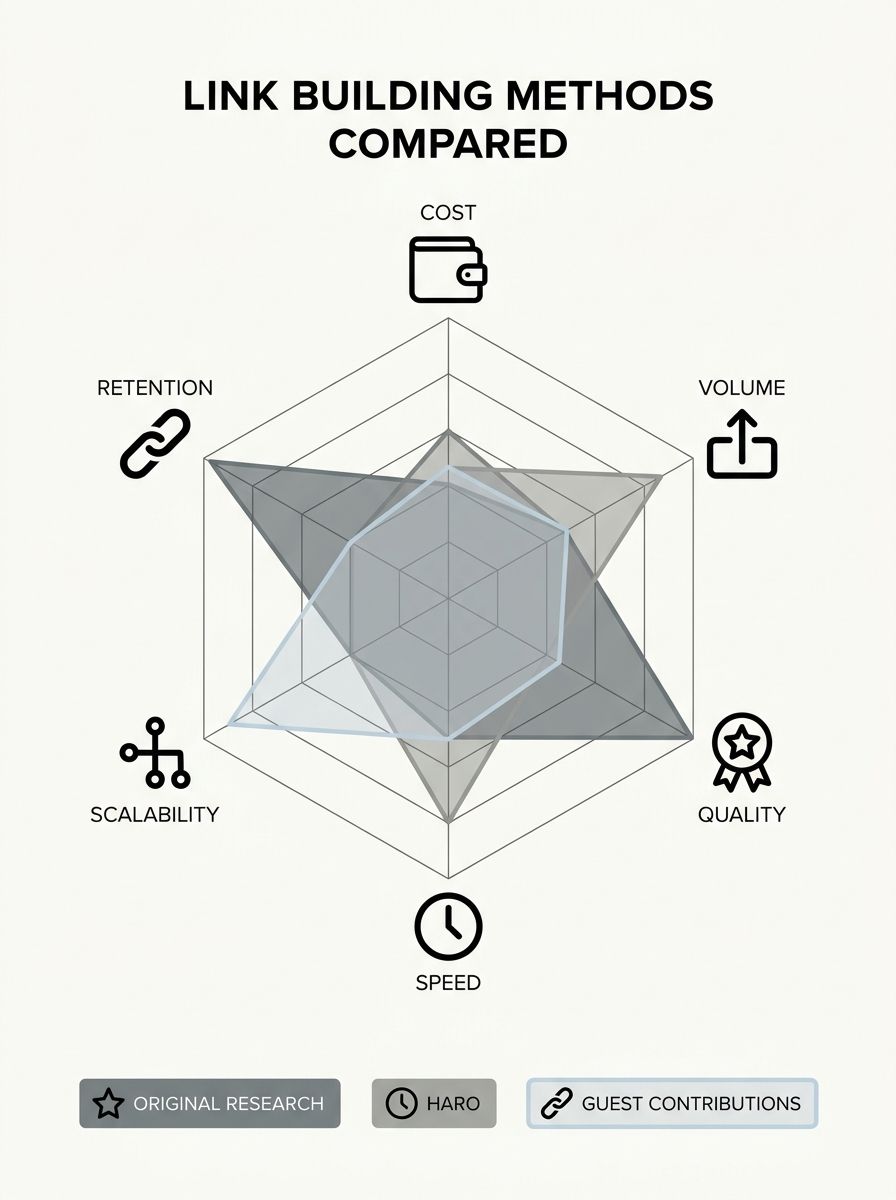
Factor | Original Research | HARO / Journalist Matching | Guest Contributions |
|---|---|---|---|
Cost per link | $750–$1,500+ (production) | $50–$200 (labor only) | $200–$500 (labor) |
Links per month | 3–7 (after asset publishes) | 2–4 | 2–5 |
Typical DR range | 60–85 | 50–80 | 20–60 |
Time to first link | 6–12 weeks | 1–4 weeks | 3–6 weeks |
Scalability ceiling | Low (resource-heavy) | Medium (time-gated) | High (repeatable) |
Risk of link loss | Very low | Low | Medium |
Original Research: The Slow Burn That Outperforms Everything Else
A single data-driven report can generate 22 backlinks and 156% branded search growth over 12 months, with minimal ongoing outreach required after publication. The catch is that producing the research costs real time and, often, real money.
Original research works because journalists, bloggers, and content creators need data to cite. When you publish a survey result, an industry benchmark, or a proprietary dataset, you become the source. Every article that references your finding links back to you. This is editorial link acquisition in its purest form: you create something worth referencing, and the links come to you.
The production cost is the barrier. A well-designed survey with 500+ respondents, professional charts, and a written report can run $750 to $1,500 in labor even if you handle everything in-house. If you're outsourcing design or data collection, double that. And the first link won't appear for 6 to 12 weeks after publication, because you still need to pitch the findings to journalists and wait for their editorial calendars to align.
"Use compelling, data-driven storytelling and visuals (e.g., maps, tables) to increase PR pitch success and journalist engagement," recommends BuzzStream's 2025 outreach guide on effective email templates. That advice maps directly to how original research should be packaged: not as a PDF buried on a resources page, but as a visually rich, scannable page with embeddable charts that make a journalist's job easier.
For digital PR on a budget, the workaround is scraping publicly available data rather than conducting original surveys. Government databases, industry filings, public APIs, and academic datasets are free. The analysis and visualization are where you add value. A site that compiled and mapped public FCC broadband data, for example, earned 30+ referring domains from local news outlets in four months, because no one else had made that data accessible in a visual format.
HARO and Journalist Matching: Fast Links, Finite Scale
Why does this method deliver results faster than everything else? Because you're responding to demand that already exists. Journalists on HARO (now Connectively), Qwoted, and SourceBottle post queries with tight deadlines. Respond within 2 hours with a quotable answer, and you can land a DR 70+ link within a week.
The economics are compelling. Each successful placement costs $50 to $200 in labor (the time spent monitoring queries and writing responses), and the resulting links typically land between DR 50 and 80. For a site starting from zero, three or four HARO wins in the first two months create a foundation of referring domain growth that makes subsequent outreach to other sites more credible.
The scale ceiling is the problem. You're limited by how many relevant queries appear in your niche per week, and response rates drop as more SEOs crowd into the same platforms. Typical success rates hover around 5–10% of pitches sent. If your niche produces 10 relevant queries per week and you respond to all of them, you're looking at 1 to 2 placements per month on average. That's meaningful but not explosive.
A Moz case study on white-hat link building documented that these reactive approaches work well as a complement but struggle as a standalone strategy. As the study's author put it, "white-hat link building (an admittedly contentious term) is possible" even in highly competitive verticals like gambling affiliates, but it requires layering multiple tactics rather than relying on a single channel.
Link prospecting for HARO is straightforward: set up alerts for your core topics, check them three times daily, and maintain a swipe file of pre-written credentials and expert bio paragraphs. The bottleneck is speed. Journalists receive 50 to 200 responses per query. Pitches submitted after the first 4 hours rarely get selected. If you can't commit to that response cadence, this method will underperform.
Guest Content Contributions: Predictable Volume, Variable Quality
uSERP's testing across multiple campaigns found guest contributions to be "far more effective than broken link building when it comes to increasing search engine rankings", largely because the relationship-building component of guest posting creates ongoing link opportunities that a one-time broken link swap never does.
Guest contributions are the workhorse of most link building campaigns. The process is mechanical: identify sites that accept contributions in your niche, pitch a relevant topic, write the piece, include a contextual link back to your site. Each successful placement costs $200 to $500 in labor and typically delivers a link in the DR 20–60 range. You can expect 2 to 5 placements per month once you've built a pipeline of 50 or more prospects.
The quality variance is where this method gets tricky. A guest post on a niche-relevant blog with 10,000 monthly readers and genuine editorial standards is a real editorial link. A guest post on a "write for us" content farm with no traffic and 400 outbound links per page is worth close to nothing and can look suspicious to Google's link spam classifiers. The difference comes down to your link prospecting process.
Effective prospect filtering requires checking three things: the site's organic traffic (anything below 1,000 monthly visits is usually not worth the effort), the ratio of outbound links to content (more than 50 external links per post is a red flag), and whether the site has genuine readership signals like comments, social shares, or newsletter subscribers. If you've already set up the right SEO tool stack, running these checks takes about 90 seconds per prospect.
For the 47-domain goal, guest contributions will likely account for 20 to 25 of those domains. They're the volume play. The quality anchors come from research and HARO.
Tracking Referring Domain Growth
Google Search Console provides free, reliable referring domain tracking through its Links section, which reveals your top linking sites, most-linked pages, and anchor text distribution. For more granular velocity tracking, tools like Ahrefs report All Time Referring Domains as a trendline, so you can map growth month over month and identify which campaigns drove spikes.
The velocity ratio, calculated as new referring domains divided by lost referring domains each month, is the metric to watch. A ratio above 2.0 indicates strong growth, where you're gaining domains twice as fast as losing them. Below 1.0 means your link profile is shrinking. During an eight-month campaign, expect the ratio to spike in months 3 through 5 (when guest contributions and HARO wins compound) and stabilize around 1.5 to 2.5 in months 6 through 8 as you run out of easy prospects.
You should also keep an eye on your anchor text distribution. If you're doing white-hat link building correctly, your anchors will be naturally diverse, featuring brand names, bare URLs, generic phrases, and occasional keyword-rich text. A profile dominated by exact-match anchors is a warning sign. We covered this kind of diagnostic thinking in more depth in our piece on how internal link patterns affect authority flow, and the same principle applies externally.
How To Choose Between These Three
The right mix depends on two variables: what you can produce and how fast you need results.
If you have strong writing skills and domain expertise but limited time, weight toward HARO (60% of effort) and guest contributions (40%). Skip original research for now. You'll reach 20 to 30 referring domains in eight months. The links will be solid, with DR averaging 40 to 60, and you'll build journalist relationships that pay dividends later.
If you can invest $2,000 to $5,000 in content production upfront and you're willing to wait 3 months for momentum, lead with original research (40% of effort), supplement with HARO (30%), and use guest contributions (30%) to fill gaps. This is the path to 47+ referring domains with the highest average DR. The research asset becomes a permanent link magnet that continues earning links after you stop actively promoting it.
If you're operating on near-zero budget and doing everything yourself, start with HARO exclusively for the first 6 weeks, then layer in guest contributions once you've landed 3 to 5 high-authority placements that give your outreach emails credibility. Original research can wait until you have revenue to fund it.
The honest answer is that none of these methods work in isolation at scale. Sites that avoid the risks of link schemes and private blog networks and commit to white-hat link building results over 6 to 12 months consistently outperform those chasing shortcuts. The 47-domain milestone is achievable in eight months, but it requires showing up every week with fresh pitches, fresh content, and the patience to let compounding do its work.
OrganicSEO.org Editorial
Editorial team writing about Ethical, white-hat, organic SEO education.
Related Articles
Why Your Link Building Outreach Gets Ignored: 6 Fixable Mistakes Killing Your Response Rate
Sending more outreach emails will make your link outreach response rate worse.

The Keyword Research Tool Budget Trap: How Much Data Do You Actually Need to Rank?
Ahrefs charges $129/month at its entry tier. Semrush starts at $139.95/month. Running both alongside a content optimization tool pushes monthly spend past $350 before you factor in annual commitments.

Niche-First Keyword Research: Why Understanding Your Market's Sub-Topics Matters More Than Search Volume
Underserved niche markets convert at 3–5x the rate of high-volume keyword targets, according to UniK SEO's analysis of low-volume search segments. The mechanism is specificity: low-volume high-intent keywords filter out casual browsers and pull in users who are already close to a purchase decision.