Keyword Allocation Strategy: How to Map Your Research to Site Architecture Without Diluting Authority
Assigning the same target keyword to two or more URLs forces Google to choose which page deserves the ranking, and it frequently picks the wrong one.

Keyword Allocation Strategy: How to Map Your Research to Site Architecture Without Diluting Authority
Assigning the same target keyword to two or more URLs forces Google to choose which page deserves the ranking, and it frequently picks the wrong one. A deliberate keyword allocation strategy — one keyword cluster per URL, one URL per intent — prevents this dilution and concentrates topical authority where it belongs.
How Keyword Cannibalization Suppresses Rankings
When two pages on your site target the same keyword (or close semantic variants), Google's crawler encounters competing signals. Both pages carry internal links, both have topically relevant content, and both request the same ranking position. Google resolves this by picking one — sometimes alternating between them across crawl cycles — and neither page accumulates the full authority it would hold as the sole candidate.
As Neil Patel's team explains, "the most direct way to prevent cannibalization is to make sure no two pages are competing for the same query. Each page should have one primary keyword tied to a distinct search intent." The problem isn't that you wrote about a topic twice. The problem is that both pieces aim at the same query-intent intersection without differentiation.
Semrush's cannibalization guide documents a common pattern: a blog post and a product page both target a commercial keyword. The blog post ranks intermittently at positions 8–12, the product page bounces between 15–25, and neither breaks into the top 5 because Google sees split signals about which URL is the canonical answer. Consolidating to one URL with proper redirects typically recovers significant visibility within 2–3 crawl cycles.
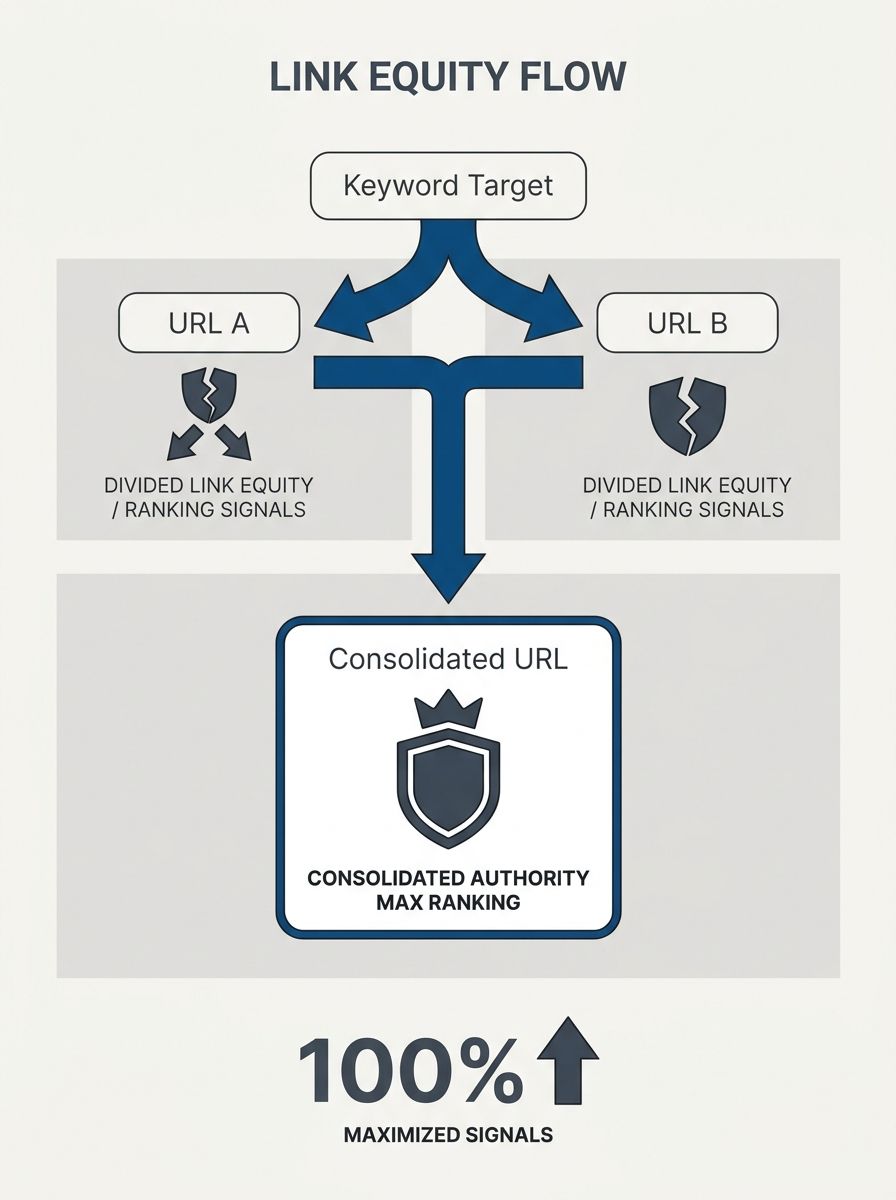
If you've already built a search intent map for your site, you have the foundation to spot these collisions before they happen. The intent map tells you what each URL is supposed to answer. The keyword allocation strategy tells you which specific queries route to that URL and nowhere else.
The Hub-and-Spoke Model for Post Assignment
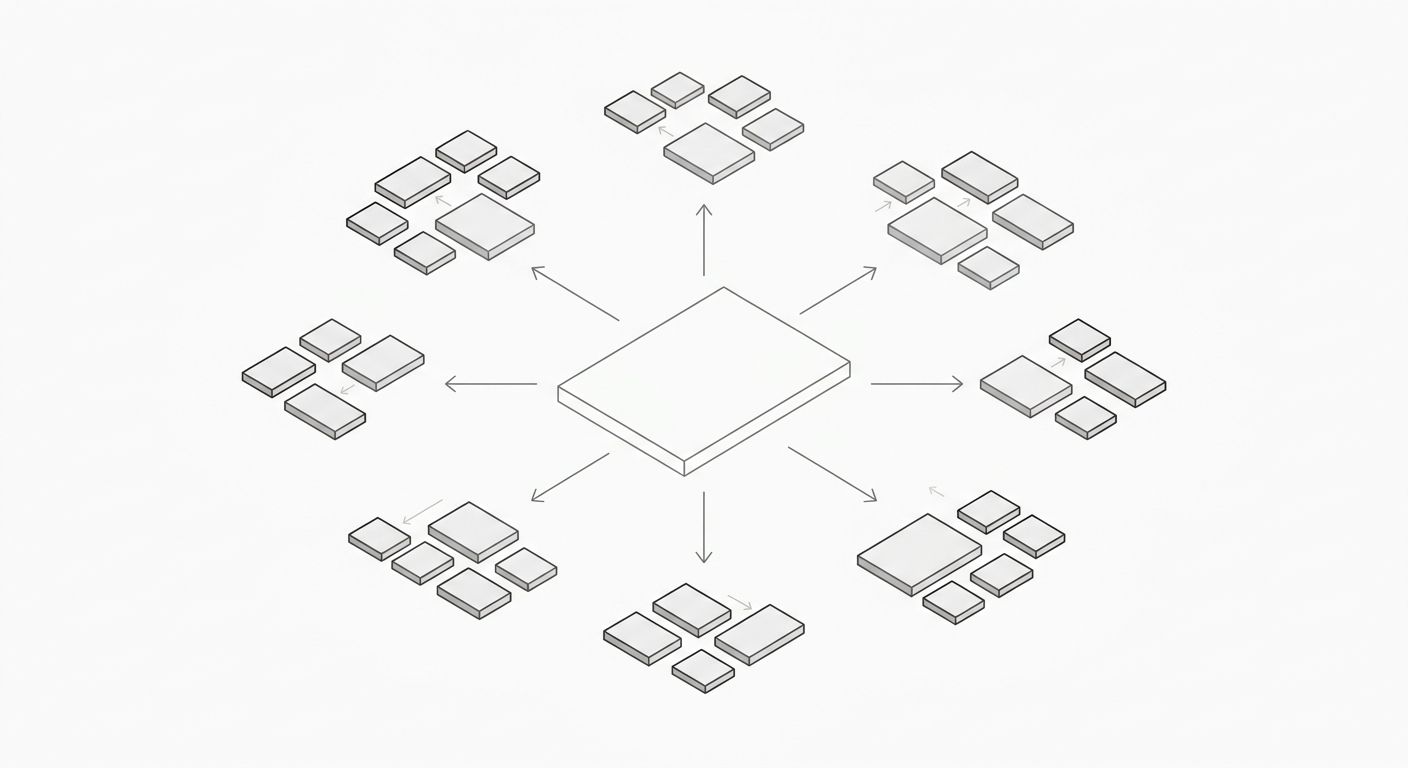
Topic clusters remain the dominant framework for keyword mapping site structure, and the logic is straightforward. A pillar page targets a broad head term. Supporting pages (spokes) each target a distinct long-tail cluster. Internal links flow between the spokes and the hub, concentrating authority on the pillar while giving each supporting page a clear, non-overlapping target.
BrightEdge's research on keyword topic clustering confirms that creating semantic relationships and hierarchy between individual content pieces produces stronger ranking signals because Google's crawlers can identify depth of expertise on a topic. A flat site with 50 blog posts all tangentially related to "email marketing" sends weaker signals than a structured cluster where one pillar page covers email marketing broadly and 12 spoke pages each address a specific subtopic — deliverability, subject lines, segmentation, automation sequences, and so on.
HubSpot's topic tool enforces a limit of 100 subtopic keywords per topic, which functions as a practical ceiling. If you're pushing past 100 subtopic keywords for a single hub, you're probably looking at two or three distinct topics that deserve their own pillar pages.
Andy Chadwick, a prominent SEO practitioner, describes keywords in 2026 as "Lego bricks" that users assemble into conversational queries. This framing matters for post assignment for keyword clusters: you're not assigning individual keywords to pages. You're assigning query patterns — groups of 5, 15, or 40 keywords that share the same intent and would be best served by the same piece of content.
The Intent-Specificity Grid
Here's a framework that makes allocation decisions concrete. For every keyword cluster in your research, score it on two axes:
Intent clarity — Does this cluster have a single, unambiguous intent (informational, commercial, transactional, navigational), or does it blend multiple intents? High clarity means one URL can serve the entire cluster. Mixed intent means you might need to split the cluster across two URLs with different content formats.
Specificity level — Is this a head term ("project management software"), a mid-tail cluster ("project management software for remote teams"), or a long-tail cluster ("free project management tool with Gantt charts for nonprofits")? Head terms go to pillar pages. Mid-tail clusters go to category pages or cornerstone articles. Long-tail clusters go to individual blog posts or product comparison pages.
Specificity Level | Intent Type | Assigned URL Type | Content Format |
|---|---|---|---|
Head term (1–2 words) | Blended / broad | Pillar page | 3,000–5,000 word guide |
Mid-tail (3–4 words) | Informational or commercial | Category page or cornerstone post | 1,500–2,500 word article |
Long-tail (5+ words) | Single clear intent | Blog post or landing page | 800–1,500 words, tightly scoped |
Branded variation | Navigational | Existing service/product page | No new page needed — optimize in place |
This grid prevents the most common allocation mistake: creating a new blog post for a keyword cluster that should be absorbed into an existing page. Clariant Creative Agency estimates 20 to 25 hours of work for a 5,000-word pillar page. You don't want to discover, after publishing, that the pillar competes with three existing blog posts that already covered pieces of its territory.
Running an Allocation Audit on an Existing Site
New sites have the luxury of building keyword mapping into site structure from scratch. If you did keyword research for your information architecture before launch, you're ahead. But most practitioners inherit a site with hundreds of existing pages and no documented allocation plan.
The audit process works in four passes:
Pass 1: Export and cluster. Pull every indexed URL from Google Search Console alongside the queries each URL received impressions for over the past 90 days. Group the queries into clusters by semantic similarity. Any tool that does SERP-based clustering works — the point is to identify which queries Google already treats as the same topic.
Pass 2: Flag collisions. Look for any keyword cluster where two or more URLs received impressions. This is where avoiding keyword cannibalization starts. Sort by impression volume to prioritize the highest-impact collisions first. A site with 200 blog posts typically has 15–30 cannibalization pairs, sometimes more if content was published without an allocation plan.
Pass 3: Decide the winner. For each collision, pick the URL that best matches the cluster's dominant intent. Factors: existing backlinks, current average position, content depth, and page type (a product page should win commercial-intent clusters over a blog post). The loser either gets consolidated into the winner via a 301 redirect or gets re-targeted to a different, non-overlapping cluster.
Pass 4: Document the map. Build a spreadsheet — or whatever system your team actually maintains — where every keyword cluster has exactly one assigned URL. This becomes the living allocation document. When someone proposes a new blog post, the first check is against this map: does the proposed target cluster already have an assigned URL?
If you've noticed your organic traffic plateau despite publishing more content, unresolved cannibalization is one of the first things to investigate. Publishing a fifth article about "email deliverability best practices" doesn't help when articles two through four are already fighting each other.
Internal Linking Reinforces or Undermines Your Allocation
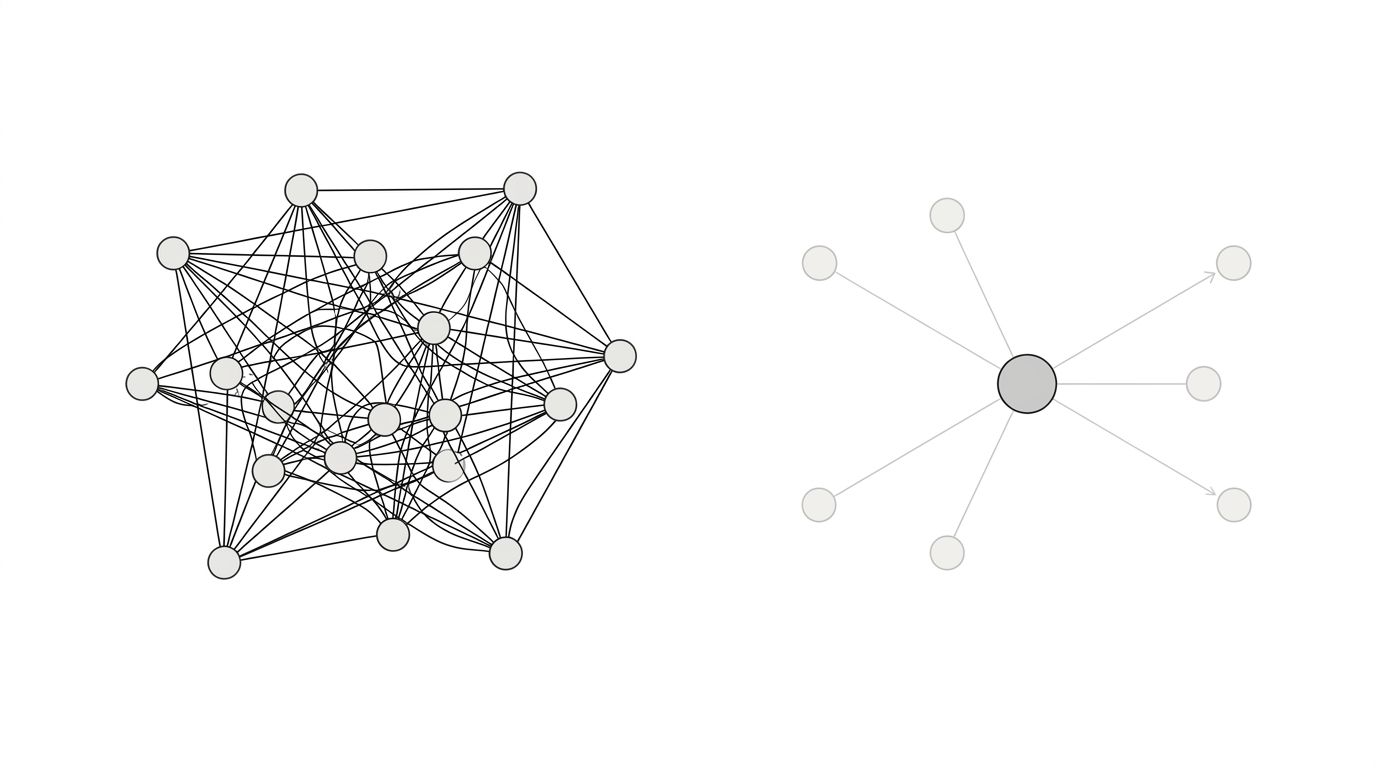
Keyword allocation doesn't end at the spreadsheet. The internal link structure needs to match. Every spoke page in a cluster should link to its hub pillar page with topically relevant anchor text. The pillar page should link back to each spoke. And spokes within the same cluster should cross-link to each other.
Where things break: orphan pages that belong to a cluster but receive zero internal links from cluster siblings. Or internal links that use the pillar's target keyword as anchor text on a spoke page, sending a competing signal. Understanding how site structure influences crawlability and authority flow is essential here — the link graph is the mechanism through which your allocation decisions become visible to Google.
Cindy Krum, a well-known mobile SEO expert, describes the evolution from optimizing for keywords to optimizing for entities and then journeys. Internal links are the connective tissue of those journeys. When your links match your allocation map, you're telling Google that a given pillar page is the authority on this topic and that the supporting pages explore specific facets. When your links contradict your map — pointing at the wrong pages, using mismatched anchors — the journey breaks down.
When Clusters Are Too Thin for Their Own Page
A less-discussed failure mode: splitting keyword clusters too finely and creating thin pages that can't rank individually. If you take a cluster of 40 related keywords and split it across 8 blog posts, each post targets only 5 keywords, has limited search volume, and lacks the depth to demonstrate topical authority through keyword placement.
The test is SERP overlap. Pull the top 10 results for the primary keyword in each proposed sub-cluster. If 7 or more results appear in both SERPs, Google treats those queries as the same topic. They belong on the same page. Wincher's clustering guide confirms that creating multiple pieces of content from keyword clusters improves site hierarchy and internal linking opportunities — but only when the clusters are genuinely distinct enough to justify separate pages.
The practical minimum for a standalone page: the cluster should have at least 3–5 keywords with distinct long-tail variations, combined monthly search volume worth targeting for your niche, and a SERP composition that differs meaningfully from sibling clusters. Anything below that threshold gets absorbed into a parent page as a section rather than spun off as its own URL.
What Still Isn't Settled
Search intent classification remains imperfect. Google's own SERPs often show mixed-intent results for mid-tail queries — a product comparison, a how-to guide, and a news article all ranking on the same page 1. When the SERP itself blends intents, allocating a keyword cluster to a single URL with a single format is a bet, and sometimes you'll bet wrong.
The role of AI Overviews adds another open question. Rishi Lakhani, a search strategist, suggests treating impression growth as a positive metric in its own right, recognizing that visibility in AI Overviews provides value even when users don't click through. If AI Overviews increasingly pull from pillar pages (which tend to have broader topical coverage), the allocation math might shift toward consolidating more clusters onto fewer, larger pages rather than distributing them across many spokes.
And entity-level authority — the idea that Google evaluates your site's expertise on named entities, not just keywords — is still evolving. Michael Bonfils has argued that "keywords are gone" in the traditional sense, replaced by FAQs and intent-rich content structures. That's an overstatement, but the direction is real: the allocation question is slowly shifting from "which page gets this keyword?" toward "which page best represents our authority on this entity?" For sites building a keyword research framework that scales beyond tool suggestions, that entity-first thinking should inform how clusters are defined in the first place.
None of this invalidates the core practice. One cluster, one URL, one clear intent — that principle holds. The edges are where the uncertainty lives, and the edges are where you'll need to revisit your allocation map quarterly as SERPs shift and Google's understanding of your site deepens.
OrganicSEO.org Editorial
Editorial team writing about Ethical, white-hat, organic SEO education.
Related Articles
Keyword Allocation Mastery: The Missing Link Between Research and On-Page SEO Success
Google's search results regularly surface two or three pages from the same domain competing for identical queries, none cracking the top five.

Keyword Research as Site Architecture Reverse-Engineering: How to Extract IA Decisions from Search Data
ClickRank's intent mapping documentation shows that sites assigning exactly one intent type per URL eliminate page-level content overlap entirely, because each URL resolves a distinct query class.
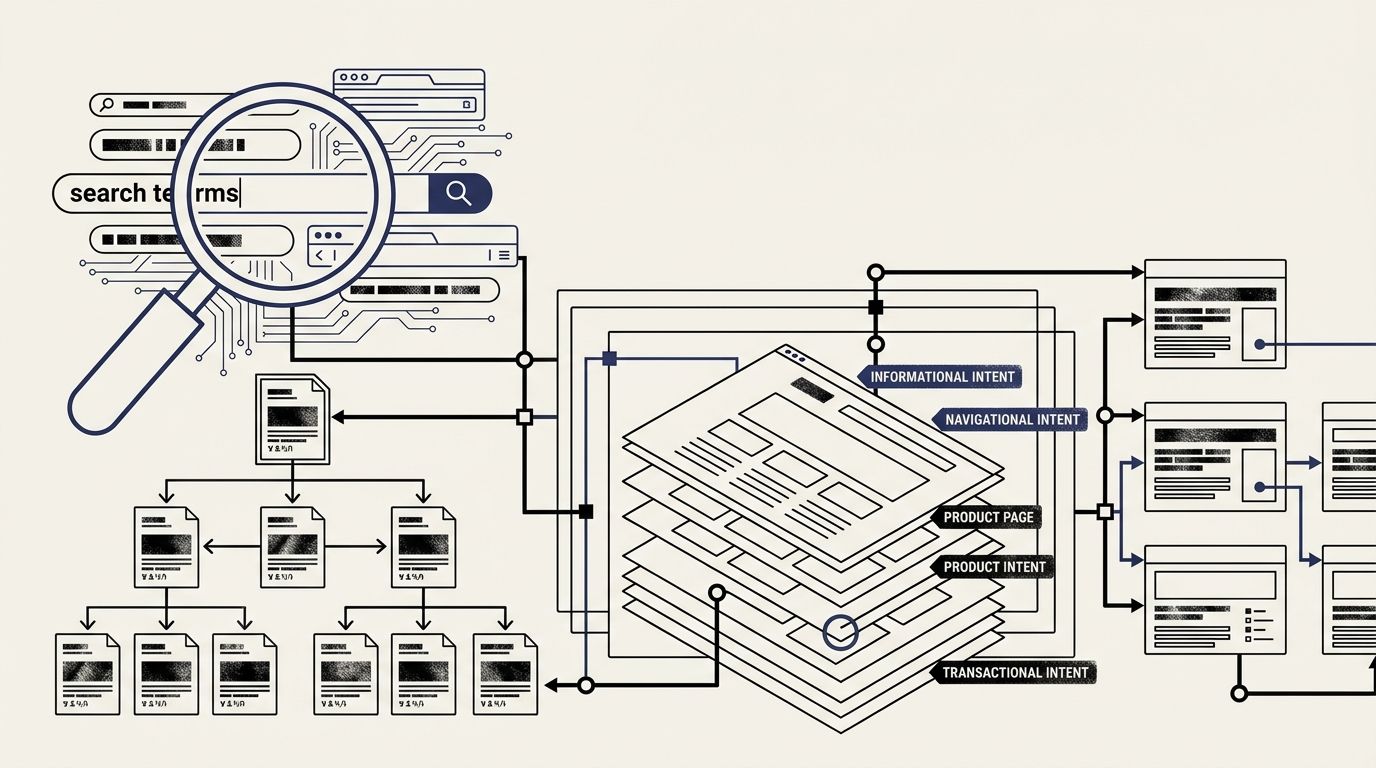
Keyword Research for Information Architecture: How to Map Search Intent to Site Structure Before Launch
Three methods dominate pre-launch keyword strategy for information architecture: SERP-driven intent mapping, topic cluster modeling, and user-task taxonomy. Each one produces a different site hierarchy, and 96.