Sales Questions as Keyword Gold: Mining Your CRM for Search Intent You're Already Missing
Your CRM already contains the highest-converting keyword list your SEO team will ever work from, and nobody on that team has opened it.

Sales Questions as Keyword Gold: Mining Your CRM for Search Intent You're Already Missing
Your CRM already contains the highest-converting keyword list your SEO team will ever work from, and nobody on that team has opened it. The sales questions logged in call notes, deal comments, and lost-deal fields map directly to high-intent search queries that third-party keyword tools either undercount or ignore entirely. This is the single biggest gap in B2B keyword research.
The Questions Your Sales Team Logs Are the Long-Tail Phrases People Actually Search
Every CRM with decent adoption contains thousands of unstructured text entries: discovery call notes, objection logs, email threads pasted into deal records, and "reason lost" fields. Inside that text sits the exact language your buyers use before they buy — or before they walk away.
This language is gold for sales questions keyword research because it's first-party and pre-qualified. A prospect who asked your sales rep "does your platform integrate with NetSuite?" almost certainly searched a variation of that phrase before or after the call. QuestionDB's analysis of SaaS keyword research that contributed to over $50 million in sales revenue found that copying recurring customer questions and phrases into a seed list captures "authentic customer language that drives high intent." These aren't hypothetical personas. These are real people, with real budgets, asking real questions.
The problem is that keyword tools display these queries as zero-volume or low-volume. A phrase like "does [your product] support HIPAA audit logs" might show 0–10 monthly searches in Ahrefs or Semrush. So the SEO team skips it. Meanwhile, the three people per month who do search that phrase are ready to buy, and they're landing on a competitor's FAQ page instead of yours.
When you're building a keyword framework from scratch, you'd typically start from seed keywords and expand outward using tool suggestions. CRM-driven first-party keyword discovery flips that process. You start from the end of the funnel — the actual buyer conversation — and work backward to the search query. The seed list writes itself.
Extracting Keywords from CRM Data Without Drowning in Noise
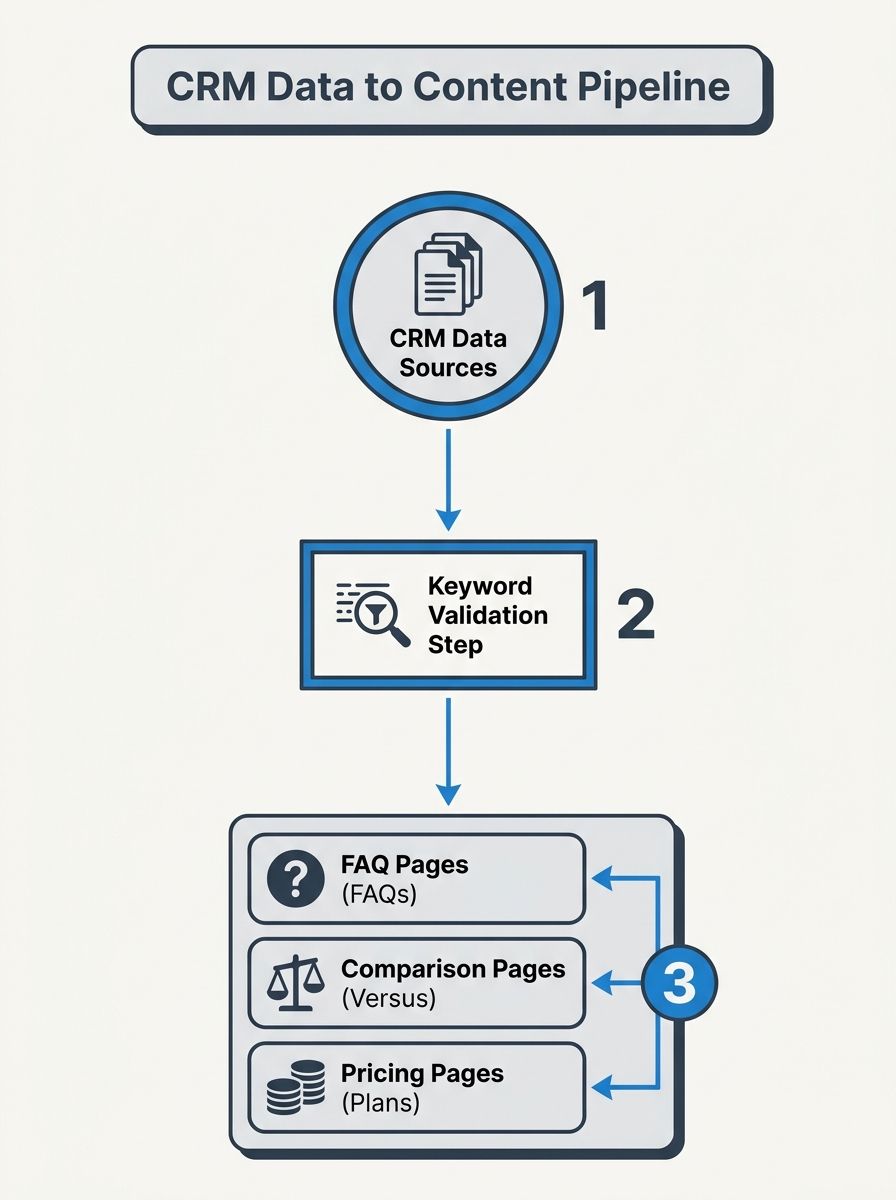
Pulling useful queries from a CRM isn't a matter of exporting every note field and dumping it into a spreadsheet. You need a filtering method. Here's what works:
Export "reason lost" and "competitor mentioned" fields first. These two fields contain the highest-intent language because they capture the exact moment a deal stalled or died. A reason-lost entry like "went with Competitor X because of their API documentation" tells you someone searched "Competitor X API docs" or "Competitor X vs [your product] API."
Search deal notes for question marks. Literal question-mark searches across your CRM's notes field surface the discovery-call and demo questions that mirror search queries. Filter for questions containing product-category terms.
Run the extracted phrases through a keyword tool to check volume and competition. Flag anything with keyword volume and low competition that's missing from your site. As Search Engine Land's guide to first-party content ideation points out, even products or services your customers search for that don't yet exist on your site can be sent to R&D for potential new offerings. That's how deep this data goes. And even zero-volume phrases deserve attention if they recur across 5+ deals. The volume exists; the tools can't measure it.
Group by buying stage. Early-funnel questions ("what is [category]?") go to educational content. Mid-funnel questions ("does [product] integrate with X?") go to feature pages or comparison content. Late-funnel objections ("why is [product] more expensive than Y?") go to dedicated objection-handling pages.
Customer Objection Keywords Convert at Rates That Embarrass High-Volume Terms
The second piece of evidence for CRM-driven SEO strategy comes from what happens when you actually publish content targeting customer objection keywords. These pages convert at rates that make your blog's top-traffic posts look like vanity projects.
SalesHive's research on objection-handling content found that pages built to preemptively answer buyer objections before they stall the sales process simultaneously improve rankings for high-intent keywords related to doubts and hesitations, and shorten the sales cycle by giving reps URLs to share during active deals. ALM Corp's 2026 analysis of high-intent SEO keywords reinforces this: FAQs built around edge-case objections cover long-tail commercial queries that individual product pages can't rank for on their own. Their conclusion: "Low volume is not the same as low value."
Consider the math. A blog post targeting "what is CRM software" might pull 12,000 monthly visits and convert at 0.3%, producing 36 leads. A page targeting "is [your product] secure enough for healthcare data" might pull 40 monthly visits and convert at 15%, producing 6 leads. The second page generates fewer leads in absolute terms, but each lead is 10–20x more likely to close. Pipeline value per visit isn't close.
Buyer intent keyword mapping works best when you organize objections by type. Here's a framework I call the Objection-to-Query Grid that maps CRM objection categories to content formats and keyword patterns:
Objection Type | Example CRM Language | Keyword Pattern | Content Format |
|---|---|---|---|
Price/Value | "Too expensive compared to X" | "[product] vs [competitor] pricing" | Comparison page |
Trust/Security | "Need SOC 2 compliance proof" | "[product] SOC 2 compliance" | Trust/security page |
Integration | "Won't work with our existing stack" | "[product] [platform] integration" | Integration docs |
Switching Cost | "Migration seems too risky" | "migrate from [competitor] to [product]" | Migration guide |
Feature Gap | "Doesn't have [specific feature]" | "[product] [feature] alternative" | Feature page or roadmap |

This grid turns a messy CRM export into a structured content calendar. Each row becomes a page. Each page targets a query your buyers are already searching. If you've been mapping keywords to your site architecture, this is where CRM data fills the gaps that third-party tools leave behind.
Third-Party Intent Tools Miss What Your Own Data Already Knows
Why does buyer intent keyword mapping fail at the tool level? Because third-party intent data platforms tell you that someone is researching a topic, not how they phrase the question. Your CRM doesn't have that limitation.
When a sales rep logs "prospect asked if we can handle 50,000 SKUs without performance degradation," you have the exact phrasing, the buying context, and the deal outcome all in one record. Intent data from Bombora or 6sense tells you "Company X is surging on inventory management software." Useful for an SDR building a call list. Useless for an SEO writing a page that needs to match a specific search query.
The data freshness gap matters too. Industry benchmarks show that intent signals decay rapidly, and the standard has shifted to daily or near-real-time updates through native CRM integrations with Salesforce, HubSpot, and Marketo. But even with real-time third-party signals, you're still working with topic-level data rather than query-level data. Umbraco's analysis found that 15–20% of their leads had engaged with intent sources like G2 before entering the CRM, which means the other 80–85% arrived through paths those platforms couldn't track at all.
Smartsheet's deployment of intent-triggered prioritization produced an 84% lift in MQLs and a 26% increase in opportunity rates. Those numbers are strong. But notice what drove them: tighter alignment between intent signals and sales action, not better keyword targeting. The keyword targeting still has to come from somewhere else. Your CRM is that somewhere else.
The practical upshot: if your SEO team and your sales team operate in separate tool stacks with no shared data pipeline, you're paying for intent platforms to approximate what your CRM already records in plain English. Before you invest in additional keyword research tools, audit what you already have.
The Claim, Pressure-Tested
The thesis here holds up under scrutiny, but it does have boundaries worth naming. CRM data is biased toward the buyers who actually talked to your sales team. People who researched your category and chose a competitor without ever contacting you don't appear in your deal notes. You still need keyword tools to find those queries. And you still need to map intent across your full site structure to avoid cannibalizing your own pages with overlapping objection content.
What CRM data solves, uniquely, is the language-match problem. Keyword tools give you volume estimates and difficulty scores for phrases that their crawlers have observed in the wild. They can't tell you which phrases your actual buyers use when they're three weeks from signing a contract. Your sales reps can. This is where sales questions keyword research bridges the gap between demand-generation metrics (traffic, impressions, rankings) and revenue metrics (pipeline, close rate, deal size).
The companies getting this right build a compounding advantage. Over 12 months, that recurring loop produces a first-party keyword discovery engine no competitor can replicate, because no competitor has your sales conversations, your objection patterns, or your win/loss language. The CRM isn't a supplementary data source for your SEO program. For buyer-intent queries, it's the primary one, and the keyword tools are the supplement.
OrganicSEO.org Editorial
Editorial team writing about Ethical, white-hat, organic SEO education.
Related Articles

When Keyword Research Data Conflicts With Ranking Reality: The Intent-Volume Paradox
Every major keyword tool defaults to sorting results by search volume descending. That single UX decision has trained an entire generation of SEOs to build content around the metric least predictive of whether a page will actually rank, earn clicks, convert visitors, or hold its position over time.

From Seed Keyword to Search Intent: Building a Keyword Research Framework That Scales Beyond Tool Suggestions
Every keyword tool on the market outputs the same four columns: search volume, keyword difficulty (a score from 0 to 100), CPC, and a one-word intent label.

Niche-First Keyword Research: Why Understanding Your Market's Sub-Topics Matters More Than Search Volume
Underserved niche markets convert at 3–5x the rate of high-volume keyword targets, according to UniK SEO's analysis of low-volume search segments. The mechanism is specificity: low-volume high-intent keywords filter out casual browsers and pull in users who are already close to a purchase decision.