From Seed Keyword to Search Intent: Building a Keyword Research Framework That Scales Beyond Tool Suggestions
Every keyword tool on the market outputs the same four columns: search volume, keyword difficulty (a score from 0 to 100), CPC, and a one-word intent label.

From Seed Keyword to Search Intent: Building a Keyword Research Framework That Scales Beyond Tool Suggestions
Every keyword tool on the market outputs the same four columns: search volume, keyword difficulty (a score from 0 to 100), CPC, and a one-word intent label. A seed keyword research strategy that stops at those four numbers produces a content calendar optimized for the tool's model of the world, not for the actual humans typing queries. The framework below treats those metrics as inputs to a decision, not as the decision itself.
The six rules that follow form what we call the Seed Escalation Framework: a repeatable process for taking any broad seed and qualifying it through six gates before you commit a single content resource. Each gate eliminates keywords that look good in a spreadsheet but fail in the real search environment.
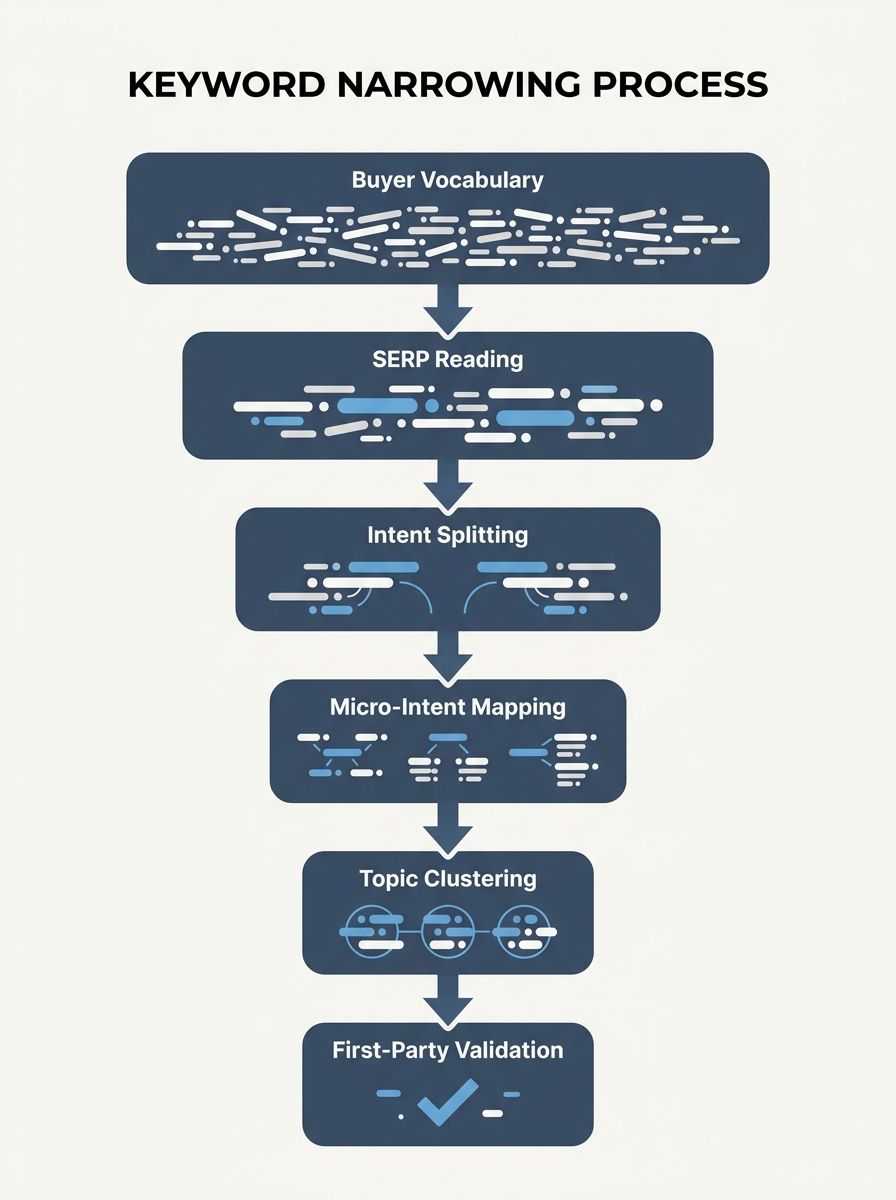
Pull your seeds from buyer vocabulary, not from the tool's suggestion box
The default workflow starts inside a keyword tool. You type your product category, scan the suggestions, sort by volume, and export. The problem is that the tool's suggestion algorithm reflects past query data, not the specific language your buyers use when they describe their problems.
First-party sources outperform tool suggestions for seed discovery because they capture the exact phrasing customers choose before they've been shaped by search autocomplete. CRM notes, support tickets, sales call transcripts, and internal site search logs contain phrases that keyword tools often miss entirely, since those tools surface terms based on aggregate search popularity rather than purchase-stage relevance. Effective seed discovery combines business insight, competitor review, tools, and community research into a single sourcing step rather than treating the tool as the starting point.
A practical sourcing protocol: export your 50 most recent support tickets, your 20 most recent sales objections, and your site search log from the past 90 days. Tag every noun phrase. You'll find 15-30 seed candidates the tool would never surface, because they're phrased the way a buyer talks ("CRM that doesn't require training") rather than the way a marketer categorizes ("CRM software features").
Read the SERP before you trust the intent label
Keyword tools assign intent labels (informational, navigational, commercial, transactional) using algorithmic classifiers trained on query modifiers. A query containing "buy" gets tagged transactional. A query containing "how to" gets tagged informational. These labels are correct roughly 60-70% of the time for unambiguous queries, but they break down on any seed keyword broad enough to matter strategically.
The only reliable keyword intent mapping method is reading the actual SERP. Google has already done the intent analysis through billions of click signals. When you search your seed and find 3 listicle comparisons, 2 product pages, and 1 how-to guide on page one, you're looking at fractional intent: Google itself isn't sure what users want, so it hedges. Mapping intent directly to live search engine results uncovers the exact, fractional goals of users far more accurately than any classifier label.
This connects to the broader practice of building a search intent map across your site, where SERP-level evidence replaces assumption-based categorization.
Split compound intent before assigning a page
Compound intent is what happens when a single seed keyword contains two or more distinct user goals that can't be served by a single page format. "CRM software" might mean "show me pricing" (commercial investigation), "explain what a CRM does" (informational), or "let me try one free" (transactional). Trying to serve all three with one page produces the content equivalent of a Swiss Army knife: adequate at everything, excellent at nothing.
Pogo-sticking (users clicking a result, bouncing back to the SERP, and clicking a different result) is a negative ranking signal that tells Google your page is irrelevant, regardless of how well-written it is. Compound-intent pages generate exactly this behavior. Gate three in the Seed Escalation Framework requires you to split each seed into its constituent intents and assign each to a separate content asset.
When your keyword research detects split intent, that's your signal to create 2-3 tightly focused pages rather than 1 broad one. If you've already published broad pages and they're stalling, the diagnosis might involve revisiting your content strategy at the plateau point rather than adding more content on top.

Go beyond four buckets into micro-intent segmentation
The standard informational/navigational/commercial/transactional model dates back to Andrei Broder's 2002 taxonomy. It was designed for web search in an era before mobile, before voice queries, before AI-generated answers. Treating it as the final word on intent classification means ignoring 20+ years of behavioral change.
Corey Morris's analysis of expanded search intent types identified 20+ distinct search behaviors that extend beyond the standard model, including post-purchase intent (queries like "how to set up my new CRM" or "return policy") that the four-bucket model ignores entirely. Nikki Brandemarte, Sr. SEO Strategist at NP Digital, recommends looking at "which pages and topics are driving the highest amount of nonbrand traffic to your competitors" because this reveals emerging intent patterns you can map content against.
Micro-intent segmentation means tagging each keyword candidate with context-specific modifiers: device type (mobile searches at 8 PM differ from desktop searches at 10 AM), buyer stage (awareness vs. evaluation vs. post-purchase), and format expectation (video, calculator, comparison table, step-by-step). This level of keyword research beyond tool metrics turns a flat spreadsheet into a dimensional decision matrix.
Cluster by topic authority, not by volume brackets
Volume-based clustering sorts keywords into tiers (high volume, medium volume, long tail) and prioritizes from the top down. This approach burns through content budgets on competitive head terms while leaving topical gaps that undermine your authority on the entire subject. Expanding seed keywords into topic clusters creates scalable, intent-aligned content frameworks that tools alone don't generate.
The clustering rule: group keyword candidates by the topic they serve, then assess whether you can credibly cover 80%+ of the subtopics within that cluster. If you can't, narrow the cluster or build content to fill the gaps before targeting the head term. This approach aligns with how site structure influences crawlability and authority flow at the architectural level.
A cluster built around the seed "email marketing" might include 40-60 subtopics ranging from deliverability to segmentation to A/B testing subject lines to compliance with CAN-SPAM and GDPR. If you only plan to publish 5 of those 40 subtopics, you don't have a cluster. You have 5 isolated articles competing against sites that cover all 40. Volume sorting would have told you to target "email marketing" first; topic-authority sorting tells you to build the supporting content first and target the head term last.
Tools like Google Keyword Planner, Semrush, and Ahrefs offer insights into search trends and related queries that help you map cluster boundaries. But the decision about which clusters to pursue depends on your existing coverage, your production capacity, and your competitive position. When evaluating which keyword research tools earn their cost, measure them by how well they support clustering decisions, not by how many raw keyword suggestions they generate.

Validate seeds against first-party data before you commit
The final gate in the Seed Escalation Framework is the one most teams skip: checking your keyword candidates against your own performance data. Google Search Console shows you the queries people already use to find your site. GA4 shows you which landing pages convert. Your CRM shows you which customers came from organic search and what they bought. If you're not connecting these three data sources, you're making keyword decisions in a vacuum.
Validation means answering three questions for every seed keyword that survives gates 1-5. First, do you already rank for any long-tail variants of this seed (check GSC for position 4-20 keywords you haven't optimized)? Second, do pages on this topic already convert at a rate above your site median (check GA4 landing page reports)? Third, have customers who arrived through related queries become high-value accounts (check CRM attribution)? If you're struggling to set up attribution you trust in GA4 and GSC, that's a prerequisite worth solving before scaling your keyword research process further.
A keyword that passes all six gates (buyer vocabulary sourced, SERP read, intent split, micro-intent tagged, topic-clustered, first-party validated) is one you can commit content resources to with confidence. A keyword that only passes 3 of 6 is a candidate worth revisiting in 90 days, not a priority for this quarter.
When These Rules Collapse
These six gates assume you have enough data to run them. A brand-new site with zero organic traffic, no CRM history, and no support tickets can't validate against first-party data because there is no first-party data. In that case, gates 1 and 6 collapse into educated guesswork, and gates 2-5 carry all the weight.
The framework also assumes your topic space is competitive enough to require this level of rigor. If you're operating in a niche with fewer than 10 competing domains and keyword difficulty scores consistently below 15, you can often skip micro-intent segmentation entirely and win with solid topical coverage and decent on-page work.
And one more caveat worth naming: the Seed Escalation Framework is a qualification process, not a content production system. It tells you which keywords deserve your investment. It doesn't tell you how to write the page, structure the content, or build the links. Those are separate disciplines with their own rules, and confusing keyword selection with content execution is how teams end up with 200 well-researched keywords and 200 mediocre pages targeting them.
OrganicSEO.org Editorial
Editorial team writing about Ethical, white-hat, organic SEO education.
Related Articles

The Seed Keyword Expansion Playbook: Moving Beyond Single Terms to Semantic Clusters Without Tool Dependency
Google's algorithmic evolution from Hummingbird through BERT and MUM turned single-keyword targeting into a losing strategy.

Niche-First Keyword Research: Why Understanding Your Market's Sub-Topics Matters More Than Search Volume
Underserved niche markets convert at 3–5x the rate of high-volume keyword targets, according to UniK SEO's analysis of low-volume search segments. The mechanism is specificity: low-volume high-intent keywords filter out casual browsers and pull in users who are already close to a purchase decision.

When Keyword Research Data Conflicts With Ranking Reality: The Intent-Volume Paradox
Every major keyword tool defaults to sorting results by search volume descending. That single UX decision has trained an entire generation of SEOs to build content around the metric least predictive of whether a page will actually rank, earn clicks, convert visitors, or hold its position over time.