SEO Tools That Actually Earn Their Subscription: A 2026 Operator's Stack
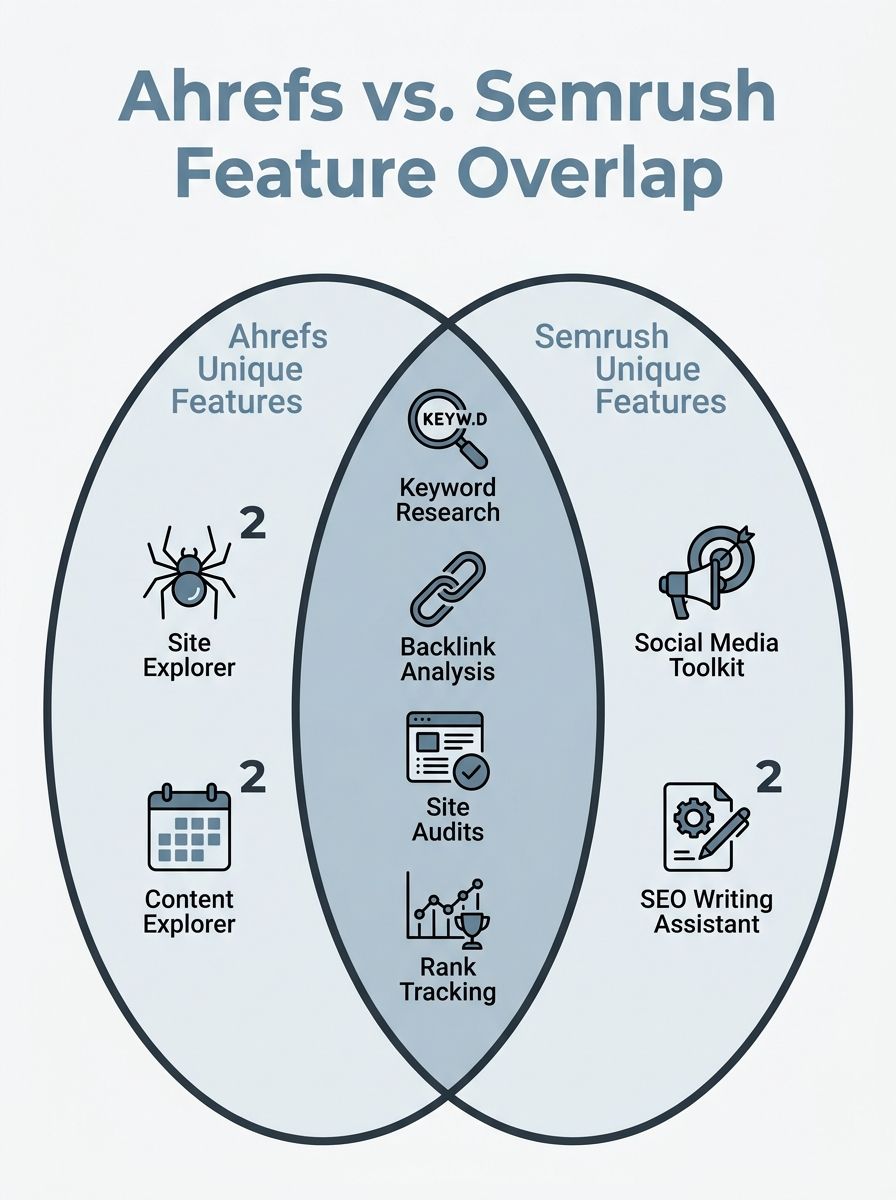
Seventy percent of what Ahrefs does, Semrush also does, and vice versa. The keyword databases differ at the margins, the backlink indexes vary by a few percentage points in coverage, and each platform has a handful of proprietary features the other lacks.
SEO Tools That Actually Earn Their Subscription: A 2026 Operator's Stack
Seventy percent of what Ahrefs does, Semrush also does, and vice versa. The keyword databases differ at the margins, the backlink indexes vary by a few percentage points in coverage, and each platform has a handful of proprietary features the other lacks. But if you're paying $249/month for Semrush Standard and $249/month for Ahrefs Standard, you're spending close to $6,000 a year on tooling that's mostly duplicated. The average SEO software stack costs operators between $400 and $900 per month, and a significant chunk of that spend buys you the same data presented in different dashboards.
The contrarian claim is simple: you need fewer paid SEO tools than the industry tells you, and the ones you keep should be doing something your free alternatives genuinely can't.
The Overlap Problem Nobody Talks About
The Ahrefs vs Semrush debate has been running for a decade, and it's gotten stale because both tools are genuinely good. Both offer keyword research with volume estimates, keyword difficulty scores, and SERP feature analysis. Both provide backlink databases that index billions of pages. Both include site audit tools that catch broken links, redirect chains, missing meta tags, and crawl errors. Both now ship some form of AI-powered content optimization scoring.
Differences between them are real but narrow. Ahrefs' backlink index tends to discover new links faster. Semrush's keyword database is larger in raw count, covering more country-level variations. Semrush bundles advertising research and social media tracking that Ahrefs doesn't attempt. Ahrefs' Content Explorer is better for prospecting link-worthy content ideas. According to a pricing analysis by Sight AI, Semrush starts at $129/month for the Lite tier, climbing to $249/month for Standard and $449/month for Advanced. Ahrefs sits in a similar range. If you're running both, the overlap gets expensive fast.
Here's the honest SEO tools comparison: pick one. If your work is heavily content-driven and you rely on topic cluster mapping and content gap analysis, Semrush's workflow is slightly stronger. If your work tilts toward link analysis and you want faster backlink discovery with a cleaner interface, Ahrefs wins. Running both tools simultaneously wastes budget for anyone who isn't operating an agency serving dozens of clients with different inherited toolsets.
And this overlap problem extends beyond the two headliners. Tools like SE Ranking, Moz Pro, and Similarweb each cover 60-80% of the same ground. A G2 comparison testing Ahrefs, Moz, Clearscope, SE Ranking, Seobility, and Similarweb across standard SEO workflows found substantial feature convergence. Differentiation lives in niche capabilities, UI preferences, and data freshness rather than in any fundamental gap in coverage.
Free SEO Tools That Replace Half Your Stack
Google Search Console remains the most underused tool in any SEO software stack. It provides exact query data for your own site, real crawl statistics from Googlebot, Core Web Vitals measurements, index coverage reports, and manual action notifications. No paid tool can replicate this data because it comes directly from Google's own systems. Everything else is an estimate. GSC is ground truth.
For site audits specifically, you don't always need to pay. Seomator's free SEO audit tool runs a professional-grade analysis that catches the same issues most paid site audit tools flag: broken links, missing alt text, slow-loading resources, thin content pages, and canonicalization errors. It's limited in scale, sure. But for operators running sites under 500 pages, a free audit tool paired with Google Search Console covers the diagnostic baseline. Semrush also offers a free site audit checker that runs 140+ technical and on-page checks without requiring a paid subscription, though the depth and crawl limits are capped.
Google's Lighthouse and PageSpeed Insights remain the definitive free tools for performance analysis. If your on-page optimization workflow doesn't start with Lighthouse scores, you're skipping the diagnostic step that costs $0 and catches the most common technical issues.
AnswerThePublic, now owned by NP Digital, visualizes search queries around question frameworks like how, what, why, when, and where. It's useful for finding the queries real people actually type, and its free tier still generates enough data for initial content planning. Google Trends, the Keyword Planner (with an active Ads account), and even autocomplete scraping tools cover broad keyword research without a subscription.
The honest assessment: free SEO tools handle about 50-60% of what a working operator needs. They fall short on competitive intelligence, historical trend data, backlink monitoring at scale, and automated alerting. Those gaps are exactly where paid subscriptions earn their cost.
Where Paid Subscriptions Actually Earn Their Cost
If free tools cover diagnostics and basic keyword research, what's left worth paying for? Three capabilities consistently justify a paid subscription, and they all share a common trait: they give you information about things you don't own or control.
Competitive backlink intelligence
You can audit your own backlinks in Search Console. You cannot see your competitors' backlinks there. Understanding who links to competing content, which pages attract editorial links, and where your link gap sits requires a paid backlink index. This is the core reason most operators keep Ahrefs or Semrush. The backlink data enables the kind of white-hat link building that moves rankings, because you can identify prospects based on who already links to similar content in your niche.
Historical keyword and visibility tracking
Free tools show you snapshots. Paid tools show you trends over months and years. Knowing that a competitor's traffic dropped 40% after a core update, or that a keyword's search volume has steadily declined over 18 months, requires historical data that free tools simply don't store. Semrush and Ahrefs both maintain multi-year keyword databases and domain visibility histories. For operators making strategic decisions about which topics to pursue, this historical context prevents you from chasing declining queries or entering markets that already peaked.
Automated crawling and monitoring at scale
Site audit tools that run weekly crawls, flag new issues via email, and track issue resolution over time are genuinely worth paying for if your site exceeds a few hundred pages. As a review of the best site audit tools notes, free tools need to be "paired with another platform for scale and granularity." Botify and Screaming Frog's paid version handle sites with millions of URLs, catching crawl budget waste and indexation problems before they tank traffic. At that scale, the subscription pays for itself in prevented losses.
Search Engine Land published a useful framework for evaluating whether SEO tools are actually earning their cost, noting that many platforms still center on keyword tracking and visibility metrics that, while useful, don't address newer requirements like AI overview monitoring and LLM visibility. As AI-generated answers reshape how searchers interact with results, the best SEO tools in 2026 will need to track citation patterns alongside traditional ranking positions. Tools that identify competitive gaps through AI-powered analysis are already moving in this direction, adding features that monitor whether your content appears in AI overviews and generative search summaries.
The Claim, Pressure-Tested
So does the thesis hold up? Can an operator genuinely run a competitive SEO program with fewer paid subscriptions than the industry standard?
The evidence says yes, with caveats. Google Search Console, Lighthouse, and free audit tools handle the diagnostic and on-page baseline for sites under a few hundred pages. One paid all-in-one tool, either Ahrefs or Semrush, covers competitive intelligence, backlink analysis, historical data, and automated monitoring. That's a total monthly spend of $129-$249, not $400-$900.
Those caveats matter, though. Enterprise sites with millions of pages need Screaming Frog, Botify, or seoClarity for crawl-level analysis that all-in-one tools can't match. Agencies managing many client accounts may need specialized reporting platforms. And as AI overviews reshape how search engines surface and rank content, new tool categories will likely earn a permanent slot in the stack. The LLM visibility monitoring space is young, and nobody has a clear winner yet.
But for the solo operator, the small team, the in-house SEO running one to five domains, the subscriptions worth keeping in 2026 are the ones doing something your free alternatives can't replicate. Audit your tool spend against that standard, and you'll probably find at least one subscription you can cancel by the end of the month.
OrganicSEO.org Editorial
Editorial team writing about Ethical, white-hat, organic SEO education.
Frequently Asked Questions
- What's the difference between Ahrefs and Semrush for SEO?
- Both tools cover similar core features like keyword research, backlink analysis, and site audits with only marginal differences. Ahrefs discovers new backlinks faster and has a better Content Explorer for link prospecting, while Semrush has a larger keyword database and includes advertising research and social media tracking. For most operators, choosing one tool over the other is sufficient since running both creates expensive overlap.
- How much does the average SEO software stack cost per month?
- The average SEO software stack costs operators between $400 and $900 per month, though much of that spending duplicates functionality across tools. A more efficient approach using free tools and a single paid platform like Ahrefs or Semrush can reduce this to $129-$249 monthly.
- What free SEO tools replace paid subscriptions?
- Google Search Console provides exact query data and crawl statistics directly from Google, Seomator and Semrush's free audit tools catch technical issues, Google Lighthouse measures performance, AnswerThePublic visualizes search queries, and Google Trends and Keyword Planner support keyword research. Free tools handle about 50-60% of what working operators need.
- What should you actually pay for in SEO tools?
- Paid subscriptions earn their cost in three areas: competitive backlink intelligence (analyzing competitors' links), historical keyword and visibility tracking (trends over months and years), and automated crawling at scale for large sites. Everything else has a free equivalent worth using first.
- Do you need both Ahrefs and Semrush?
- No. Running both tools simultaneously wastes budget since they overlap by 70% in functionality. Pick one based on your priorities: Semrush for content-driven work and topic clustering, or Ahrefs for link analysis and faster backlink discovery.
- What's the minimum SEO tool stack for a solo operator?
- Google Search Console, Lighthouse, free audit tools, and one paid all-in-one platform like Ahrefs or Semrush Standard ($129-$249/month) provides competitive intelligence and historical data that free tools cannot replicate. This covers most operators running one to five domains.
- When should you use paid site audit tools instead of free ones?
- Free site audit tools work for sites under a few hundred pages, but paid tools like Screaming Frog and Botify become necessary for sites with millions of URLs to handle automated weekly crawls, email alerts, and scale monitoring that prevents crawl budget waste.