Entity Consistency Across Your Site: The Often-Missed Technical SEO Foundation
Entity consistency SEO is the practice of naming, describing, and marking up every person, organization, product, or concept identically across every page, schema block, and social profile your brand controls.

Entity Consistency SEO: 6 Rules That Keep Your Site Graph Clean
Entity consistency SEO is the practice of naming, describing, and marking up every person, organization, product, or concept identically across every page, schema block, and social profile your brand controls. When entity names drift, search engines split your authority across what they interpret as separate things.
The six rules below form a framework we call the Entity Naming Integrity (ENI) checklist: pick one name, wire the graph, audit what exists, align anchors, validate against rendered output, and commit to the timeline. Each rule is simple. Each one breaks in specific, predictable situations.
Pick one canonical name for each entity and enforce it site-wide
Every entity your site references (your brand, your founder, your products, your service categories) needs exactly one canonical string. That string goes into your JSON-LD, your title tags, your navigation labels, your image alt attributes, and your social profiles. No abbreviations. No stylized variants. No switching between "Dr. Jane Smith" on the team page and "J. Smith, PhD" in the blog byline.
Google's Knowledge Graph builds confidence through repetition. According to Stackmatix's 2026 guide to entity-based SEO, "initial schema implementation can show results in weeks, but significant Knowledge Graph recognition typically takes 6-12 months of consistent entity building." Every inconsistent mention during that window resets the clock.
Create a reference document: a single spreadsheet listing each entity, its canonical name, any known Knowledge Graph ID, and the sameAs URLs (Wikipedia, Wikidata, LinkedIn, Crunchbase) that confirm it. Content Whale's entity SEO guide is direct about the structural requirement: "Start with a main entity in the introduction. Follow it with clearly connected subtopics throughout the post. Use subheadings, bulleted lists, and consistent terminology." That consistency starts with the name itself.
When does this rule bend? Multilingual sites sometimes need localized entity names ("München" vs. "Munich"). In those cases, use the hreflang attribute to signal the relationship and keep each locale internally consistent within its own language.
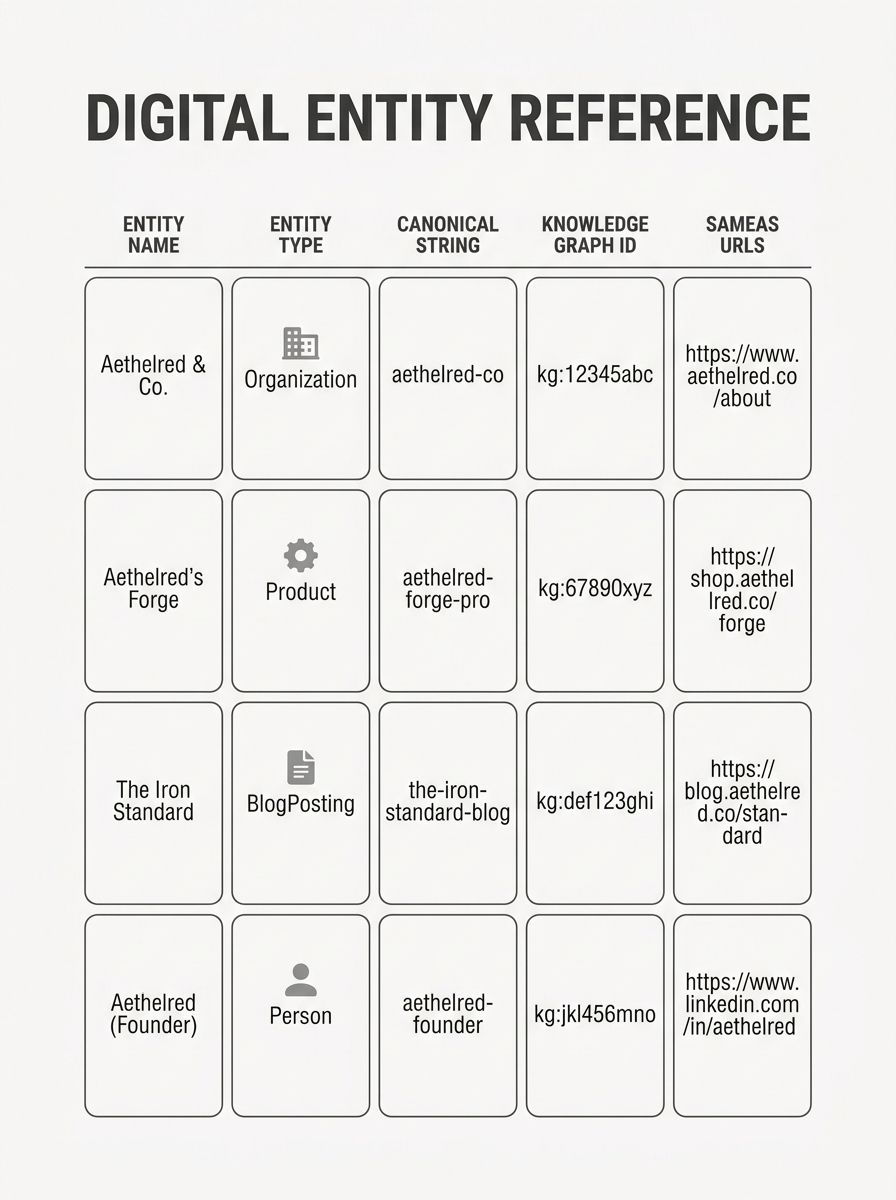
Wire your schema graph with @id identifiers
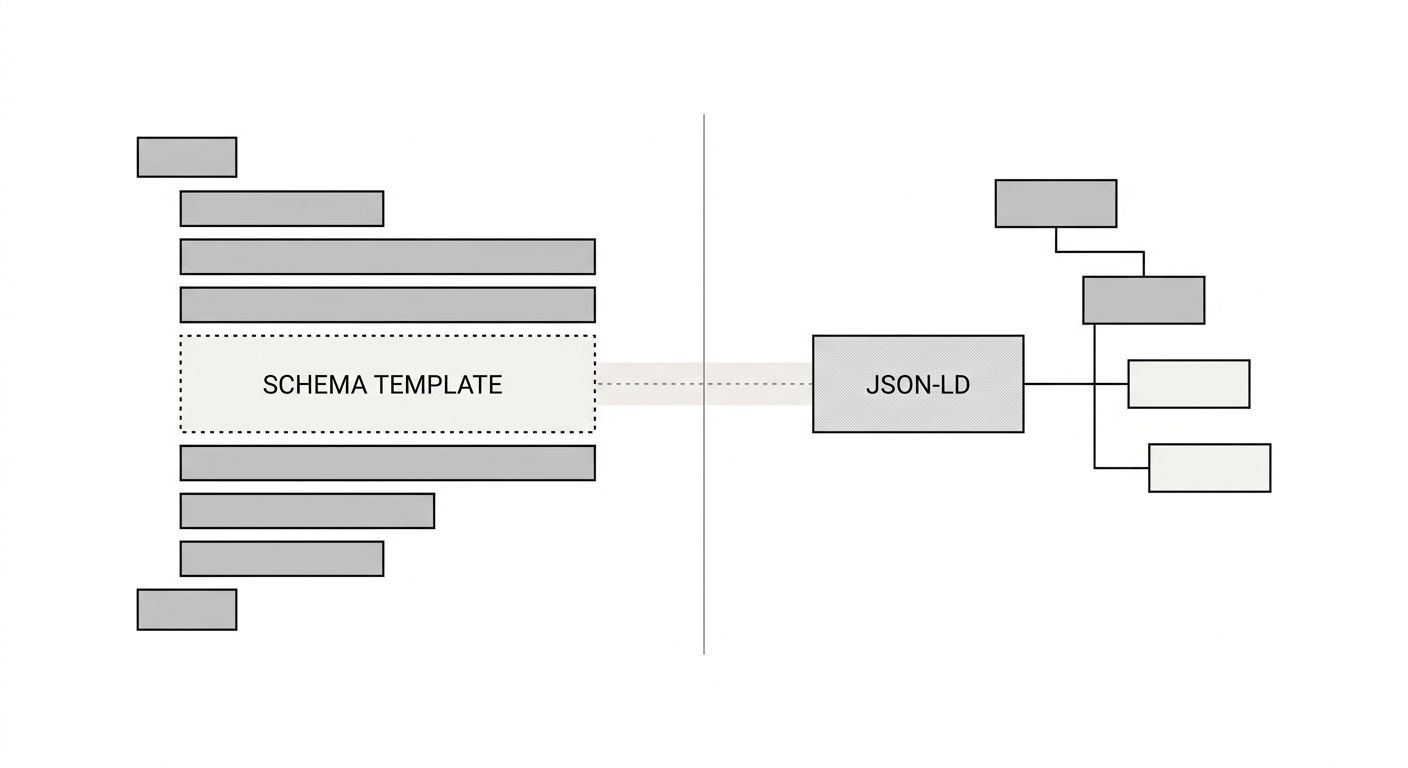
Structured entity naming means nothing if your schema blocks exist as disconnected islands. Every JSON-LD block on your site should reference shared @id values so Google can stitch the graph together. Your Organization entity on the homepage gets an @id (typically your domain URL followed by a fragment like #organization). Your Article schema on a blog post references that same @id in its publisher field. Your Person schema for authors references the Organization @id in their worksFor field.
The 2026 schema markup reference from Digital Applied is explicit: "Use @id identifiers to connect related entities (Organization to Person, Article to Organization) across your site graph." Without those connections, you have 47 pages of markup that Google reads as 47 unrelated claims about 47 unrelated things.
Google Search Central's own documentation confirms that all 3 supported structured data formats (JSON-LD, Microdata, RDFa) are equally valid, though Google recommends JSON-LD as the easiest to implement and maintain. Stick with one format across your entire site. Mixing Microdata on product pages with JSON-LD on blog posts creates parsing inconsistencies that are hard to debug. If you're building out your on-page optimization for the first time, start with JSON-LD everywhere and don't look back.
Search Engine Land's guide to entity-first SEO describes the process editorial teams should follow: define the page's meaning, then "translate that meaning into structured data, implementing schema, @id, and sameAs attributes to connect pages to recognized entities." The order matters. Meaning first, markup second.
Audit your existing metadata before writing new markup
The most common mistake in technical SEO entity recognition is adding new schema to a site that already has broken, contradictory, or orphaned metadata. A metadata consistency audit should always precede new structured data work.
A case study from BPL Database illustrates the scale of drift that accumulates silently: a single bank's metadata review uncovered 200,000 records with invalid "Account_Status" tags, along with legacy tags from 2015 that were still clogging internal search results. SEO metadata drifts the same way. Title tags written by three different agencies over 4 years. Description meta tags that reference products discontinued 2 years ago. Schema blocks copy-pasted from a template that names the organization differently than the current brand guidelines specify.
The Metadata Governance Checklist outlines 5 sequential steps: audit current metadata and identify gaps, set measurable goals with assigned ownership, understand regulatory requirements, implement classification and access standards, and deploy monitoring tools like Collibra or Alation. For SEO-specific audits, the process is similar but the targets differ. You're checking for: matching Organization names across all JSON-LD blocks, consistent author Person entities, accurate sameAs URLs that still resolve, and BreadcrumbList schemas that reflect your actual site architecture.
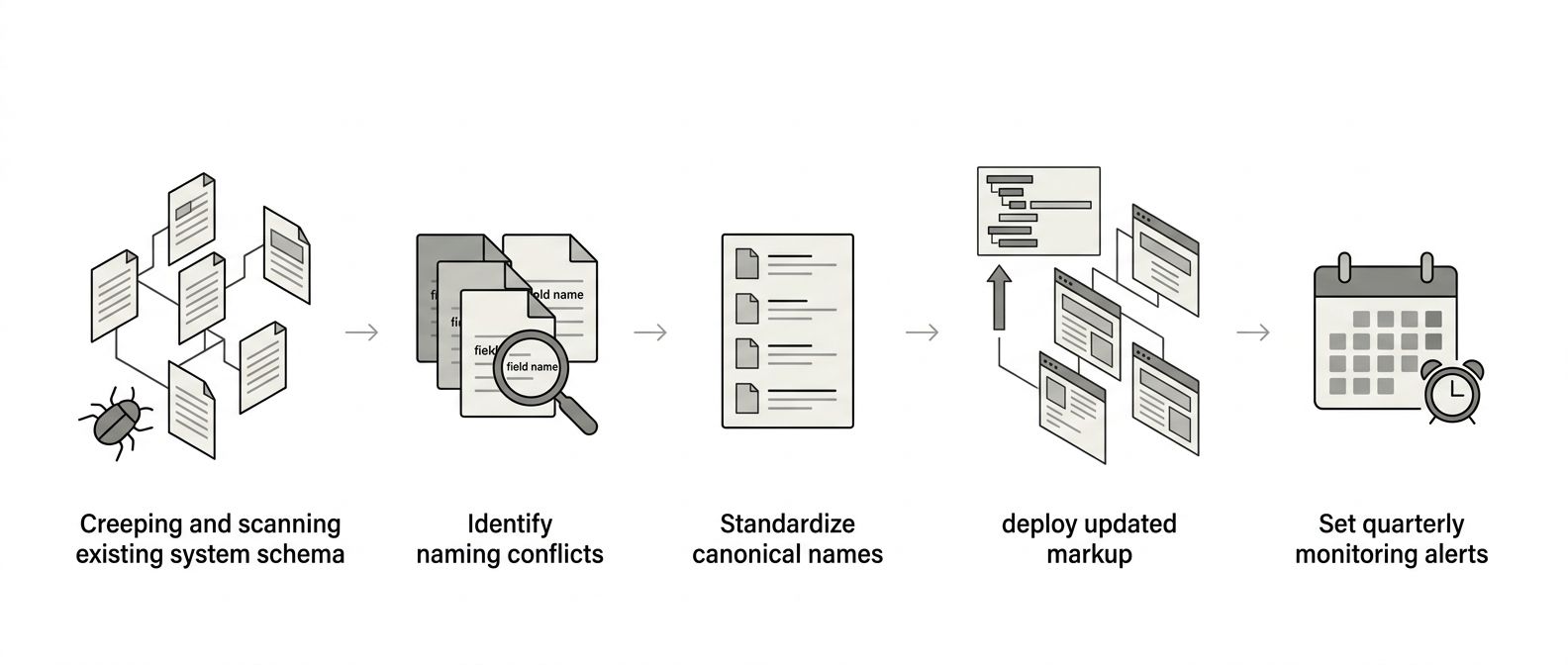
Match your internal anchor text to your entity names
Entity consistency extends beyond schema into the words you use when linking between your own pages. Google's link best-practices documentation states that "anchor text tells people and Google something about the page being linked to" and that good anchor text should be "descriptive, concise, and relevant." The guide also specifies that every important page should have at least one link from another page on the site.
This means your internal linking language is an entity signal. If your canonical entity name for a service is "Enterprise Cloud Migration," don't link to that page with anchor text reading "our cloud services," "migration solutions," or "click here." Use the entity name or a close natural variant. When you're debugging SEO inconsistencies across a large site, anchor text mismatches are one of the first things to check. They're easy to fix and the impact on entity recognition compounds over time.
Sites practicing white hat SEO already understand that link quality matters more than link volume. The same principle applies to internal anchor text: 10 links using your exact entity name are worth more for entity recognition than 50 links with vague or varied anchors.
Validate structured data against live rendering, not source code
A surprising number of entity markup errors survive because teams validate their JSON-LD against the raw HTML source rather than the rendered DOM. If your schema is injected by JavaScript (which is common with tag managers, React-based sites, and plugin-generated markup), the source code may show a template placeholder while the rendered page shows the actual populated values. Or worse, the rendered page shows nothing because a script failed silently.
Google's Rich Results Test renders the page before validation, which is correct. But many third-party schema validators parse source HTML only. If you're relying on a crawl tool that doesn't execute JavaScript, you're validating markup that your users (and Googlebot) never see. Run your validation against 3 different sources: Google's Rich Results Test (rendered), your crawl tool's JavaScript-rendered audit mode, and a manual spot-check using the browser's developer tools to inspect the live DOM.
This is especially critical for sites with 500+ pages generated from templates. A single variable error in the template (a missing @id reference, a misspelled Organization name, a null author field) propagates to every page using that template. Catch it in rendered output, not in source.
Firebrand Technologies' metadata audit guidance reinforces this point: "It's not enough for metadata to be complete, it must be effective." Completeness means every field is populated. Effectiveness means every field is accurate, current, and consistent with the canonical entity name you've established.
Treat Knowledge Graph recognition as a 6-to-12-month project
Structured entity naming produces compounding results, but the timeline is longer than most teams expect. The 6-to-12-month window cited in the Stackmatix research represents the time between initial schema deployment and meaningful Knowledge Graph recognition. During that period, consistency is everything. One renamed product, one rebrand of a subsidiary, one conflicting sameAs URL can fragment the entity signal Google has been accumulating.
Build your SEO measurement framework with entity recognition milestones baked in. Track whether your brand's Knowledge Panel appears, whether it pulls the correct logo and description, whether your key people show up with their proper affiliations. These are lagging indicators, but they confirm the entity graph is consolidating.
Geordy AI's entity recognition glossary is clear about the prerequisite: "Implement schema.org markup to explicitly identify entities and their attributes." That implementation is day one. Months 2 through 12 are about disciplined repetition, quarterly audits, and resisting the urge to rename things for stylistic reasons.
When These Rules Collide
These 6 rules work cleanly on a single-brand site with a stable product line and one content team. They get complicated when a parent company operates 4 sub-brands with overlapping service names, or when a merger creates 2 competing canonical names for the same entity, or when a product rebrand happens mid-quarter and the old name has 8 months of schema history.
In those cases, prioritize @id continuity over name consistency. If you rename an entity, keep the same @id value and update the name property across all pages in a single deployment. Don't let 30% of your pages carry the old name while the other 70% show the new one. A clean cutover preserves the graph. A gradual rollout fragments it. Run the metadata consistency audit immediately before and 2 weeks after any entity rename, and compare tag completeness scores across both snapshots. The delta tells you whether the migration held or introduced new drift.
OrganicSEO.org Editorial
Editorial team writing about Ethical, white-hat, organic SEO education.
Related Articles
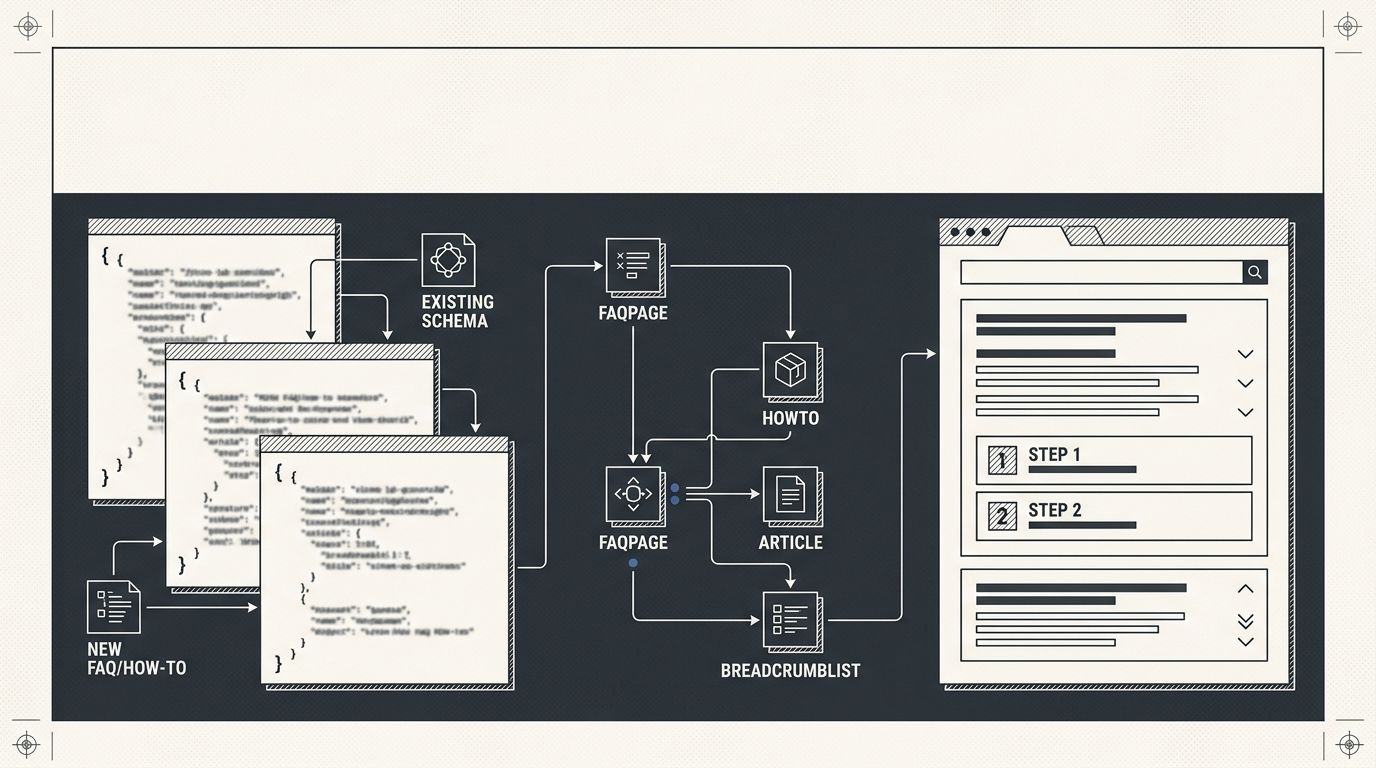
How to Implement Structured Data for FAQs and How-Tos Without Breaking Your Existing Schema
Google retired FAQ rich results on May 7, 2026, removing the expandable accordion from search listings. FAQPage schema still functions for Bing, Perplexity, and AI extraction. HowTo structured data retains full Google rich result eligibility.
The SEO Debugging Checklist: How to Diagnose Visibility Drops Systematically (Not Frantically)
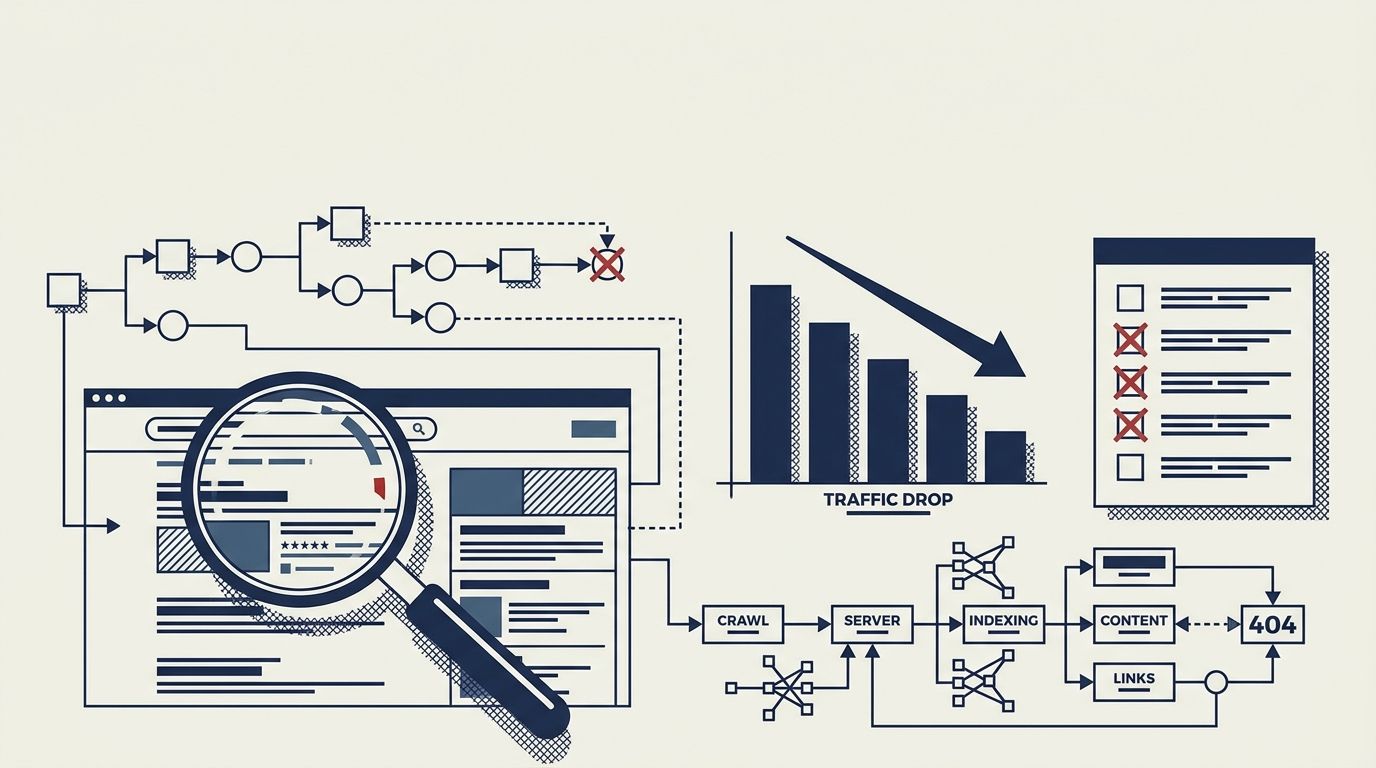
Diagnosing organic traffic drops requires a bottom-up diagnostic sequence through five layers: Crawl, Render, Index, Rank, and Click. Fixing lower layers first prevents wasted hours rewriting content that Google never crawled in the first place.

7 Canonical Tag Mistakes That Quietly Drain Crawl Budget and Authority (and How to Fix Them)
Audits across more than 1,000 brand websites consistently rank rel canonical misconfiguration among the top 10 technical SEO issues that erode rankings. These errors fragment link equity, waste crawl budget on duplicate URLs, and suppress pages from Google's index without any visible warning.