Ahrefs vs. Semrush for Keyword Research in 2026: Which Tool Actually Wins Where It Counts
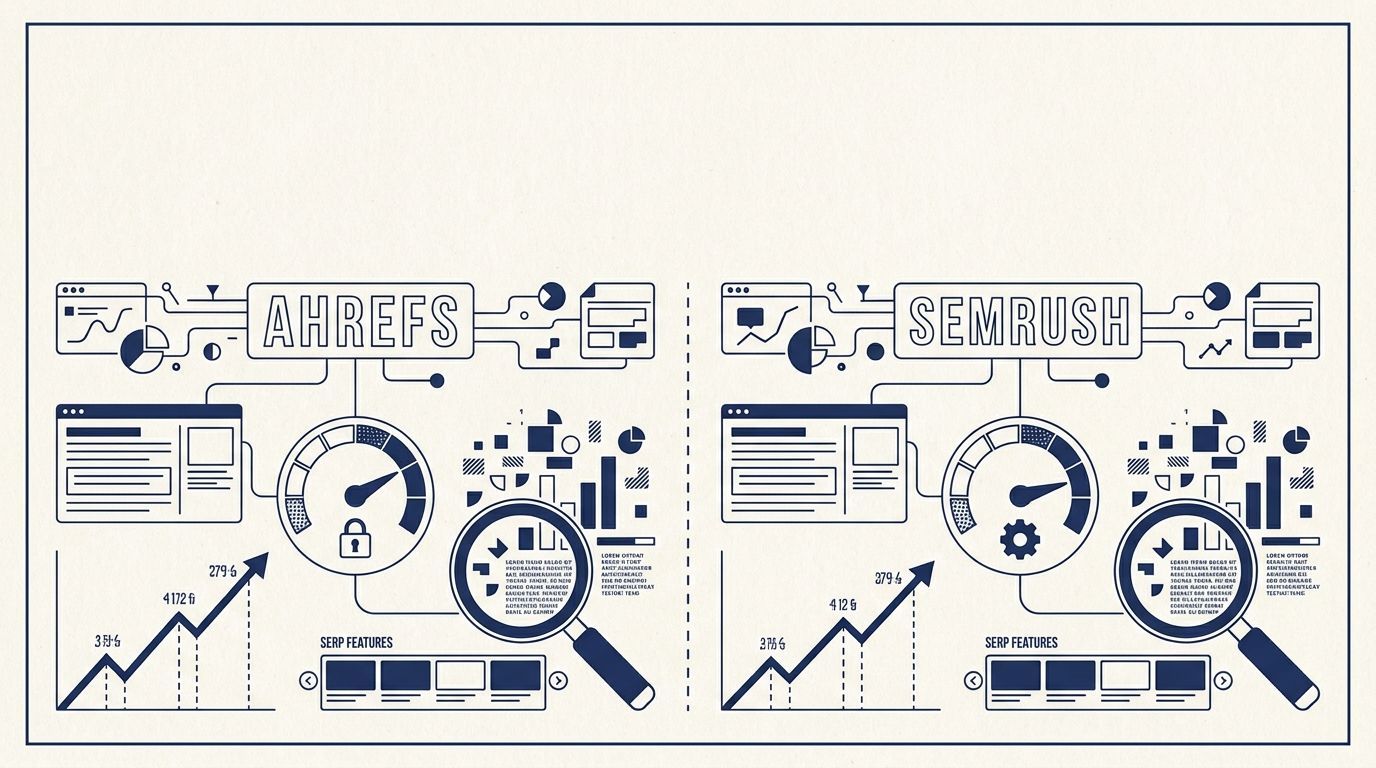
Ahrefs and Semrush pull keyword data from fundamentally different pipelines — different crawlers, different clickstream providers, different difficulty algorithms.
Ahrefs vs. Semrush for Keyword Research: Which Tool Actually Wins Where It Counts
Ahrefs and Semrush pull keyword data from fundamentally different pipelines — different crawlers, different clickstream providers, different difficulty algorithms. The same keyword typed into both tools regularly produces two different difficulty scores, two different volume numbers, and two different pictures of the SERP. Understanding how each pipeline works tells you which tool to trust for which decision.
How the Keyword Databases Get Built
Both tools maintain keyword databases in the billions, but they source and refresh that data differently, which creates downstream disagreements in every metric they report.
Semrush's Keyword Magic Tool draws from a pool of approximately 27.3 billion keywords globally, with 3.7 billion of those specific to the United States. The data comes from a blend of clickstream feeds purchased from third-party browser extensions and panel providers, combined with proprietary machine-learning models that extrapolate volume for long-tail queries where clickstream coverage is thin. Semrush refreshes its US keyword data more aggressively than most international databases, which partially explains why its US-based search volume reliability tends to outperform its estimates for smaller markets.
Ahrefs' Keywords Explorer pulls from a database of roughly 28.7 billion keywords. The raw size is comparable, but Ahrefs' data pipeline emphasizes a different output: alongside standard volume and difficulty, it calculates a "Clicks" metric and a "Traffic Potential" figure that try to model actual user behavior after the search happens. Ahrefs also relies heavily on its own crawler, AhrefsBot, which ranks among the most active web crawlers by volume. That crawler feeds the backlink index, which in turn informs the difficulty algorithm.
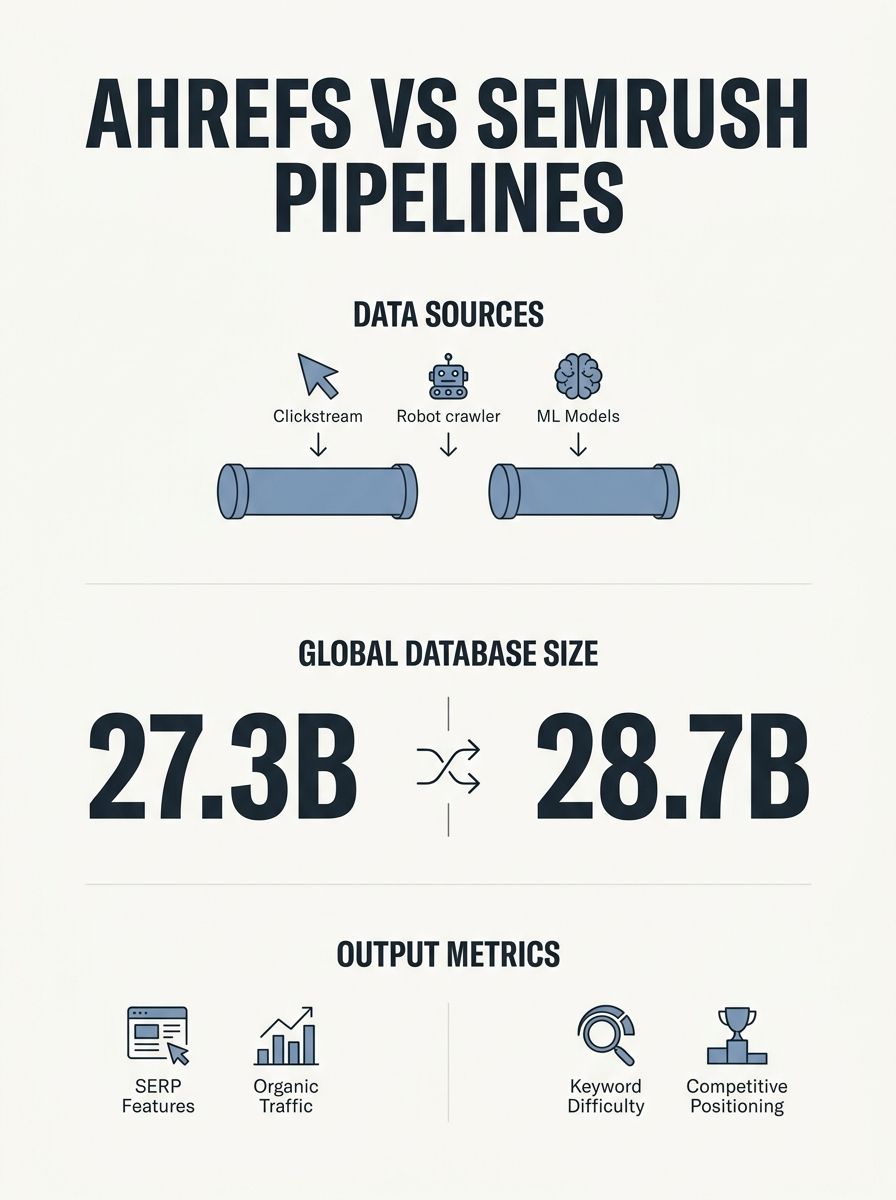
If you're weighing these tools as part of a broader SEO tool stack evaluation, the database size difference is effectively a wash. What matters is what each tool does with that data after ingestion.
Why Keyword Difficulty Scores Disagree
Keyword difficulty accuracy is the single most debated difference in every Ahrefs vs Semrush comparison, and the disagreement traces back to how each tool defines "difficulty" mechanically.
Ahrefs calculates keyword difficulty (KD) primarily by analyzing the backlink profiles of the pages currently ranking in the top 10. The score reflects how many referring domains you'd need to acquire to compete for a position on page one. This backlink-weighted approach produces scores that correlate well with actual ranking effort for sites that compete primarily through link authority. Independent practitioners on SEO forums consistently report that Ahrefs' difficulty score tracks closer to real-world ranking outcomes than Semrush's equivalent number.
Semrush's keyword difficulty score blends more signals. It factors in backlink data but also incorporates domain authority of ranking pages, content relevance signals, and SERP feature presence. The result is a score that tries to capture a broader picture of competitive intensity but introduces more variables, which means more room for the estimate to drift from reality. Semrush has responded to accuracy criticism by introducing AI-powered Personal Keyword Difficulty (PKD) scores that adjust the difficulty estimate based on a specific domain's existing authority and topical relevance. PKD scores can differ significantly from the generic KD number for the same keyword.
Attribute | Ahrefs KD | Semrush KD | Semrush PKD |
|---|---|---|---|
Primary signal | Backlink profiles of top 10 | Backlinks + domain authority + SERP features | Generic KD adjusted for your domain |
Best for | Link-driven niches | Multi-signal competitive analysis | Domain-specific prioritization |
Common criticism | Underweights content quality signals | Scores can feel inflated for low-competition terms | Requires domain input; unavailable for general research |
Accuracy consensus | Slightly more accurate overall | Broader but noisier | Promising but newer; limited independent validation |
The practical takeaway: if you're doing a broad keyword research tool comparison and your competitive landscape is backlink-heavy (think finance, legal, SaaS), Ahrefs' difficulty scores will steer you more accurately. In content-driven niches where topical authority matters as much as links, Semrush's multi-signal approach has a reasonable argument, especially with PKD enabled.
Search Volume Estimates and the GSC Gap
Why do both tools show different monthly search volumes for identical keywords? Because neither tool has direct access to Google's actual query logs. They're both estimating, and their estimation methods diverge.
Semrush combines clickstream data with its own models to produce volume estimates. Testing by DemandSage found that Semrush's volume figures land 32.39% closer to Google Search Console impressions data compared to other major SEO tools. That's a meaningful gap when you're sizing content opportunities or forecasting traffic. Semrush's US volume accuracy benefits from heavier clickstream sampling in English-language markets.
Ahrefs takes a different approach to the same problem. Its volume estimates incorporate clickstream data but also layer in Google Ads data and its own click modeling. The result is volume numbers that can differ from Semrush by 20-40% on individual keywords, particularly for queries under 1,000 monthly searches where clickstream samples get thin. Ahrefs has historically been more conservative with volume estimates, which some practitioners prefer because it sets more realistic traffic expectations.
Both tools struggle with the same blind spots: seasonal queries, trending topics that spike and crash within weeks, and queries where Google's autocomplete drives volume that clickstream panels miss. If your keyword research process depends on volume accuracy for budget decisions, cross-referencing both tools against GSC data for keywords you already rank for gives you a calibration baseline.
SERP Feature Detection Across Both Tools
SERP feature data determines whether a keyword with 10,000 monthly searches actually delivers 10,000 click opportunities or whether featured snippets, People Also Ask boxes, and AI Overviews absorb most of that demand before anyone reaches a blue link.
Ahrefs identifies SERP features for each keyword in its index and displays them directly in Keywords Explorer. Its SERP feature tracking covers featured snippets, knowledge panels, People Also Ask, image packs, video carousels, local packs, and more. Ahrefs also shows the top-ranking pages alongside their backlink counts and domain strength, giving you a concrete view of what's actually occupying the SERP for a given query.
Semrush provides similar SERP feature identification and adds a few extras. Its data includes click-through rate estimates that factor in SERP feature presence, intent classification labels (informational, navigational, commercial, transactional), and content gap analysis tools that surface keywords where competitors hold SERP features you don't. For teams tracking how AI Overviews affect organic CTR, Semrush's integration of SERP feature data with its traffic estimation model provides a more complete picture of actual click opportunity.
The functional difference: Ahrefs gives you better raw SERP composition data for individual keywords. Semrush gives you better tools for acting on that data at scale, especially through its Keyword Gap analysis, which highlights feature-level competitive differences across entire domains.
Ahrefs' Clicks Metric and the Zero-Click Problem
Why does Ahrefs report a "Clicks" number alongside search volume when Semrush doesn't? Because Ahrefs is trying to solve a specific measurement problem that standard volume metrics ignore entirely.
The Clicks metric estimates how many times users actually click on a search result after performing a query. For a keyword with 10,000 monthly searches, the Clicks number might show only 6,200 if 38% of searches end without a click due to featured snippets, knowledge panels, or AI-generated answers resolving the query directly in the SERP. This metric draws from Ahrefs' clickstream data and represents actual observed click behavior rather than query frequency alone.
Semrush doesn't offer a directly equivalent metric. Its approach instead bakes click-through estimates into its traffic potential calculations at the domain level rather than exposing them per keyword. You can approximate the same insight by combining Semrush's SERP feature flags with its CTR distribution data, but it requires more manual analysis.
For practitioners running an audit of their keyword tool spending, the Clicks metric is one of Ahrefs' strongest arguments for keeping its subscription active even if Semrush handles most other keyword research needs. Prioritizing keywords by clicks rather than raw volume prevents you from chasing high-volume queries that deliver minimal organic traffic.
AI Visibility Tracking
Both platforms now track how brands appear in AI-generated search results, reflecting the growing share of queries where traditional rankings don't tell the full story.
Semrush One monitors brand mentions and visibility across ChatGPT, Perplexity, and Google Gemini responses. It integrates this AI visibility data into the same dashboard as traditional keyword tracking, making it easier to see how AI-generated answers affect organic traffic for specific queries. Semrush also embeds AI features into its SEO Writing Assistant, using AI models to score content against ranking competitors.
Ahrefs takes a different approach with its Brand Radar tool, which monitors AI search mentions as a standalone feature rather than integrating them into keyword-level reporting. Brand Radar covers a broader set of AI platforms but keeps the data separate from traditional keyword metrics, which means more manual cross-referencing when you're trying to understand how AI answers affect a specific keyword's click potential.
For teams using AI-powered competitive analysis in their keyword research, Semrush's tighter integration between AI visibility and keyword data gives it a structural advantage. Ahrefs' separation of the data can actually be useful for enterprise teams that want AI monitoring without muddying their traditional keyword reporting workflows.
Where Both Models Break Down
Every keyword research tool comparison eventually hits the same wall: both tools are modeling Google's behavior from the outside, and that model has known failure modes that no amount of data can fully fix.
Volume estimates for keywords under 100 monthly searches are unreliable in both tools. Clickstream panels don't sample enough users in low-volume niches to produce stable estimates, and both Ahrefs and Semrush resort to rounding and bucketing that can make a 40-search keyword and a 90-search keyword show the same number. If your strategy targets long-tail queries in narrow niches, treat volume numbers below 100 as directional rather than precise.
Keyword difficulty scores in both tools assume a relatively stable SERP. When Google rolls out a core update or shifts how it weights content quality signals (as happened with the March 2026 core update's emphasis on information gain), difficulty scores calculated from pre-update SERP data become temporarily misleading. Neither tool recalculates difficulty in real time after algorithm changes.
SERP feature data lags behind Google's actual SERP rendering. Both tools refresh SERP feature flags on a crawl schedule, not in real time. A keyword that gained an AI Overview yesterday might not show that feature in either tool for days or weeks. And neither tool can predict when Google will add or remove SERP features for a given query, which means any traffic forecast based on current SERP composition carries an expiration date.
The honest answer to the Ahrefs vs Semrush question is that you're choosing between two imperfect models of the same underlying system. Semrush's search volume estimates run closer to ground truth. Ahrefs' difficulty scores track better against real ranking outcomes. Both tools' SERP feature data is useful but delayed. And both tools are guessing, with varying degrees of sophistication, about a system that only Google fully understands. The practitioners who get the most from either tool are the ones who treat every number as an estimate and calibrate it against their own Search Console data, rather than accepting any single tool's output as fact.
OrganicSEO.org Editorial
Editorial team writing about Ethical, white-hat, organic SEO education.
Related Articles
Keyword Research Data Conflicts in 2026: Why Ahrefs, Semrush, and Google Keyword Planner Give Different Numbers (And What to Do About It)
Ahrefs, Semrush, and Google Keyword Planner report different search volume numbers for the same keywords because each tool collects, models, and categorizes search data through fundamentally different methods.
Why Your Keyword Research Tools Disagree on Search Volume (And How to Break the Tie)
Store Growers tested 10 commercial keywords across Google Keyword Planner, Semrush, Ahrefs, and SpyFu and found that no two tools agreed on volume for a single term.
The Keyword Research Data Trap: Why Multiple Tools Contradict Each Other and How to Resolve Conflicts
Google Ads Keyword Planner API, the single upstream source feeding search volume data into Ahrefs, Semrush, Moz, and nearly every other SEO platform, returns estimates bucketed into ranges that can span 10x.