Site Structure as a Ranking Signal: How Information Architecture Influences Crawlability and Authority Flow
Site architecture is the hierarchical organization of URLs, navigation paths, and internal links that determines which pages search engines discover first, crawl most often, and rank highest. When this structure breaks down, even well-written content sits unindexed and invisible.
Site Structure as a Ranking Signal: How Information Architecture Influences Crawlability and Authority Flow
Site architecture is the hierarchical organization of URLs, navigation paths, and internal links that determines which pages search engines discover first, crawl most often, and rank highest. When this structure breaks down, even well-written content sits unindexed and invisible.
How Search Engines Interpret Your Site's Blueprint
Information architecture is the process of organizing and structuring content on a website to facilitate both user navigation and search engine crawling, as NAV43's architecture guide defines it. The concept predates the web, library science coined the term in 1975, but its SEO significance has grown as Google's crawlers have become more selective about what they spend resources indexing.
Google allocates a crawl budget to every domain: a finite number of pages its bots will request during any given crawl cycle. More popular sites receive larger budgets, while smaller or newer domains have to make every crawled page count. Your site architecture SEO ranking depends directly on how efficiently that budget gets spent. If bots burn through 80% of their allocation on faceted navigation pages or duplicate parameter URLs, your important content pages may never get crawled at all.
The architecture also tells crawlers about relationships between pages. A URL nested under /blog/seo/technical/crawling/ communicates a different topical signal than one sitting at /resources/crawling-guide/. These URL paths, combined with internal link patterns and navigation menus, form the map that Googlebot uses to understand what your site is about and which pages deserve priority.
Crawl Depth: The Discovery Layer
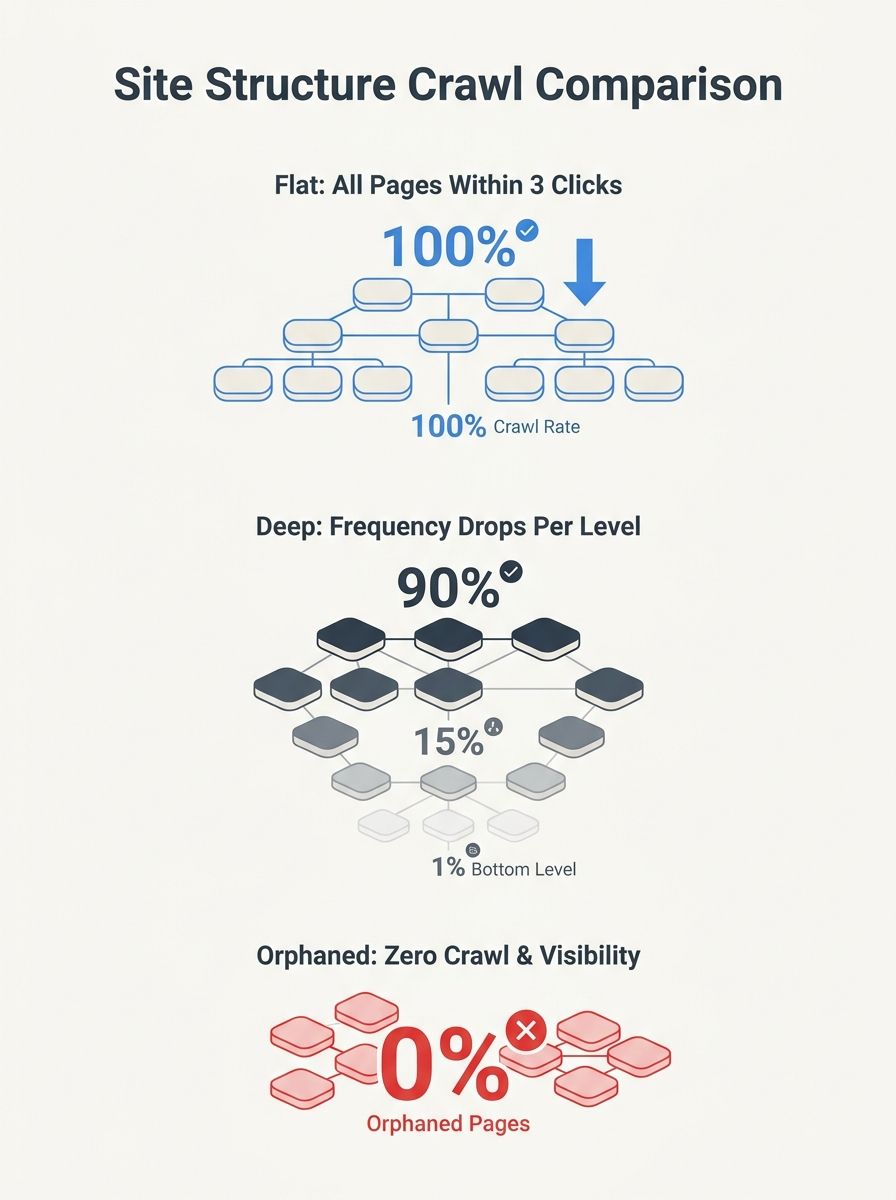
Pages accessible within 2–3 clicks from the homepage receive consistent crawl attention. Pages buried 6–7 levels deep get crawled rarely or skipped entirely. An Ahrefs study found that 95% of pages never receive organic traffic from Google, and a primary cause is architectural: those pages are either orphaned (no internal links pointing to them) or buried so deep that crawlers never reach them within their budget.
Flat site structures keep important pages shallow. The practical target is ensuring that any page you want indexed lives within 3 clicks of the homepage. This doesn't mean cramming everything into the top navigation. It means building internal link paths through hub pages, contextual body links, and breadcrumbs that create short routes to deep content.
Breadcrumbs deserve specific attention here. Implementing breadcrumbs with structured data markup following Google's guidelines increases the likelihood of those breadcrumbs appearing in search results, which improves click-through rates and gives crawlers an additional hierarchical signal. Every breadcrumb trail is also an internal link chain, feeding authority down the hierarchy.
If you've dealt with crawlability problems caused by session IDs appended to URLs, you've seen how quickly a single technical issue can multiply across an entire architecture. Each session-parameterized URL looks like a unique page to Googlebot, burning crawl budget on duplicates and starving real content pages of attention.
Authority Distribution Through Internal Links
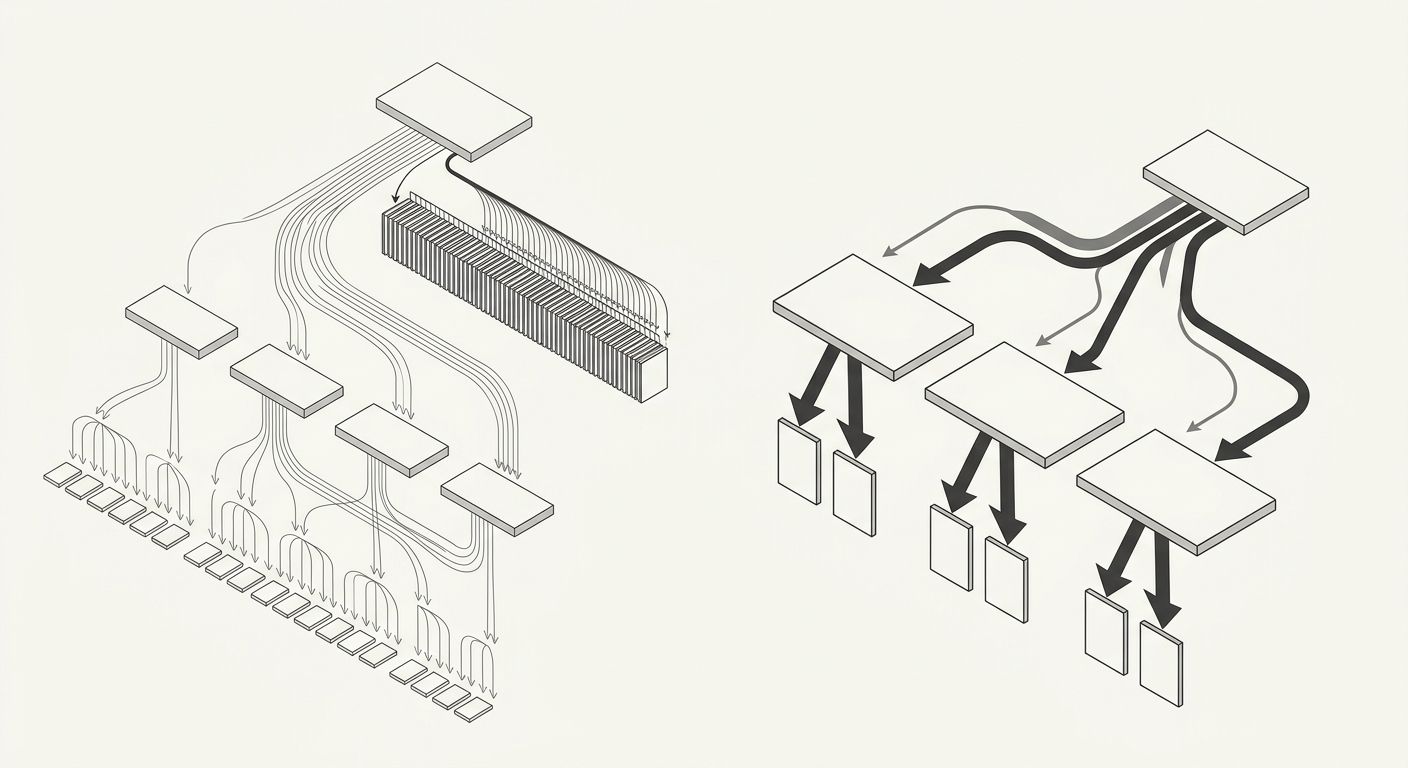
Every internal link passes a fraction of the linking page's authority (PageRank) to the destination. This is the core mechanism behind website structure link distribution: your homepage, which typically holds the most authority from external backlinks, feeds that equity to category pages, which feed it to individual content pages. The shape of your internal link graph determines where authority concentrates and where it thins out.
The arithmetic is straightforward. If a page has 100 outgoing internal links, each one passes roughly 1/100th of that page's available authority. If it has 10 outgoing links, each passes roughly 1/10th. This is why strategic limitation of links plays a vital role alongside link creation. Bloated navigation menus with 200+ links dilute the authority flowing to any single destination until the signal becomes practically zero.
Semrush's internal linking guide recommends identifying your most powerful pages, those with the most referring domains, and deliberately adding internal links from them to pages that need ranking boosts. Export your top pages sorted by referring domains, paste them into a working document, and map internal links from these authority-rich pages to your target content. This is the single most controllable lever in internal authority distribution.
Contextual links within body content carry more weight than links in headers, footers, or sidebars. A link placed within a relevant paragraph, surrounded by topically related text, sends a stronger signal about the destination page's subject matter. Aim for 3–10 contextual internal links per content page, connecting to genuinely related resources. The same principle applies when you're building external links through white-hat methods: relevance and context determine value.
Topical Clusters and the Pillar-Cluster Model
Topical cluster authority flow works through a specific architectural pattern. A central pillar page covers a broad topic in depth. Multiple cluster pages each address a specific subtopic. Cluster pages link back to the pillar, and the pillar links out to each cluster, creating a bidirectional network.
Search Engine Land's guide to topic clusters frames it directly: "Thoughtful internal linking signals to search engines that your site is an authority, giving you credit for expertise rather than just isolated keywords." The cluster model makes this expertise explicit. Instead of 15 disconnected blog posts about loosely related subjects, you build a structured network that tells Google: this site covers this entire topic space, and here's the map.
In a reverse silo structure, links move bidirectionally between parent and child pages, as LinkBoss's topical authority guide documents. Parent pillar pages link down to supporting pages, and those supporting pages link back up to the parent. This creates a tightly interlinked cluster where authority flows in both directions, reinforcing the topical signal at every node in the structure.
Measuring cluster effectiveness requires looking beyond individual page metrics. Monitor how often users consume multiple pieces of content within the same topic cluster during a single session. High cluster coherence, where users naturally move from one cluster page to another, indicates that your internal linking is guiding people through related content effectively. When you're running your three-month keyword research refresh cycle, evaluate cluster performance alongside individual keyword rankings to see whether the architecture is pulling its weight.
The Three Layers Working Together
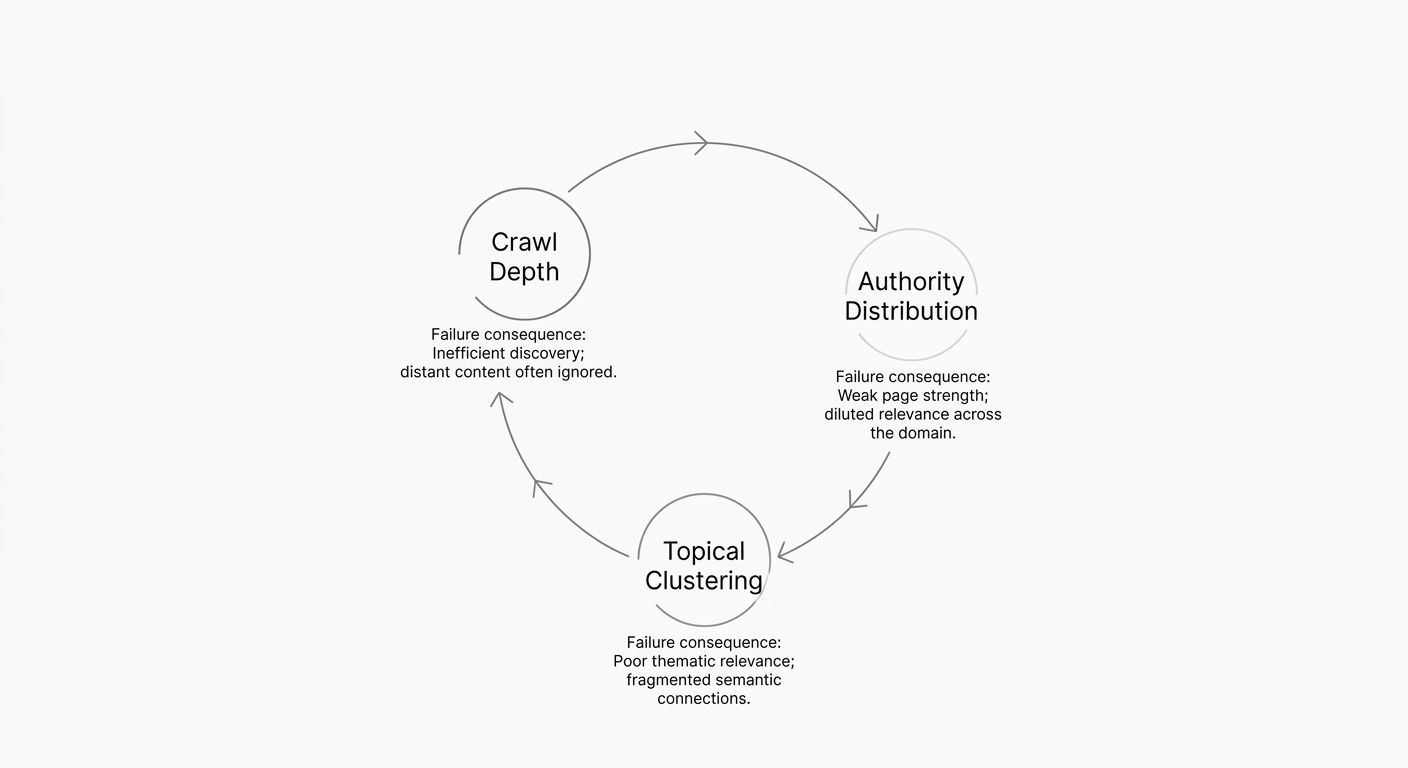
Information architecture crawlability, authority distribution, and topical clustering aren't separate systems. They form a reinforcing feedback loop.
When crawl depth is shallow (Layer 1), bots discover cluster pages quickly. When those cluster pages are well-linked internally (Layer 2), authority distributes evenly across the cluster. When the cluster's topical coherence is tight (Layer 3), the accumulated authority signal reinforces the site's expertise on that subject, which makes Google more willing to crawl deeper and more frequently, feeding back into Layer 1.
This three-layer interaction explains why partial fixes so often disappoint. Restructuring your navigation to reduce click depth (Layer 1 fix) won't help if your internal links aren't passing meaningful authority (Layer 2 problem). Building elaborate topic clusters (Layer 3 fix) won't rank if the cluster pages are orphaned from the main navigation (Layer 1 problem). You can use a systematic troubleshooting framework to diagnose which layer is actually failing before investing in the wrong fix. Each layer needs to function for the others to deliver results.
Where The Model Breaks
The three-layer model has real boundary conditions where it fails or produces counterintuitive results.
Over-linking destroys the signal. There's no fixed maximum number of internal links per page, but Americaneagle's internal linking analysis emphasizes aiming for clear, contextual links and avoiding overwhelming users or diluting relevance. Pages with 300+ internal links pass so little authority per link that the distribution becomes functionally meaningless. The links exist, but the signal is noise.
JavaScript rendering breaks crawl paths. Sites built on JavaScript frameworks often hide critical navigation and internal links behind client-side rendering. If links don't exist in the initial HTML served to crawlers, Googlebot may never discover the pages they point to. Server-side rendering or pre-rendering is non-negotiable for any link that matters to your architecture.
Rigid silos create isolation. Strict content siloing, where pages within one category never link to pages in another, can cut entire sections of a site off from each other's authority. Best practice is to maintain primary silos while adding strategic cross-silo links where they serve genuine user needs. A cooking site's "Equipment Reviews" silo should link to specific recipes in the "Recipes" silo when the context makes sense.
Scale introduces entropy. On sites with 50,000+ pages, maintaining architectural coherence requires ongoing discipline. Quarterly full-structure audits with monthly spot-checks for crawl errors and orphan pages represent the current expert consensus on maintenance frequency. Without this cadence, new content accumulates without integration, creating exactly the orphan page problem the architecture was designed to prevent.
One additional factor is gaining importance: AI visibility. Straight North's crawlability guide notes that crawlability now directly affects AI visibility, since tools like ChatGPT, Gemini, and Perplexity rely on accessible, well-structured web data for training and real-time answers. The same architectural principles that help Googlebot discover and index your content help LLMs extract and cite it accurately.
Common Questions
Does changing site structure hurt rankings temporarily?
Yes. Restructuring typically causes a ranking fluctuation that lasts 2–6 weeks while Google recrawls and reindexes affected URLs. Implementing proper 301 redirects and submitting an updated XML sitemap accelerates the transition. The more thorough the redirect mapping, the shorter the disruption.
How many internal links should each page have?
There's no universal number. The practical range for content pages is 3–10 contextual body links plus whatever navigation and breadcrumb links your template provides. The ceiling is determined by dilution: each additional outgoing link reduces the authority passed through every other link on that page. If a link wouldn't genuinely help a reader, it's hurting your architecture.
Do topic clusters work for small sites with under 50 pages?
They work well at small scale, often better than on large sites because there's less structural complexity to manage. Even a cluster with 1 pillar page and 4–5 supporting pages creates a meaningful topical signal. The key is tight relevance between cluster pages and consistent bidirectional linking.
Should every site use a flat structure?
No. E-commerce sites with thousands of product pages benefit from hierarchical category structures that mirror how users shop. Content-heavy sites and blogs benefit from flatter structures centered around topic clusters. The 3-click depth target applies universally, but the path to achieving it varies by site type, catalog size, and content volume.
OrganicSEO.org Editorial
Editorial team writing about Ethical, white-hat, organic SEO education.
Frequently Asked Questions
- How does site structure affect SEO rankings?
- Site architecture influences rankings through three mechanisms: crawl-depth allocation (how deep search engine bots travel), authority distribution (how link equity flows through internal links), and topical clustering (how related pages signal expertise). Google allocates a finite crawl budget to each domain, and site structure determines whether that budget gets spent on important content or wasted on duplicate pages.
- How deep should pages be from the homepage?
- Pages should be accessible within 2-3 clicks from the homepage to receive consistent crawl attention. Pages buried 6-7 levels deep rarely get crawled or may be skipped entirely due to crawl budget limitations. An Ahrefs study found that 95% of pages never receive organic traffic, with a primary cause being pages that are either orphaned or buried too deep for crawlers to reach.
- How many internal links should a page have?
- The practical range for content pages is 3-10 contextual body links plus navigation and breadcrumb links. Each additional outgoing link reduces the authority passed through every other link on that page, so pages with 300+ links dilute the signal to meaninglessness. Only add internal links that genuinely help readers.
- What is the pillar-cluster model in SEO?
- The pillar-cluster model is a topical architecture where a central pillar page covers a broad topic in depth, multiple cluster pages address specific subtopics, and cluster pages link back to the pillar while the pillar links to each cluster. This bidirectional linking creates a tightly interlinked cluster that signals expertise to search engines and reinforces topical authority.
- Does changing site structure hurt rankings?
- Yes, restructuring typically causes ranking fluctuation lasting 2-6 weeks while Google recrawls and reindexes affected URLs. Using proper 301 redirects and submitting an updated XML sitemap can accelerate the transition, with more thorough redirect mapping resulting in shorter disruption.
- How do internal links pass authority to pages?
- Every internal link passes a fraction of the linking page's authority (PageRank) to the destination. If a page has 100 outgoing internal links, each passes roughly 1/100th of that page's authority; if it has 10 links, each passes roughly 1/10th. Contextual links within body content carry more weight than links in headers, footers, or sidebars.
- How often should you audit site structure on large sites?
- On sites with 50,000+ pages, quarterly full-structure audits with monthly spot-checks for crawl errors and orphaned pages represent current expert consensus. Without this maintenance cadence, new content accumulates without integration, creating orphaned pages that remain invisible to search engines.
- What happens with breadcrumbs in SEO?
- Implementing breadcrumbs with structured data markup following Google's guidelines increases the likelihood of breadcrumbs appearing in search results, which improves click-through rates. Every breadcrumb trail also functions as an internal link chain that feeds authority down the hierarchy.
Related Articles
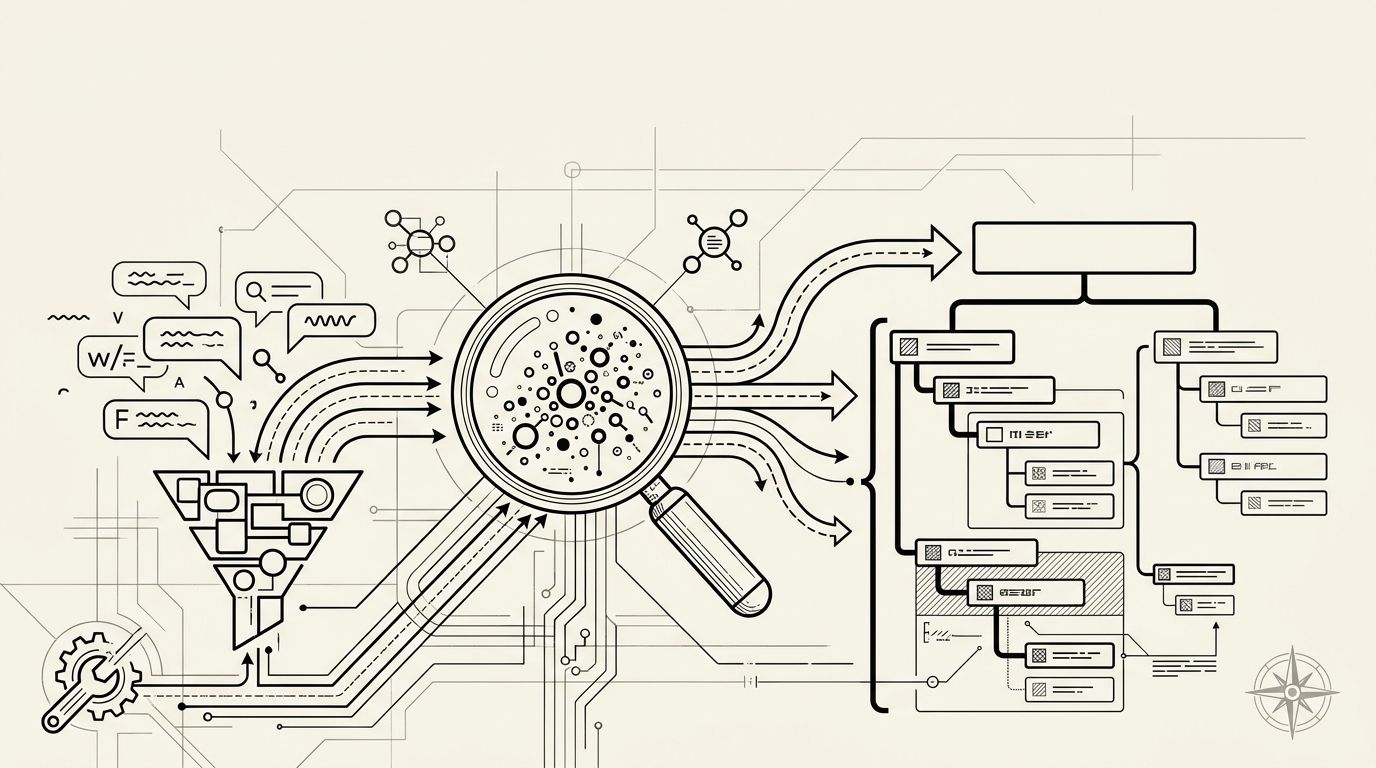
Keyword Research as Site Architecture Reverse-Engineering: How to Extract IA Decisions from Search Data
ClickRank's intent mapping documentation shows that sites assigning exactly one intent type per URL eliminate page-level content overlap entirely, because each URL resolves a distinct query class.
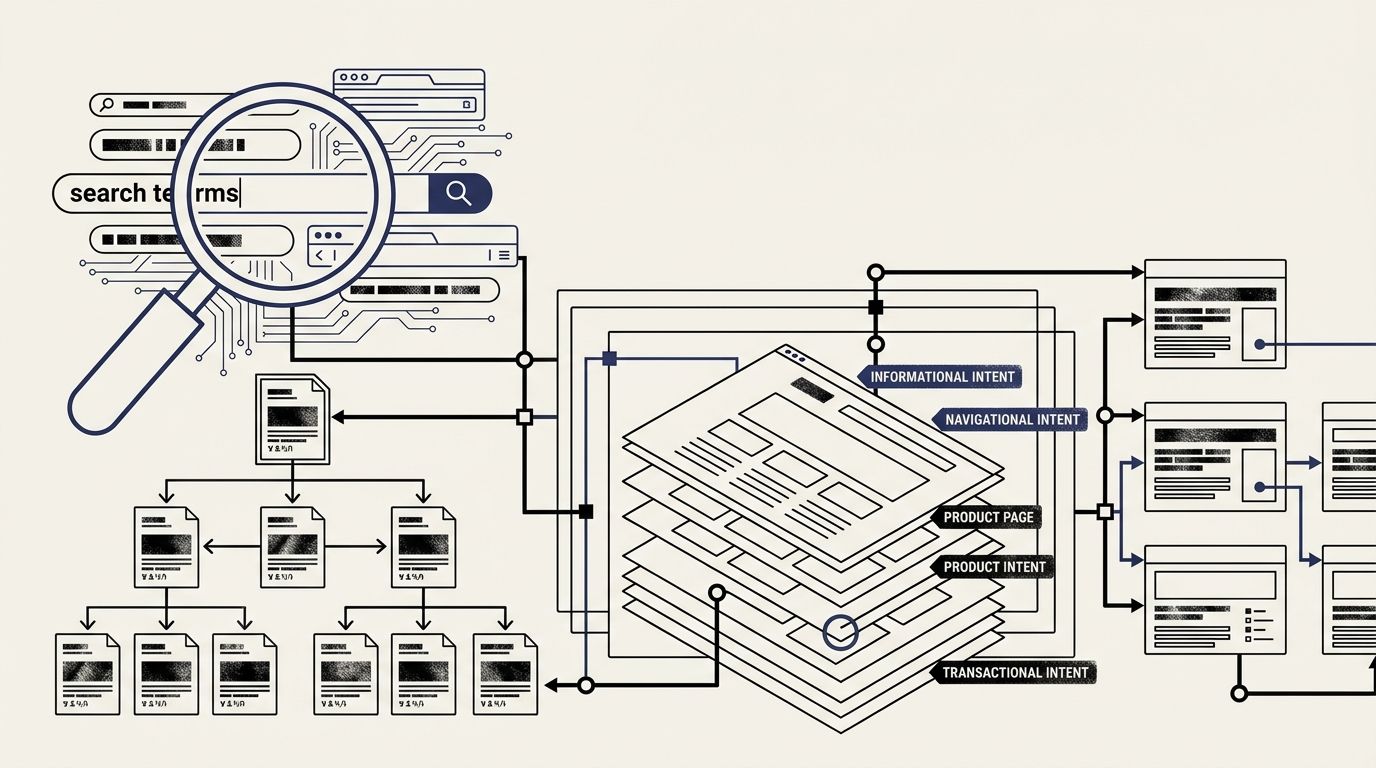
Keyword Research for Information Architecture: How to Map Search Intent to Site Structure Before Launch
Three methods dominate pre-launch keyword strategy for information architecture: SERP-driven intent mapping, topic cluster modeling, and user-task taxonomy. Each one produces a different site hierarchy, and 96.
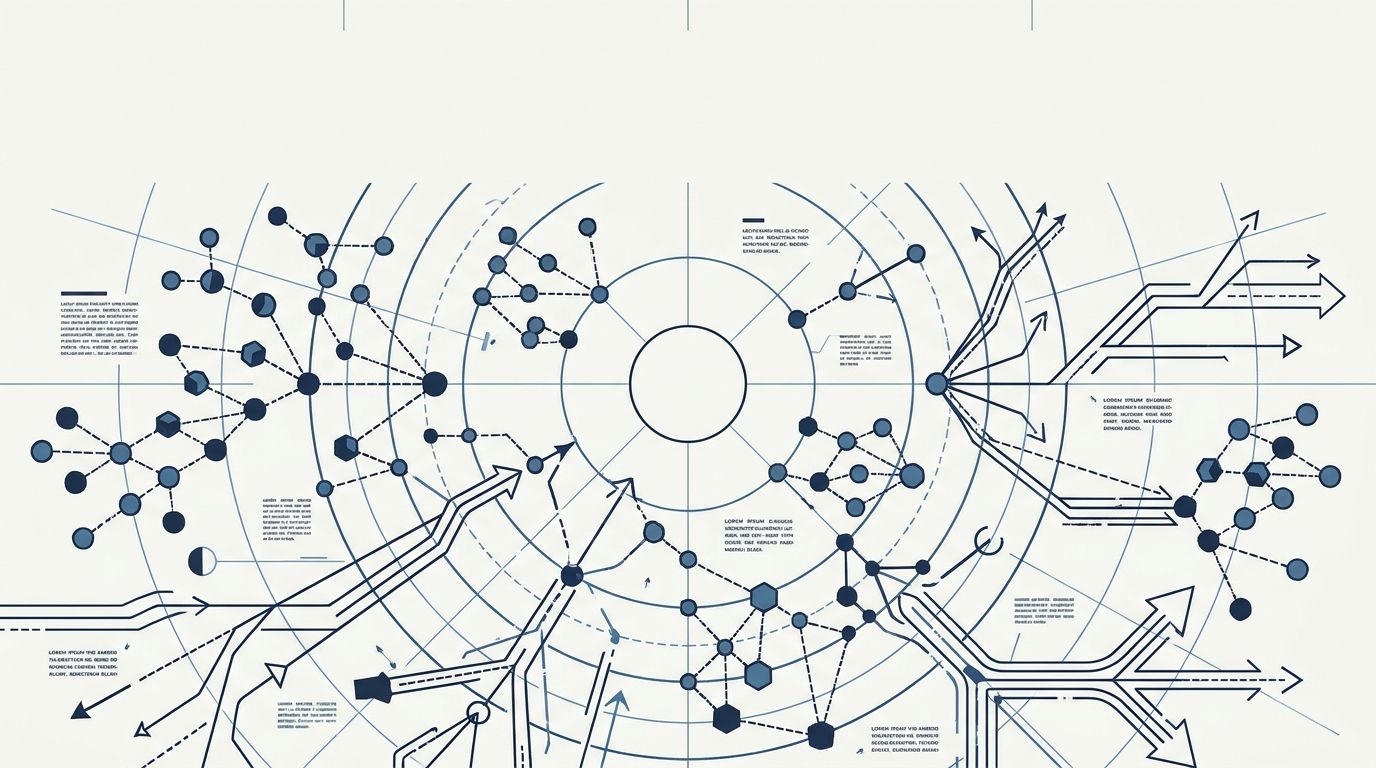
The Seed Keyword Expansion Playbook: Moving Beyond Single Terms to Semantic Clusters Without Tool Dependency
Google's algorithmic evolution from Hummingbird through BERT and MUM turned single-keyword targeting into a losing strategy.