The SEO Debugging Checklist: How to Diagnose Visibility Drops Systematically (Not Frantically)
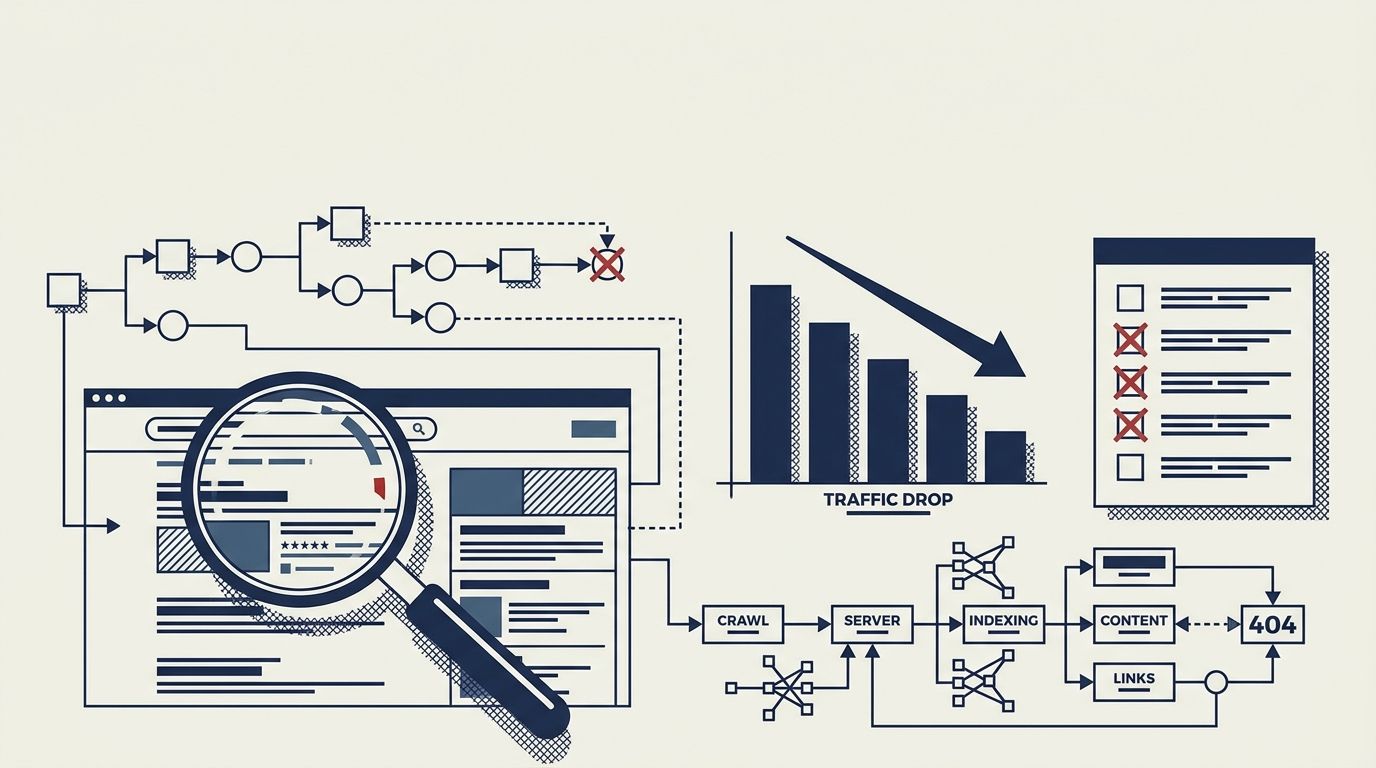
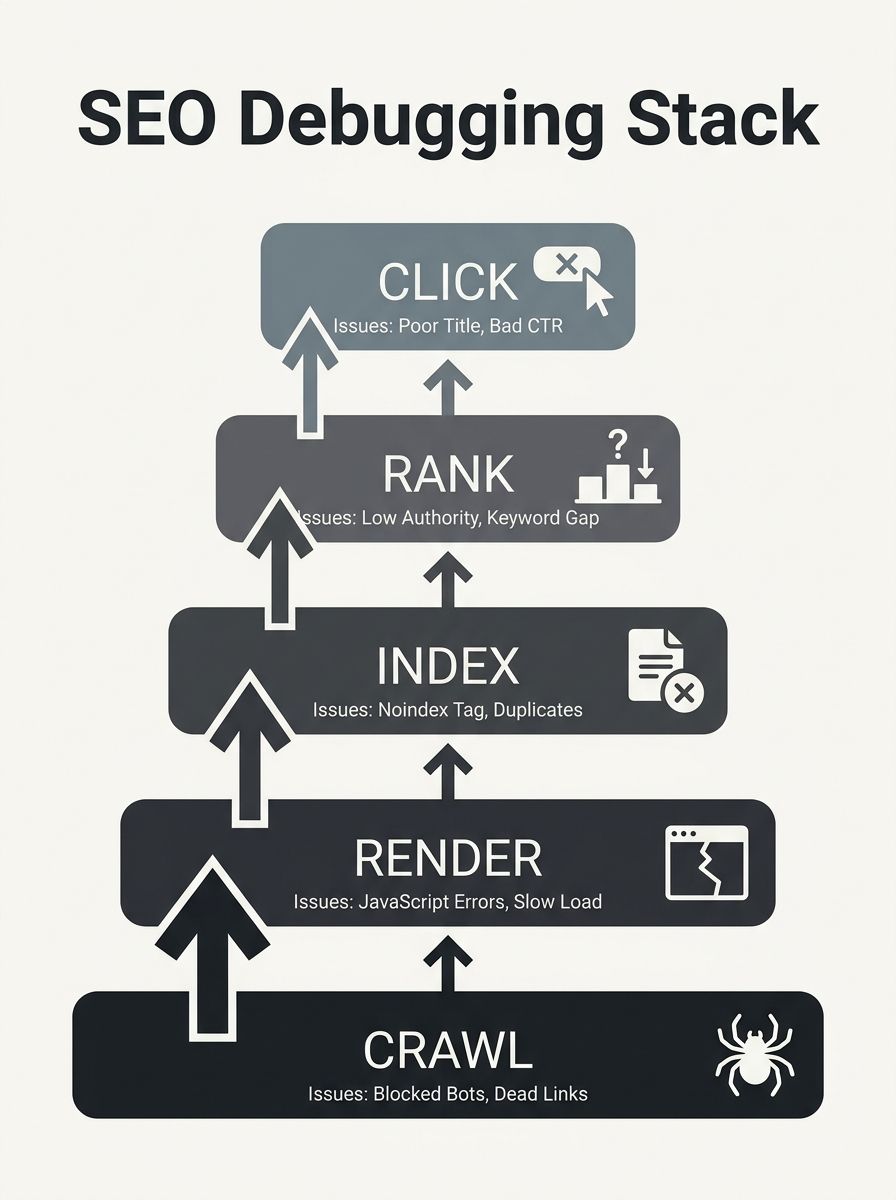
Diagnosing organic traffic drops requires a bottom-up diagnostic sequence through five layers: Crawl, Render, Index, Rank, and Click. Fixing lower layers first prevents wasted hours rewriting content that Google never crawled in the first place.
The SEO Debugging Checklist: How to Diagnose Visibility Drops Systematically (Not Frantically)
Diagnosing organic traffic drops requires a bottom-up diagnostic sequence through five layers: Crawl, Render, Index, Rank, and Click. Fixing lower layers first prevents wasted hours rewriting content that Google never crawled in the first place. Most ranking issues in 2026 trace back to crawlability or indexation failures, not algorithm changes.
Why Bottom-Up Diagnosis Beats Symptom-Chasing
Most SEO troubleshooting starts at the wrong end. Rankings dropped? Rewrite the content. Traffic tanked? Assume a penalty. As Search Engine Land's debugging framework explains, "Smart SEO debugging follows a repeatable framework that systematically eliminates variables to isolate root causes instead of chasing red herrings." The five-layer stack forces you to confirm each foundation before moving to the next.
This matters because roughly 80% of panicked "why did my traffic drop" investigations resolve at the crawl or index layer. Someone changed a robots.txt rule. A CMS update added noindex tags to a template. A redirect chain broke. None of these problems respond to content rewrites or link building, yet those are the first interventions most people reach for.
We've covered three systematic debugging methodologies in depth before, including the CRAFT and GRAAF frameworks that Moz SEO experts recommend for unexpected ranking drops. According to their analysis of 400+ troubleshooting cases, checking Google Search Console for crawl errors is the essential first step. This checklist builds on those frameworks with a practical, step-by-step diagnostic flow.
Can Google Even Reach the Page?
Open Google Search Console's Coverage report and Pages report before anything else. You're looking for three specific failure types:
Blocked resources. Check robots.txt for recently added Disallow rules. A single misplaced wildcard can block entire subdirectories. Run a live URL test in GSC to confirm Googlebot can access the affected pages.
Crawl budget waste. Sites with more than 10,000 URLs need to care about this. Faceted navigation pages, parameter-heavy URLs, and orphaned content consume crawl capacity that should go to money pages. Sites with canonical tag errors frequently bleed crawl budget to duplicate or near-duplicate pages without anyone noticing.
Server errors. Look for spikes in 5xx responses in GSC's Crawl Stats report. Intermittent server errors during Googlebot's crawl window can silently deindex pages over weeks. A technical SEO audit checklist from Digital Applied covering 200+ items confirms that most ranking issues in 2026 trace to crawlability or indexation problems, not content quality or backlink profiles.
The December 2025 rendering update added another wrinkle: Googlebot now excludes pages returning non-200 HTTP status codes from the rendering pipeline entirely. If your server returns a 404 or 503 but still serves visible HTML content (a soft 404), that content won't be rendered or indexed. Pages need valid 200 OK headers before client-side JavaScript execution even begins.
Rendering Failures Hide in Plain Sight
Once you've confirmed crawlability, the rendering layer asks whether Googlebot can actually process the page's content. JavaScript-heavy sites are the usual suspects here.
Use GSC's URL Inspection tool and compare the rendered HTML to your source HTML. If critical content like product descriptions, pricing, or reviews only appears after JavaScript execution, and that JavaScript fails or times out during Googlebot's render, the page effectively has no content from Google's perspective.
Server-side rendering eliminates this risk for pages that need immediate indexing. Client-side rendering works fine for logged-in dashboards and user-specific content, but product pages, service pages, and blog posts should serve their core content in the initial HTML response.
A related 2026 concern is schema drift. When your structured data (JSON-LD) contradicts the visible page content, maybe because a CMS template generates schema from a database while the page renders different content dynamically, AI engines and Google's systems lose trust in both signals. Automated testing that compares JSON-LD values against the rendered DOM before deployment catches these mismatches before they erode visibility.
Indexation: The Quiet Killer of Organic Visibility
A page that's crawled and rendered can still fail to appear in search results. Search for site:yourdomain.com/specific-page in Google. If it doesn't appear, check GSC's Index Coverage for that URL. Common indexation failures include:
Noindex tags added by CMS plugins, staging environment settings accidentally pushed to production, or template-level meta robots directives
Canonical tags pointing elsewhere, telling Google that a different URL is the preferred version
Thin content triggers, where Google's quality filters determine the page adds insufficient value to index
Content decay plays a significant role here. According to Seer Interactive's diagnostic guide, old pages losing relevance as search intent evolves is a leading cause of gradual deindexation. Pages that once ranked for evolving queries get quietly dropped from the index as fresher, more relevant alternatives appear.
Index budget deserves more attention than crawl budget in 2026. Google's systems apply quality limitations at the index level, meaning they can crawl a page, render it, and still decide not to index it because the domain's overall quality signal doesn't warrant storing more of its pages. Pruning low-quality pages protects the index quality score for the pages that matter.
Ranking Signal Investigation Comes Fourth, Not First
Only after confirming that crawling, rendering, and indexation are healthy should you investigate ranking-level causes. This is where keyword coverage analysis becomes critical.
Pull your GSC Performance report for the affected time period. Compare average positions, impressions, and clicks against the prior period. Look for patterns:
Broad position decline across many queries suggests a site-wide signal change: an algorithm update, a Core Web Vitals regression, or a domain-level quality assessment shift. Check your Core Web Vitals data in GSC and PageSpeed Insights. INP scores above 500ms indicate blocked main threads and function as a confirmed negative ranking factor. LCP above 2.5 seconds and CLS above 0.1 also contribute to ranking suppression.
Position drops concentrated on specific queries points to content-level or intent-level problems. Search those queries yourself. Has the SERP composition changed? Did Google introduce AI Overviews for queries that previously showed 10 blue links? A shift from informational results to transactional ones (or vice versa) can evaporate rankings for pages that no longer match the dominant intent.
Position drops on specific pages while other pages hold steady suggests on-page issues. Check for recent content changes, broken internal links, or lost backlinks to those specific URLs.
For systematic keyword coverage analysis, export your full keyword set from GSC and group queries by page, intent type, and position range. If you've been running continuous keyword monitoring rather than quarterly audits, you'll have the historical data to pinpoint exactly when positions shifted and correlate that timing with site changes, algorithm updates, or competitor movements.
Diagnostic Signal | Likely Cause | First Investigation Step |
|---|---|---|
Broad position decline, all queries | Site-wide quality or technical regression | Check CWV scores, recent algorithm updates, robots.txt changes |
Position drops on specific queries | Intent shift or SERP composition change | Manual SERP review, compare current vs. cached SERP features |
Position drops on specific pages | On-page issue, lost links, content decay | Check page-level backlink changes, recent edits, internal link health |
Impressions drop with stable positions | Reduced search demand or query refinement | Google Trends comparison, seasonality check |
Positions stable but clicks declining | CTR compression from SERP features | AI Overview presence check, featured snippet displacement |
Click-Through Drops With Stable Rankings
The final diagnostic layer addresses a scenario that's grown more common since AI Overviews expanded across Google's SERPs: your pages still rank, positions are stable, but clicks are declining.
Pull GSC data filtered to queries where average position hasn't changed but click-through rate has dropped. This pattern almost always traces to one of two causes.
AI Overview cannibalization. Google's AI Overviews now answer many informational queries directly in the SERP. Users get the answer without clicking through. If your traffic drop is concentrated on informational queries, this is the likely cause. We've written about measuring CTR impact from AI Overviews and what to track going forward.
SERP feature displacement. Featured snippets, People Also Ask expansions, knowledge panels, and local packs push organic results further down the page, reducing CTR even when rankings hold. A page ranking position 3 in 2024 occupied a very different visual position than a page ranking position 3 today.
The fix for click-through issues differs entirely from the fix for ranking issues. You're optimizing title tags, meta descriptions, and structured data for click appeal, not content quality or backlink acquisition.
Ruling Out External Factors Before Blaming Your Site
A proper SEO debugging framework accounts for causes outside your control before concluding that something on your site broke.
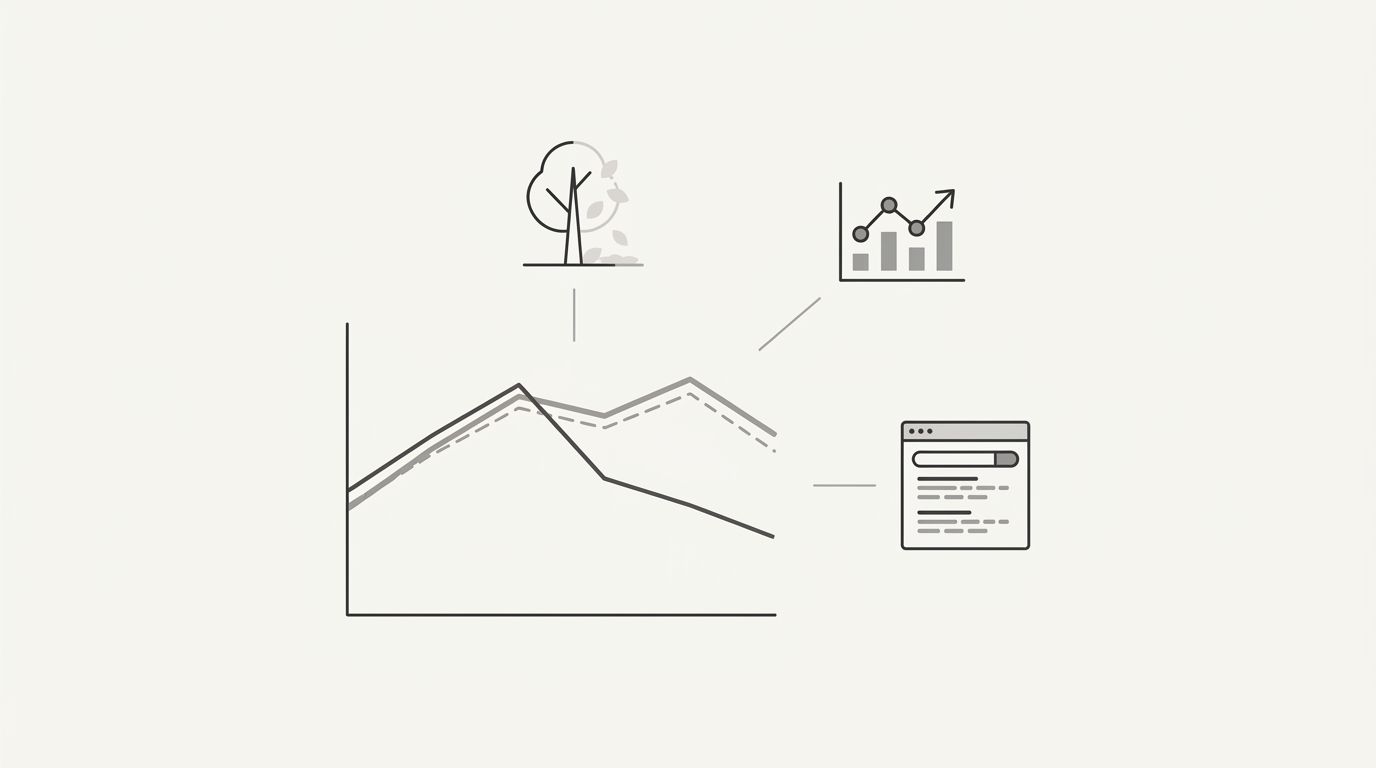
Seasonality. Compare year-over-year data, not month-over-month. A December dip for a B2B SaaS site is predictable. A January spike for fitness content is normal. Google Trends for your core queries gives you the demand baseline. Seer Interactive identifies seasonality as one of the first factors to rule out when diagnosing organic traffic decline across their 18-factor diagnostic model.
Competitor movement. Search your target queries and check who moved up as you moved down. If a competitor published a substantially better resource, acquired strong backlinks, or earned a featured snippet, your positions may have dropped despite your pages remaining unchanged. Keyword coverage analysis across competitors reveals whether you lost ground or the ground shifted.
Search demand shifts. Sometimes queries lose volume. A technology becomes obsolete. A trend peaks and declines. An industry term gets replaced by a newer one. If search demand dropped 40% for your core terms, a 40% traffic drop isn't a site problem.
The Full Diagnostic Sequence, Distilled
Turning this into a repeatable process means documenting each investigation step and its outcome:
Quantify the drop. Use GSC Performance data to determine whether the decline is in impressions, clicks, CTR, or positions, and whether it's site-wide, section-specific, or page-specific.
Check crawlability. GSC Coverage report, robots.txt review, server log analysis for Googlebot activity, live URL inspection.
Check rendering. URL Inspection rendered HTML comparison, JavaScript dependency audit, schema drift validation.
Check indexation. site: operator search, GSC index status, canonical tag audit, noindex meta review.
Check ranking signals. CWV scores (target INP under 200ms, LCP under 2.5s, CLS under 0.1), backlink profile changes, content freshness, internal linking health.
Check click-through. CTR trends by query type, AI Overview presence, SERP feature displacement, title and description optimization.
Rule out external factors. Seasonality via YoY comparison, competitor analysis, search demand trends.
Each step either reveals the problem or clears that layer and advances you to the next. Technical SEO problem-solving becomes predictable rather than panicked when you enforce this order.
What Still Isn't Settled
The five-layer framework handles most visibility drops cleanly, but several diagnostic gaps remain.
Google's AI Overview impact on organic CTR is still poorly measured across industries. Tools that track AI visibility, including 16 compared in a 2026 Ekamoira analysis covering ChatGPT, Perplexity, and Google AI Mode, vary widely in what they actually track versus what they claim. Until AI Overview CTR data becomes available natively in GSC, diagnosing click-through problems at Layer 5 requires estimation rather than measurement.
Index budget as a concept lacks official documentation from Google. We know quality thresholds exist at the indexation layer, but Google hasn't published the signals it uses to determine how many pages from a given domain deserve indexation. Pruning low-quality pages helps empirically, but the mechanism remains opaque.
And the interaction between rendering changes (like the December 2025 update excluding non-200 pages from the render pipeline) and JavaScript-heavy architectures will create new classes of silent failures that current monitoring tools don't catch well. Server log analysis combined with GSC inspection data is the best available signal, but it requires manual correlation that most teams skip under time pressure.
The discipline of systematic SEO troubleshooting lies in accepting these uncertainties while still following the diagnostic order. You won't always find a clean root cause. But by working bottom-up through crawl, render, index, rank, and click, you eliminate the easy mistakes before spending cycles on the hard questions. That alone prevents the majority of misdiagnosed visibility drops from turning into months-long recovery projects.
OrganicSEO.org Editorial
Editorial team writing about Ethical, white-hat, organic SEO education.
Related Articles
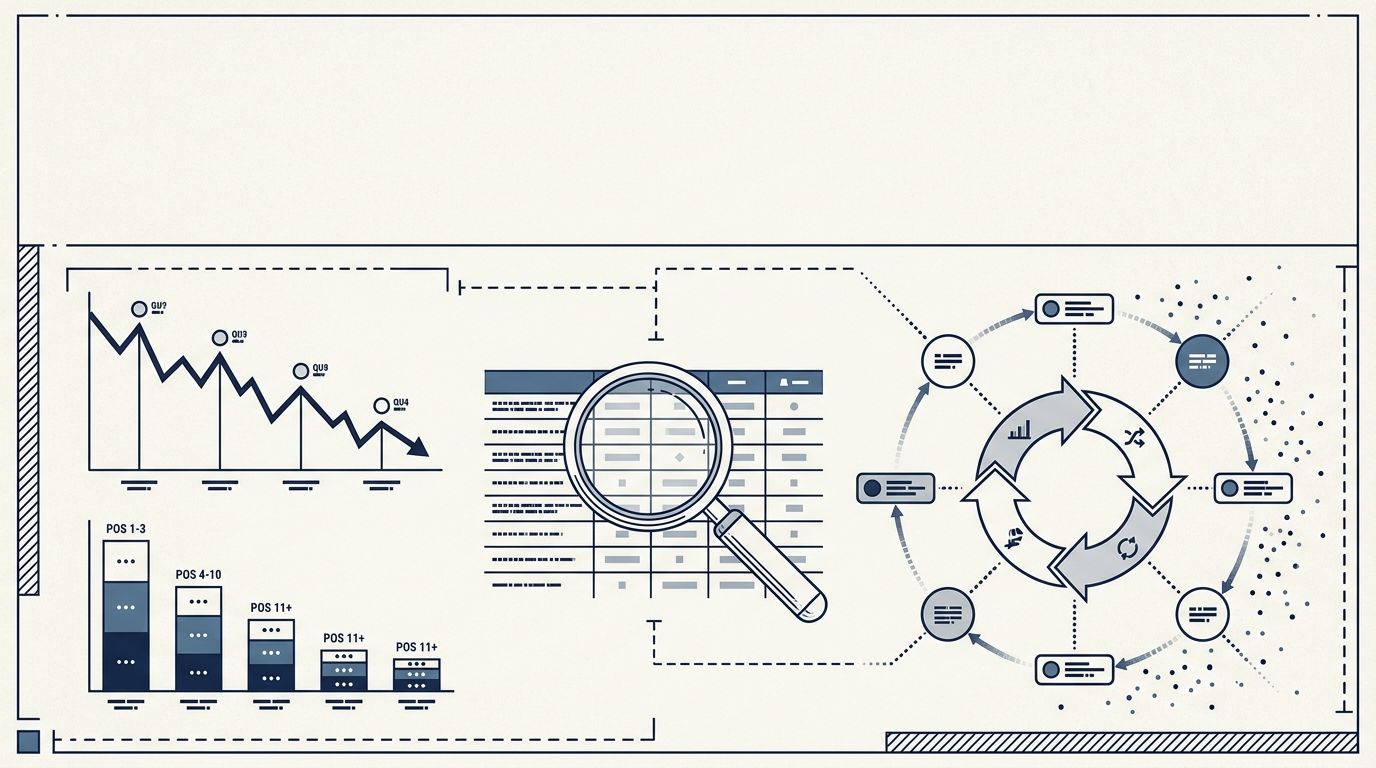
The Quarterly Keyword Refresh Cycle: How to Catch Ranking Declines Before They Compound
Ranking declines become visible in position-tracking tools 4 to 6 weeks after they first appear in impression data.
Keyword Intent Mismatch: How to Spot When Your Rankings Hide Poor Traffic Quality
Pages ranking on page one for target keywords convert at roughly 3% on average, but pages with strong keyword intent alignment push past 5%, per Grow and Convert's conversion data. The gap between those numbers is where intent mismatch hides, and three detection methods exist to find it.
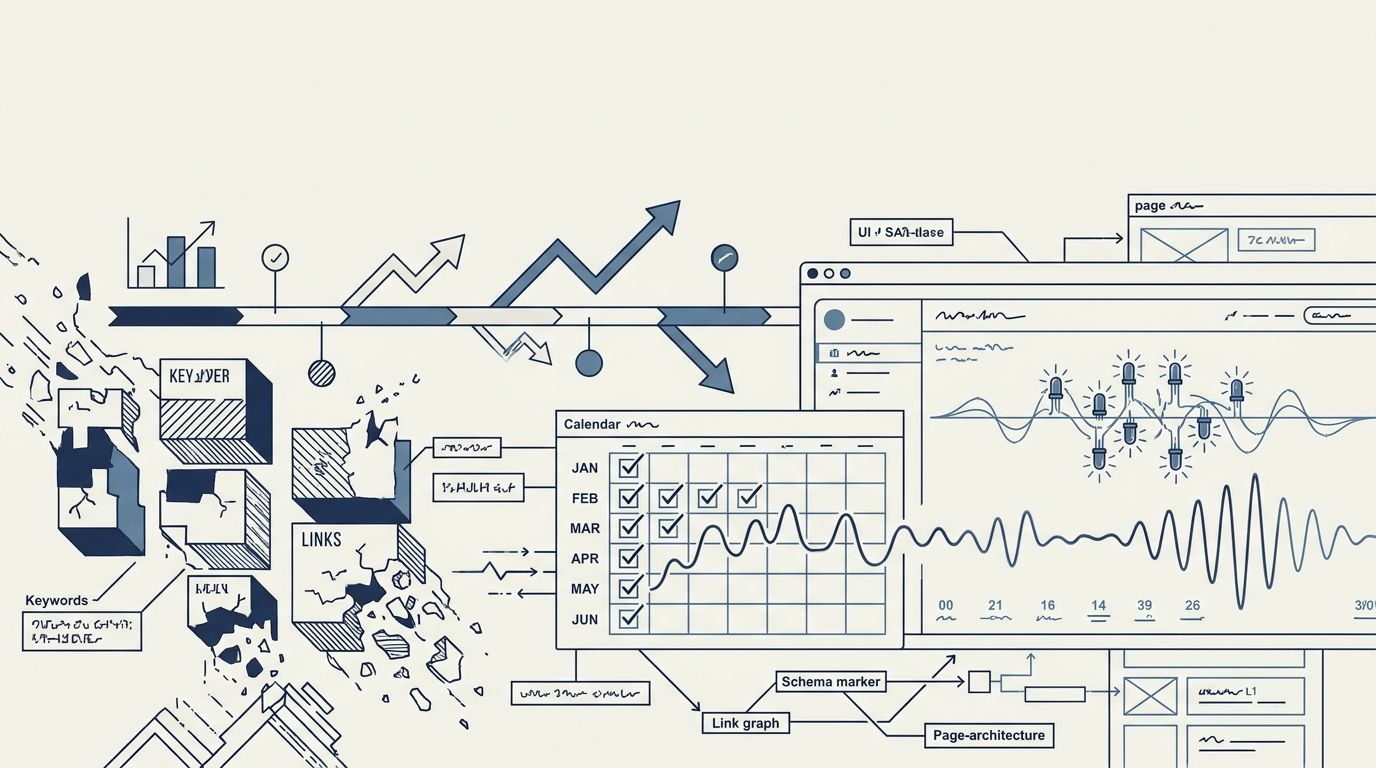
The Keyword Research Refresh Trap: When Continuous Monitoring Beats Quarterly Audits
Quarterly keyword audits leave a 90-day blind spot where ranking positions erode, search intent shifts, and competitors claim territory unchecked. Continuous keyword monitoring SEO workflows detect drift within days, giving teams time to respond before traffic loss compounds.