Keyword Allocation Mastery: The Missing Link Between Research and On-Page SEO Success
Google's search results regularly surface two or three pages from the same domain competing for identical queries, none cracking the top five.

Keyword Allocation Mastery: How the Step Between Research and Rankings Actually Works
Google's search results regularly surface two or three pages from the same domain competing for identical queries, none cracking the top five. The root cause is a missing step between research and execution: keyword allocation, the process where each target term gets assigned to exactly one URL based on intent and page fit.
The Gap That Keyword Research Alone Can't Close
Keyword research answers "what should we target?" Keyword allocation answers a different question entirely: "which page should target each term?" Skipping the second question is how sites end up with three blog posts all optimized for variations of the same phrase, each cannibalizing the others' rankings.
As Backlinko's cannibalization guide puts it, you need to "create keyword clusters and map keywords for all website pages to avoid unknowingly targeting the same terms on multiple pages." The word "unknowingly" is doing heavy lifting in that sentence. Cannibalization is rarely intentional. It happens because teams publish content on a rolling basis without checking what's already targeting a given keyword family.
The keyword allocation strategy sits between two other processes, research upstream and on-page optimization downstream, and functions as the routing layer. Research generates a list of destinations. Allocation decides which vehicle (page) goes to which destination. And on-page placement determines how well the vehicle performs once it arrives.
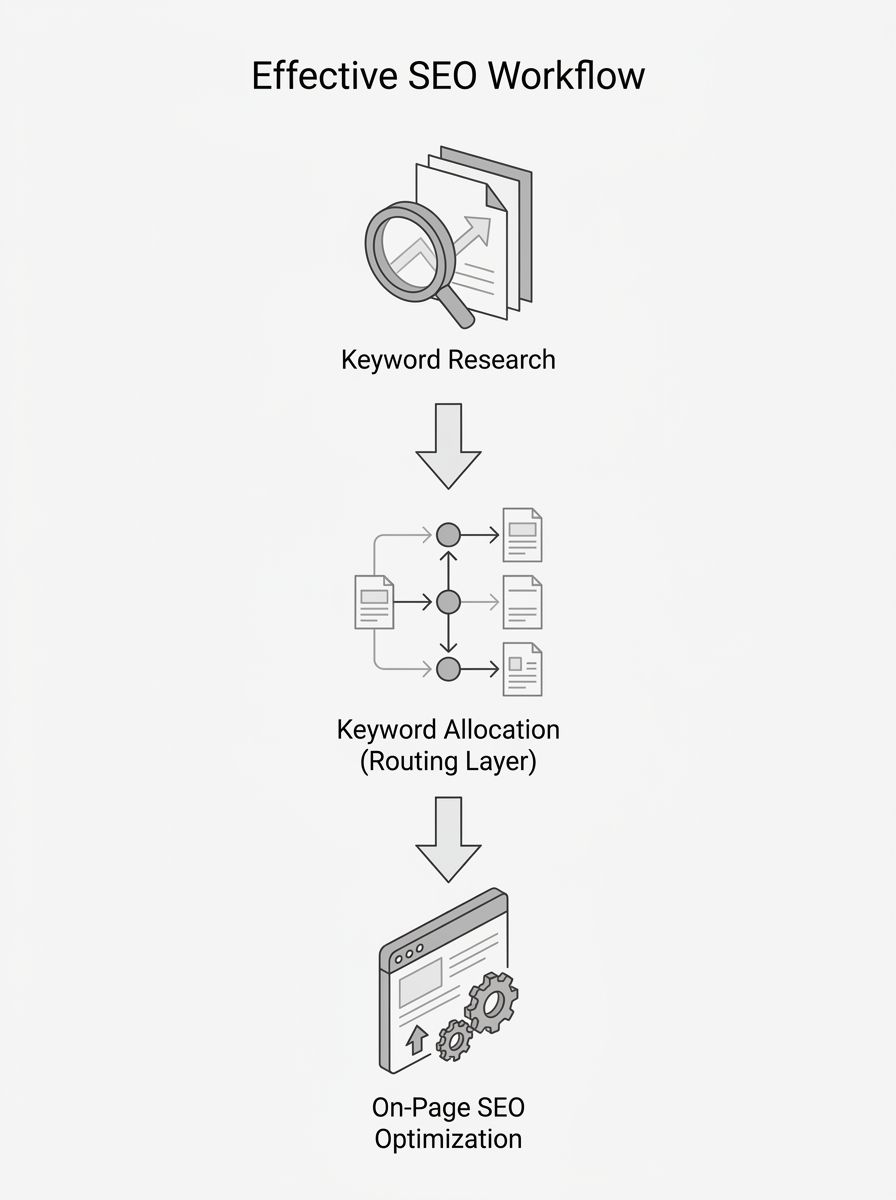
If you've experienced situations where your tools disagree on search volume, you already know that raw keyword data is messy. Allocation is where you impose order on that mess.
How Keyword-to-URL Mapping Works Under the Hood
The core mechanism of keyword mapping to pages is deceptively simple: build a spreadsheet (or database) where every important keyword is assigned to exactly one URL. SEOsiah's keyword map methodology describes this as building "a living spreadsheet that assigns every important keyword to exactly one URL, groups related terms into topic clusters, and becomes the single source of truth for your entire content operation."
A functional keyword map contains five columns at minimum:
Column | What It Contains | Why It Matters |
|---|---|---|
Target keyword | The primary term this URL should rank for | Prevents duplicate targeting |
URL | The single page assigned to this keyword | Creates clear ownership |
Search intent | Informational, navigational, transactional, or comparative | Ensures content format matches what Google expects |
Monthly search volume | Volume estimate from your preferred tool | Helps prioritize optimization effort |
Secondary keywords | 3-8 related terms and synonyms | Guides semantic coverage within the page |
The secondary keywords column is where most people get the mechanism wrong. These are semantic reinforcements for the primary keyword, not separate targets that warrant their own pages. A page targeting "keyword allocation strategy" might list "keyword mapping," "assigning keywords to pages," and "keyword-page alignment" as secondaries. All of them support the same page. None of them get their own URL.
This distinction matters because Google's understanding of topical relationships has grown more sophisticated. The search engine groups related queries into clusters and expects a single authoritative page to address that cluster, not five thin pages each picking off one variant. When you understand how search intent maps to site structure, the allocation process becomes less about spreadsheet gymnastics and more about matching Google's own clustering logic.
Intent as the Sorting Criterion
Why does intent determine which page gets which keyword? Because Google ranks pages based on format-intent alignment before it considers traditional ranking signals. A transactional keyword assigned to an informational blog post won't rank well regardless of how careful your on-page keyword placement is. The content format has to match what the SERP already rewards.
Here's how intent sorting works in practice. You pull up the current top-10 results for a keyword. If 8 of the 10 results are comparison guides, that keyword belongs on a comparison page. Not a product page, not a homepage, not a case study. The SERP is your format signal.
Mangools' guide on avoiding keyword cannibalization emphasizes that "you can prevent cannibalization issues simply by doing thorough keyword research (and mapping) before creating content for your website." But mapping without intent analysis produces a map that looks clean on paper while misaligning content formats in practice. You can have perfect one-keyword-one-URL discipline and still fail if your blog post targets a keyword whose SERP is dominated by product pages.
The Three-Axis Allocation Score
To formalize keyword-to-URL assignment, evaluate each pairing on three factors:
Intent match — does the page's format (guide, product listing, comparison, tool) align with what currently ranks for this keyword? Score 1-3.
Authority potential — does the page have (or can it earn) enough internal links and external authority to compete? Score 1-3.
Content fit — can the page address the keyword's topic naturally without forcing unrelated sections? Score 1-3.
A pairing that scores 7 or above across the three axes gets the assignment. Below 7, either the page needs restructuring or the keyword needs a new home. This scoring approach makes allocation decisions auditable and repeatable across teams rather than relying on gut feel.

Where Keywords Carry Weight on a Page
Once allocation assigns a keyword to a URL, on-page keyword placement determines how clearly the page signals relevance. HubSpot's on-page guide defines this as "the deliberate practice of including your target keywords in the specific locations where they carry the most weight."
Those high-weight locations follow a clear hierarchy:
Title tag. The single highest-impact placement. Your primary keyword should appear here, ideally within the first 60 characters. Semrush's on-page SEO guide confirms that strategically placing target keywords in title tags remains a core on-page ranking factor.
H1 heading. Should reflect the title tag's keyword targeting, though the exact wording can vary. The H1 confirms to both users and crawlers what this page is about.
First 100 words of body content. Google's crawlers weight early-page content more heavily. Getting your primary keyword into the opening paragraph without forcing it signals topical focus from the first sentence a user reads.
H2 and H3 subheadings. Secondary keywords from your allocation map belong here. If your primary keyword is "keyword allocation strategy," your H2s might naturally include terms like "keyword-to-URL mapping" or "on-page keyword placement," both of which reinforce the page's topical cluster without repetition.
Meta description. Doesn't directly influence rankings, but affects click-through rate. A meta description containing the target keyword gets bolded in search results, which increases the likelihood of a click.
Image alt text and file names. A lighter signal, but one that contributes to image search visibility and reinforces page-level relevance.
Keeping the Map Alive
A keyword map created during a site launch and never updated becomes inaccurate within months. New pages get published. Old pages accumulate unexpected rankings. Search intent shifts as Google refines its understanding of queries. The maintenance mechanism has three components that work in cycle.
Quarterly SERP audits. For your top 50 keywords, check whether Google still ranks the same content format it did when you first allocated. If informational results have shifted to transactional ones, your page may need a format change or the keyword needs reallocation entirely. We've covered how to catch ranking declines before they compound in detail, and the audit process described there feeds directly into allocation updates.
Cannibalization monitoring. Use Google Search Console to identify queries where multiple pages from your site appear in results. When two URLs share impressions for the same query, your allocation map has a conflict. Resolve it by consolidating content, adding canonical tags, or adjusting internal linking to strengthen the designated page. Avoiding keyword cannibalization is fundamentally a monitoring problem, not a one-time setup task.
New content checkpoints. Before publishing any new page, cross-reference its target keyword against the existing map. If the keyword already has an owner, either fold the new content into the existing page or pick a different primary target. This single step prevents the majority of cannibalization cases. If your site uses AI-assisted keyword clustering, you can automate parts of this cross-referencing, since clustering tools flag overlapping keyword groups across hundreds of pages.

Where This Model Breaks Down
The single-owner allocation model works well for sites with clear page boundaries and distinct content purposes. It gets strained in three predictable scenarios.
Large ecommerce sites with overlapping product categories. A running shoe that fits into both "trail running shoes" and "lightweight running shoes" creates a genuine allocation dilemma. The product page can't own both keyword clusters without either stuffing the page or splitting its relevance signal. The typical workaround involves using category pages as keyword owners and product pages as supporting nodes within those categories, but this adds architectural complexity that small teams struggle to maintain.
Sites with user-generated content. Forum threads, community posts, and Q&A pages generate keyword targeting you don't control. A forum thread might start ranking for a term you've carefully allocated to a pillar page, and you can't easily redirect or consolidate without disrupting the community experience. The only reliable fix is aggressive canonical tagging and strong internal linking toward the designated ownership page.
Rapidly shifting SERPs. Some keyword spaces see Google change its preferred content format every few months. A keyword that rewards blog posts in January might reward tools or calculators by June. Allocation maps struggle to keep pace when the intent signal itself is unstable. In these cases, monitoring has to tighten from quarterly to monthly, which taxes team bandwidth and makes the map feel more like a liability than an asset.
The Three-Axis Allocation Score helps surface these edge cases early. Any keyword-URL pairing that scores below 5 on initial assessment is likely to produce ongoing friction. And the honest response is sometimes to deprioritize the keyword entirely rather than force an allocation that will need constant babysitting.
Keyword allocation isn't a creative process. It's a routing decision backed by data, and the sites that treat it as mandatory infrastructure between research and on-page work avoid the cannibalization traps that plague everyone who skips the step. The model works because it imposes a constraint that human content workflows naturally resist: one keyword, one page, no exceptions until the map says otherwise.
OrganicSEO.org Editorial
Editorial team writing about Ethical, white-hat, organic SEO education.
Related Articles

Keyword Allocation Strategy: How to Map Your Research to Site Architecture Without Diluting Authority
Assigning the same target keyword to two or more URLs forces Google to choose which page deserves the ranking, and it frequently picks the wrong one.

Niche-First Keyword Research: Why Understanding Your Market's Sub-Topics Matters More Than Search Volume
Underserved niche markets convert at 3–5x the rate of high-volume keyword targets, according to UniK SEO's analysis of low-volume search segments. The mechanism is specificity: low-volume high-intent keywords filter out casual browsers and pull in users who are already close to a purchase decision.

The Seed Keyword Expansion Playbook: Moving Beyond Single Terms to Semantic Clusters Without Tool Dependency
Google's algorithmic evolution from Hummingbird through BERT and MUM turned single-keyword targeting into a losing strategy.