Keyword Research as Site Architecture Reverse-Engineering: How to Extract IA Decisions from Search Data
ClickRank's intent mapping documentation shows that sites assigning exactly one intent type per URL eliminate page-level content overlap entirely, because each URL resolves a distinct query class.

Keyword Research as Site Architecture Reverse-Engineering: How to Extract IA Decisions from Search Data
ClickRank's intent mapping documentation shows that sites assigning exactly one intent type per URL eliminate page-level content overlap entirely, because each URL resolves a distinct query class. That single constraint, applied systematically across keyword clusters, produces a site structure derived from search behavior rather than internal assumptions about how pages should be organized.
SERP Overlap as an Architectural Blueprint
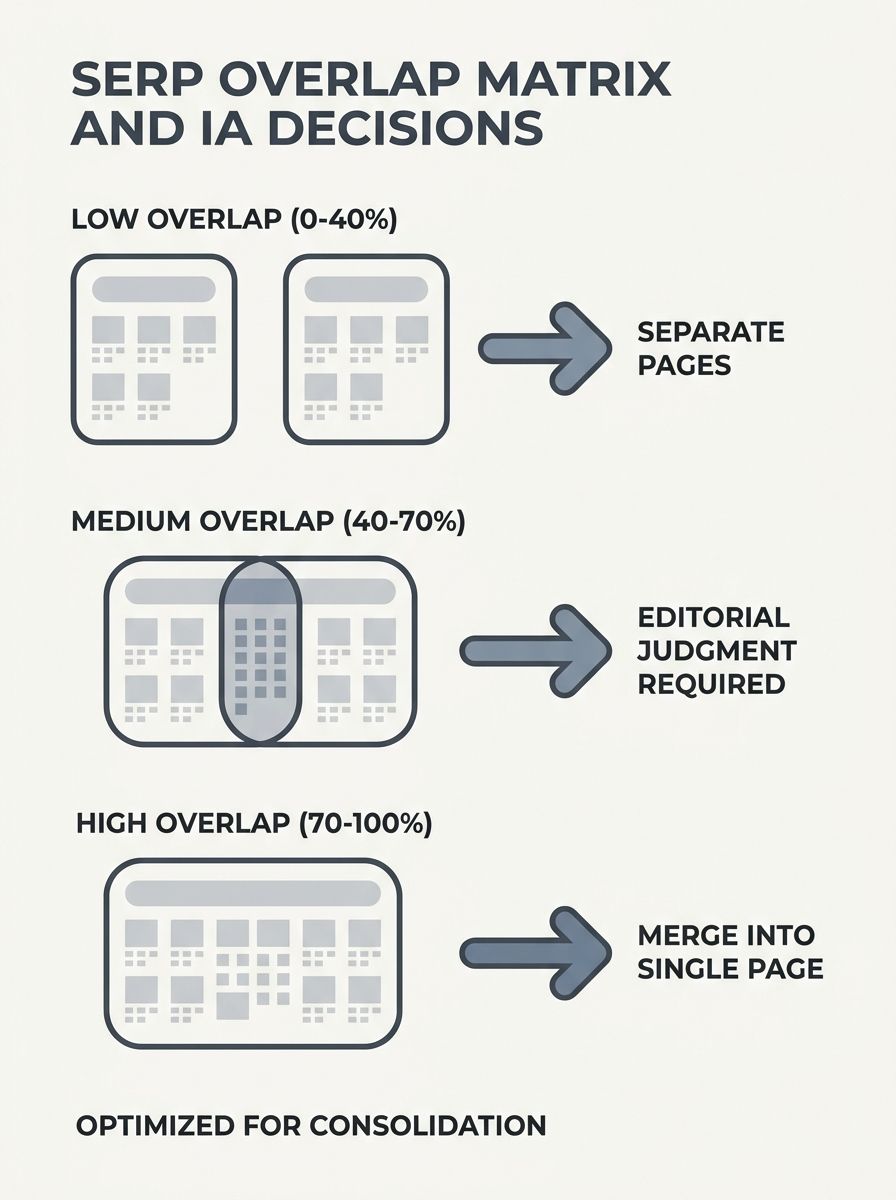
Why do two keywords belong on the same page? Because Google already ranks the same URLs for both. That's the core logic of SERP overlap clustering, and it doubles as an IA decision engine. When 60-70% of the top 10 results for "email marketing" and "email campaigns" are identical URLs, the search engine has already decided these queries resolve to the same content type. Creating separate pages for each splits authority and invites cannibalization.
Makarenko Roman's breakdown of keyword clustering on Medium confirms: "Two keywords might show similar results but serve different aspects of the same topic. Understanding these relationships helps create content that satisfies all cluster variations." The overlap percentage becomes your threshold for page-merging decisions. Below 40% overlap, you're looking at separate pages. Above 70%, a single page handles both. The 40-70% range is where editorial judgment earns its keep.
This process works in reverse too. If you have an existing site with 150 pages, pulling your ranking keywords from Google Search Console and clustering them by SERP overlap reveals which pages Google already treats as interchangeable. That's your IA audit, derived entirely from search data.
If you've already explored AI-assisted keyword clustering tools, the output from those workflows feeds directly into this architecture-building process. The clusters are page-level IA decisions waiting to be formalized into URLs.
The Intent-Hierarchy Framework for Turning Clusters into Navigation
Site structure planning from keywords requires more than flat clusters. You need vertical hierarchy. The Intent-Hierarchy Framework sorts clusters into 3 layers based on intent type and search volume ratios, converting clustered keyword data into navigational depth.
Layer 1: Transactional anchors (top-level navigation). These are your money pages. Brian Schnurr, writing about intent architecture, states: "When I rebuild a service business site now, I prioritize transactional and navigational intent for core service pages. Informational content supports it, but the architecture is built around conversion, not traffic." Service pages, product categories, and pricing pages sit here. They target keywords with commercial or transactional intent modifiers like "buy," "pricing," "hire," and "near me." Typical volumes range from 100-2,000 monthly searches per keyword, but conversion rates run 3-5x higher than informational queries.
Layer 2: Comparison and evaluation content (subfolder level). Keywords containing "vs," "best," "top," "review," and "alternative" signal users mid-funnel. These pages link upward to Layer 1 transactional pages and downward to Layer 3 educational content. A site with 8-12 Layer 2 pages per service category typically covers 65-80% of mid-funnel query space for that category.
Layer 3: Informational and educational content (blog or resource hub). "How to," "what is," "guide," and "examples" modifiers live here. Volume is highest, often 5-10x the search volume of transactional queries, but intent distance from conversion is also greatest.
Layer | Intent Type | Typical Modifiers | Volume Range | Conversion Proximity | IA Role |
|---|---|---|---|---|---|
1 | Transactional / Navigational | buy, hire, pricing, near me | 100–2,000/mo | High (direct) | Top-level nav pages |
2 | Commercial Investigation | vs, best, review, alternative | 500–5,000/mo | Medium (mid-funnel) | Subfolder pages |
3 | Informational | how to, what is, guide, examples | 1,000–20,000/mo | Low (top-funnel) | Blog / resource hub |
RankDots' clustering guide states the principle directly: "Instead of creating individual pages for every keyword variation, you create one page that ranks for the entire group. This structured approach prevents self-competition and builds a clear site architecture." Each layer maps to a navigation tier, and the keyword clusters within each layer determine how many pages that tier needs.

Extracting Hierarchy from Keyword Modifier Patterns
The modifiers users attach to head terms encode navigational expectations. Sort your keyword list by modifier type, and the site structure users expect will emerge from the data. The School of Content's reverse-engineering methodology maps this across the user journey: "You'll start from the user journey and write down as many keywords as possible for each of the stages." Their chiropractor example shows 3 distinct modifiers for the same head term: "chiropractor Alkmaar contact," "chiropractor Alkmaar appointment," "chiropractor Alkmaar location." Each modifier implies a different page or page section.
Geographic modifiers deserve special attention for building IA from keyword research data. A keyword set like "commercial architectural planning services [city]" tells you the site needs location-specific service pages, not a single generic service page with city names scattered through body copy. MarketKeep's keyword analysis for architects recommends URL structures like "/residential-architecture-[city]" and "/commercial-design-[city]," where each geographic modifier generates a distinct URL in the architecture.
Here's the practical extraction process in 4 steps:
Export all ranking keywords from GSC, filtering to queries with at least 10 impressions over 90 days to cut noise.
Tag each keyword with its primary modifier type: geographic, intent-based (how/what/buy/vs), service-specific, or audience-specific.
Group keywords sharing the same head term but different modifiers. Each unique modifier type appearing 3 or more times across your set signals a potential standalone page.
Map the resulting groups to a URL hierarchy where head terms become directories and modifier types become pages within those directories.
A 200-keyword export typically yields 12-25 distinct page-level IA decisions through this process. Sites with 500+ ranking keywords often surface 40-60 pages worth of architecture from modifier analysis alone. Understanding how keyword allocation maps to your site's structure prevents the most common mistake here: assigning 15 keywords to a page that should be 3 separate pages, or splitting 4 closely related keywords across pages that belong together.
When Org Charts and Search Data Disagree
Lazarina Stoy's analysis of search intent-driven website architecture identifies a persistent problem: SEOs are brought into the IA process as secondary contributors, after stakeholders have already decided the site structure based on internal department boundaries. The marketing team gets a section, the product team gets another, support gets its own. But users don't search by org chart.
Search intent information architecture forces a different organizing principle. When your keyword data shows that 70% of queries about "website redesign" co-occur in the same SERP results as queries about "SEO audit," those topics belong together in your IA, even if they're owned by different internal teams. One agency documented discovering that their organic SERP footprint covered "agency/website design" broadly but had zero mid-funnel visibility for the term "website redesign SEO." The gap existed because the site's architecture followed service team boundaries instead of search behavior patterns.
ClickRank's intent mapping methodology makes this concrete: "Intent mapping prevents content overlap by explicitly stating the intent that each piece of content is designed to satisfy." When Page A targets an informational query and Page B targets a transactional one, their content, format, and conversion goal are structurally distinct. The IA decision gets baked into the intent assignment itself.
If you've built a search intent map for your full site, you've already done half this work. The step most teams skip is converting that map into actual navigational and URL hierarchy changes: turning the intent map into a sitemap revision rather than a content calendar.
Competitor IA Reveals What Search Data Rewards
Reverse-engineering competitor keyword strategies surfaces which architectural decisions Google has already rewarded in your vertical. Pull the top 5 ranking domains for your 20 highest-priority keywords. Map which URLs rank for which keyword clusters. Patterns emerge quickly: some competitors consolidate 30-40 keywords onto a single pillar page, while others distribute them across 8-10 targeted subpages. The domain ranking higher has made the IA decision Google prefers for that query set.
This is where the distinction between content strategy and information architecture becomes concrete. You're extracting the page-to-cluster ratio that works in your niche. If the top 3 competitors all maintain separate pages for "enterprise SEO audit" and "small business SEO audit," that signals Google treats these as distinct intents requiring distinct pages, and your architecture should reflect that separation.
What The Data Doesn't Tell Us
SERP overlap clustering, intent mapping, and modifier analysis produce a data-backed site structure. But the data has blind spots worth naming. Keyword research data tells you what users search for today. It cannot tell you what they'll search for after you publish content that reframes a category. It cannot distinguish between a page that should exist because users need it and a page that should exist because it completes a topical map that strengthens surrounding pages through internal link equity.
And roughly 15% of IA decisions are pure brand and positioning choices: whether your services section leads with industry verticals or service types, whether you name a category using the term your audience uses or the term you want to own. No amount of SERP data can validate those calls in advance.
The process outlined here gets you roughly 75-85% of the way to a defensible IA. The remainder requires editorial judgment about content gaps your competitors haven't filled and structural bets on emerging search behavior. Treat keyword-derived IA as your evidence base, build the structure it clearly supports, then document which remaining decisions you made on instinct so you know what to revisit when new data arrives.
OrganicSEO.org Editorial
Editorial team writing about Ethical, white-hat, organic SEO education.
Related Articles
Keyword Research for Information Architecture: How to Map Search Intent to Site Structure Before Launch
Three methods dominate pre-launch keyword strategy for information architecture: SERP-driven intent mapping, topic cluster modeling, and user-task taxonomy. Each one produces a different site hierarchy, and 96.
The Seed Keyword Expansion Playbook: Moving Beyond Single Terms to Semantic Clusters Without Tool Dependency
Google's algorithmic evolution from Hummingbird through BERT and MUM turned single-keyword targeting into a losing strategy.

AI-Assisted Keyword Clustering: Using Claude and ChatGPT to Scale Research Without Losing Precision
Keyword Insights shipped a Claude skill that clusters keywords using live SERP overlap data, which means keywords grouped together actually share ranking URLs in Google's index.