The Keyword Research Tool Budget Trap: How Much Data Do You Actually Need to Rank?
Ahrefs charges $129/month at its entry tier. Semrush starts at $139.95/month. Running both alongside a content optimization tool pushes monthly spend past $350 before you factor in annual commitments.
The Keyword Research Tool Budget Trap: How Much Data Do You Actually Need to Rank?
Ahrefs charges $129/month at its entry tier. Semrush starts at $139.95/month. Running both alongside a content optimization tool pushes monthly spend past $350 before you factor in annual commitments. Free alternatives surface roughly 80% of the keyword data that shapes real ranking decisions, and most sites overpay for redundant metrics that never change a content outcome.
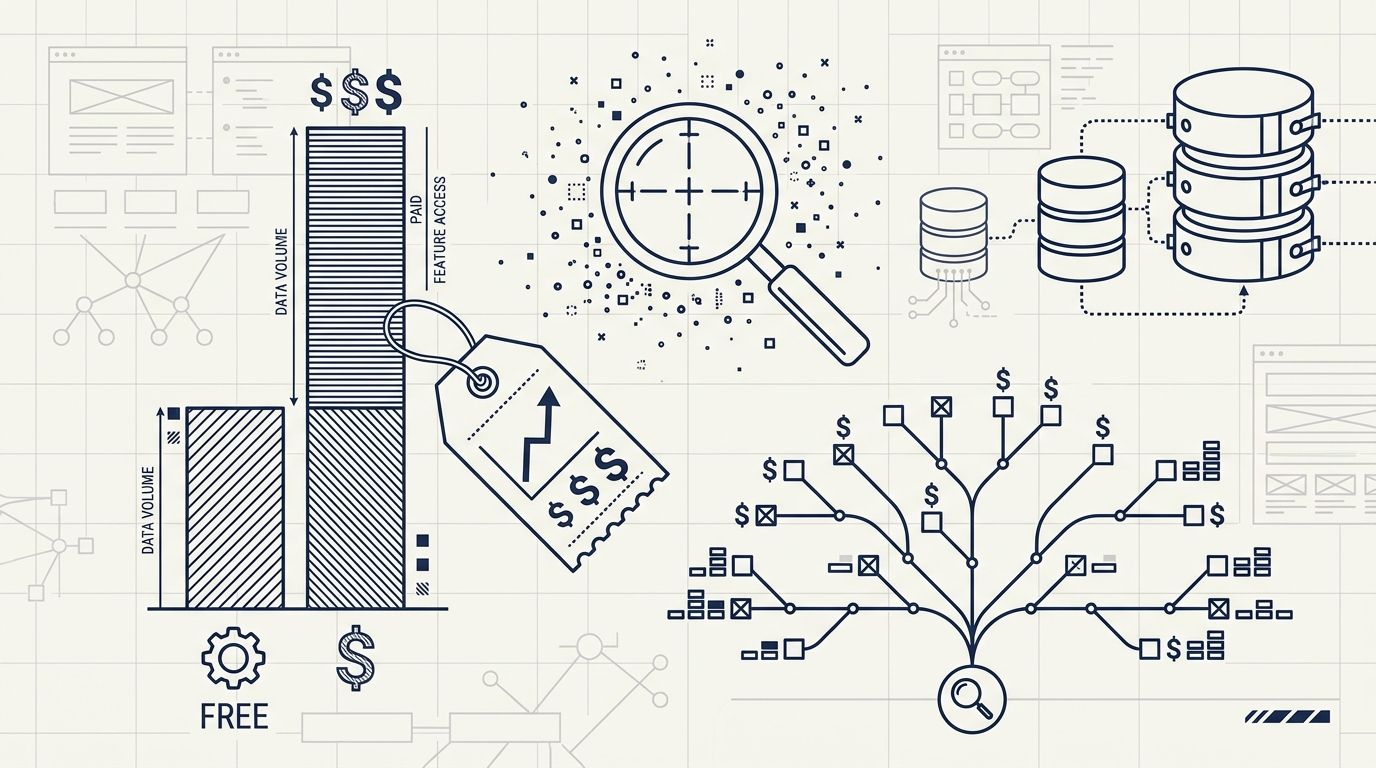
Three tiers dominate SEO tool budget allocation in practice: the free-only stack, a single paid subscription, and the multi-tool setup. Each tier gives you more data. The question worth $2,000-4,000/year is whether that extra data translates into better rankings or just fancier spreadsheets.
What Free Tools Actually Give You (and Where They Stop)
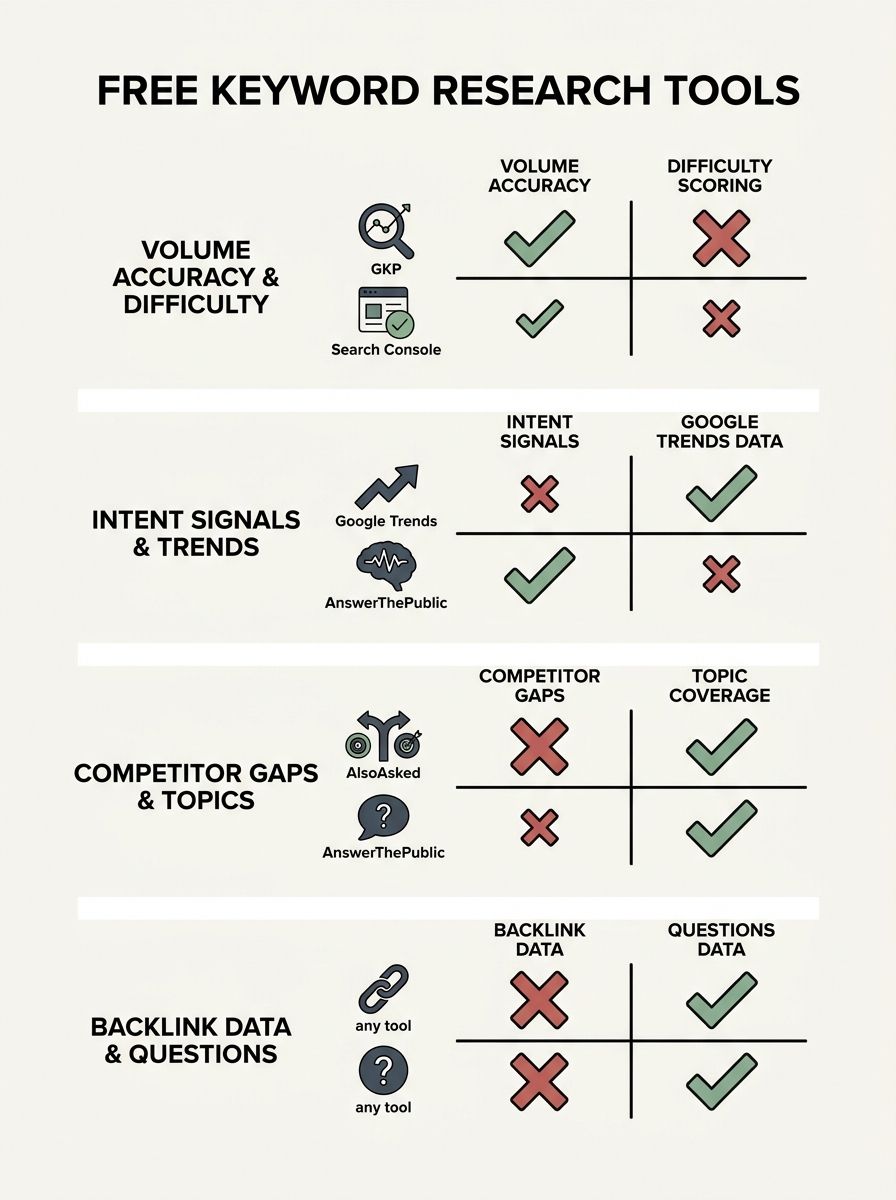
Google Keyword Planner, Google Search Console, Google Trends, AnswerThePublic (limited free tier), and AlsoAsked (3 free daily searches) collectively provide five core data points: search volume ranges, click-through behavior on your own site, seasonal trends, question-format queries, and People Also Ask structures. That combination covers the majority of what's needed to pick targets and write content that ranks.
Google's own SEO Starter Guide states plainly: "There are no secrets here that'll automatically rank your site first in Google." The implication runs deeper than humility. Ranking depends on content quality, site structure, and backlinks far more than on having a proprietary keyword difficulty score from a third-party tool.
The free stack's blind spots are genuine, though. Google Keyword Planner shows volume in ranges (1K-10K), not precise estimates. It offers no keyword difficulty metric. You get zero backlink data. And competitor keyword gaps? Invisible. If you're building a search intent map for your site, you can do it with free tools, but expect to spend 3-5x longer cross-referencing sources manually.
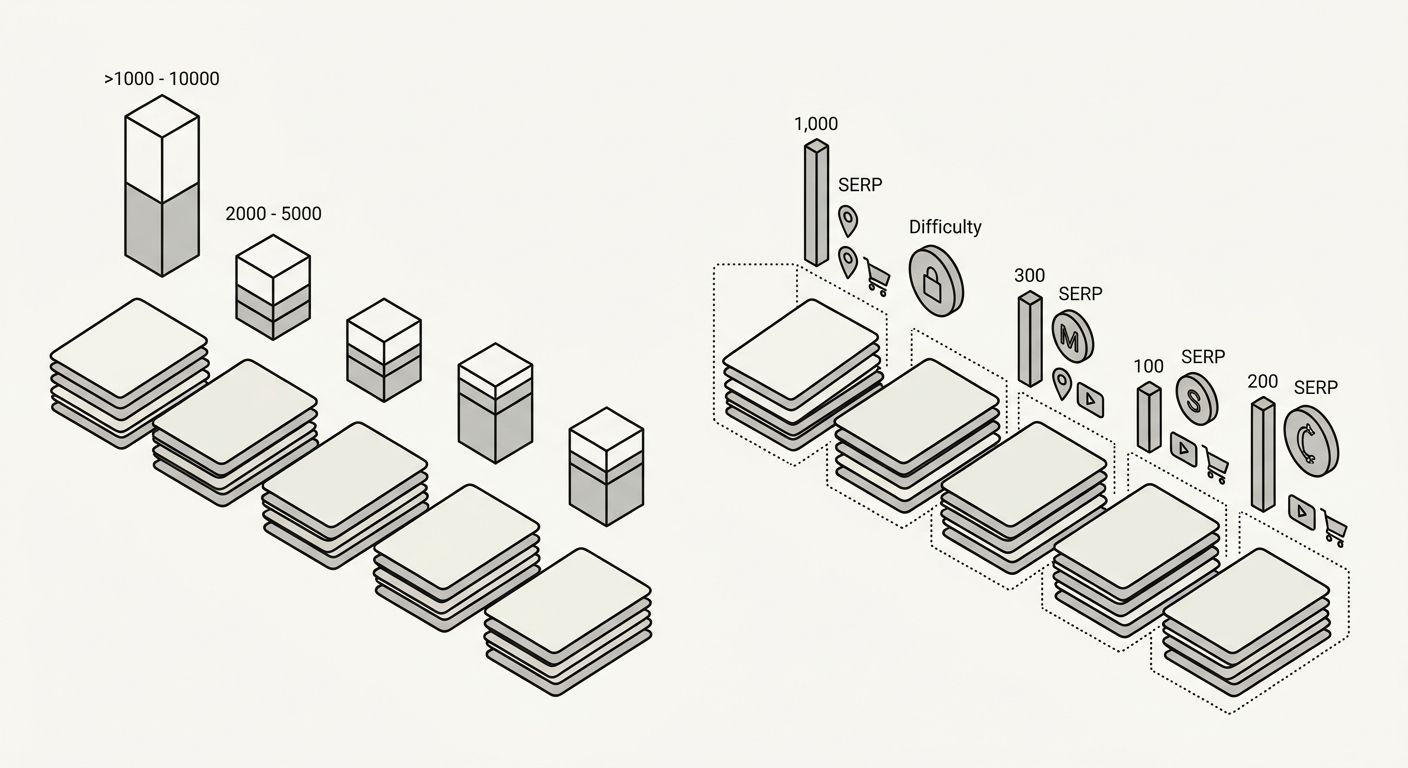
The keyword research data accuracy question matters here. Keyword Planner's volume ranges are directionally correct for sorting high-volume terms from low-volume ones. For decisions like "should I target this 200/month keyword or that 2,000/month keyword," the ranges work fine. For decisions like "is this keyword 1,400 or 1,800 searches/month," they don't. That level of precision rarely changes a content decision anyway.
One practitioner on the r/SEO subreddit described targeting keywords with as few as 20 monthly searches and finding success, observing that "the search number alone is not a good" indicator of whether a keyword is worth pursuing. Brafton's 2026 guide reinforces this, defining easy-to-rank keywords by low difficulty, long-tail format, and high relevance rather than raw volume. Free tools surface these long-tail opportunities just as well as paid ones, because identifying them depends on understanding your audience, not on a proprietary database.
Who it fits: Solo bloggers, niche affiliate sites under 50 pages, anyone publishing fewer than 4 articles per month. If your site earns under $500/month from organic traffic, a $140/month tool subscription is eating 28% or more of that revenue with no guaranteed lift.
One Paid Tool at $100-140/Month
A single Ahrefs or Semrush subscription changes three things: you get estimated search volumes as integers instead of ranges, you get a keyword difficulty score, and you get backlink plus competitor gap data. We've broken down exactly how Ahrefs and Semrush compare feature by feature separately, so the full comparison lives there.
The keyword difficulty (KD) score is the feature most people buy these tools for, and it's the feature most likely to mislead. KD scores are proprietary calculations based primarily on backlink profiles of current top-ranking pages. They don't account for content quality, topical authority, site age, or internal linking strength. A keyword showing KD 45 on Ahrefs might register KD 62 on Semrush for the identical query. Neither number tells you whether your site can rank for it.
What the paid tier genuinely improves is competitive gap analysis. Seeing which keywords your competitors rank for that you don't, then cross-referencing against your site's topical authority, is a workflow that barely exists in free tools. When you're mapping keyword allocation across your site architecture, paid tools cut research time from days to hours.
HubSpot's long-running keyword research analysis found that "AI tools and algorithms now prioritize topic authority over individual keywords," recommending that teams build content clusters around a single theme instead of chasing dozens of loosely related terms. A paid tool makes cluster identification faster because you can pull keyword groupings, SERP overlap data, and parent topic analysis in a few clicks. But the strategic decision of which clusters to build still depends on editorial judgment, not the tool's output.
SmartClick's tracking analysis suggests monitoring more than 160 keywords per client is possible but recommends prioritizing the top 10 most relevant keywords during the initial strategy phase. That's a useful frame: even with a paid tool's database of millions of keywords, the actionable subset for any single site is usually small. You don't need a bigger tool. You need a tighter focus.
Who it fits: Sites publishing 4+ articles per month, freelancers or agencies managing 1-5 client sites, anyone whose organic channel generates enough revenue to justify the $1,200-1,680 annual cost. If you're already running continuous keyword monitoring rather than quarterly refreshes, a paid tool makes that workflow dramatically faster.
The Multi-Tool Stack at $300+/Month
Running Ahrefs ($129+), Semrush ($139.95+), and a content optimization tool like Clearscope or SurferSEO ($49-99) puts monthly spend between $320 and $470. Some agencies add Moz ($49+) on top, pushing totals past $500. Annual commitments across these tools run $4,200-6,000, a number that rarely appears in SEO budget planning conversations because each subscription is evaluated in isolation.
The case for stacking: each tool's crawler indexes a different slice of the web at different intervals. Ahrefs and Semrush don't always agree on search volumes, keyword difficulty, or even which URLs rank for a given query. Running both gives you two independent data points, which can surface discrepancies worth investigating. Moz adds its own link index and Domain Authority metric, though DA is a proxy metric with real limitations worth understanding before you rely on it.
The case against stacking: you're buying incremental improvements on data that already has wide confidence intervals. Ahrefs' search volume estimate for a keyword might be 1,200. Semrush might say 1,600. The actual number in Google's systems could be 900. Having two imprecise estimates doesn't make your targeting decision more reliable. It doubles the time you spend reconciling data that was never precise to begin with.
Feature | Free Stack (GSC + Planner + Trends) | One Paid Tool ($100-140/mo) | Multi-Tool Stack ($300-500/mo) |
|---|---|---|---|
Volume data | Ranges (1K-10K) | Integer estimates (±30-40% accuracy) | 2+ integer estimates (still ±30-40% each) |
Keyword difficulty | None | Proprietary score (tool-specific) | Multiple scores (often contradictory) |
Backlink data | None | One link index | 2-3 link indexes |
Competitor gap analysis | Manual (slow) | Automated | Automated from multiple angles |
SERP feature tracking | Basic (GSC) | Full | Full, cross-validated |
Content optimization scoring | None | Limited | Dedicated tool possible |
Annual cost | $0 | $1,200-1,680 | $4,200-6,000 |
SimpleTiger's SEO ROI framework emphasizes that estimated monthly search volume forms the basis of prospective ROI calculations, and that data comes from any single paid tool. The marginal accuracy gain from cross-referencing Ahrefs and Semrush volumes doesn't shift the ROI calculation in a meaningful way unless you're operating at traffic volumes where a 20% variance represents thousands of dollars monthly.
Who it fits: Agencies managing 10+ client sites where the time saved by cross-referencing data across tools pays for itself in billable hours. Enterprise in-house teams with dedicated SEO analysts and $10,000+ monthly content budgets, where a 5% improvement in keyword targeting efficiency carries real dollar weight. For everyone else, this tier is where the budget trap springs shut.
Who Should Pick Which
The honest framing for free vs paid keyword tools in 2026 comes down to one variable: how many content decisions per month hinge on keyword data.
If the answer is fewer than 4, free tools handle it. Google Search Console tells you what Google already thinks your site is about. Keyword Planner gives you enough volume data to prioritize. Trends shows you seasonality. You don't need a KD score to decide whether to write a blog post for a niche audience.
If the answer is 4-20, one paid tool pays for itself in time savings alone. Pick Ahrefs or Semrush based on which interface you prefer and which features match your workflow. Don't buy both.
If the answer is 20+ across multiple sites, the multi-tool stack becomes defensible, but only if you've built processes that actually use the overlapping data. Owning two keyword research platforms without a workflow for reconciling their outputs is paying twice for the same uncertainty.
The budget trap works like this: SEO tool companies sell on features, not outcomes. They present dashboards full of numbers, and the implicit promise is that more numbers produce better rankings. But rankings are driven by content depth, backlink profiles, site structure, and clear intent alignment with your target keywords. No keyword tool, free or paid, writes the content or earns the links. These tools help you pick targets faster. That's a real benefit with a ceiling, and most sites hit that ceiling well before they hit $300/month in tool spend. The keyword research tool ROI question has a boring answer: buy the minimum tier that saves you meaningful time, and spend the difference on content and links that actually move rankings.
OrganicSEO.org Editorial
Editorial team writing about Ethical, white-hat, organic SEO education.
Related Articles
Keyword Research Data Conflicts in 2026: Why Ahrefs, Semrush, and Google Keyword Planner Give Different Numbers (And What to Do About It)
Ahrefs, Semrush, and Google Keyword Planner report different search volume numbers for the same keywords because each tool collects, models, and categorizes search data through fundamentally different methods.
Why Your Keyword Research Tools Disagree on Search Volume (And How to Break the Tie)
Store Growers tested 10 commercial keywords across Google Keyword Planner, Semrush, Ahrefs, and SpyFu and found that no two tools agreed on volume for a single term.
Beyond Search Volume: Why Keyword Research Tools Miss Half Your Opportunity in 2026
Roughly 15% of the queries Google processes each day have never appeared in any keyword research tool's index. That figure represents the floor of what volume-based research misses, before accounting for the queries tools do track but measure with wildly conflicting numbers across platforms.