Screaming Frog vs. Sitebulb: Which Crawler Fits Your Technical SEO Workflow
Screaming Frog's annual license costs £259 for unlimited URL crawling on a single desktop. Sitebulb Lite starts at £11 per month with tiered URL caps.
Screaming Frog vs. Sitebulb: Which Crawler Fits Your Technical SEO Workflow
Screaming Frog's annual license costs £259 for unlimited URL crawling on a single desktop. Sitebulb Lite starts at £11 per month with tiered URL caps. The £127 annual price gap at the low end masks a fundamental design split between raw data control and prioritized, visual recommendations across 300+ issue types.
Pricing Tells You More Than You'd Expect
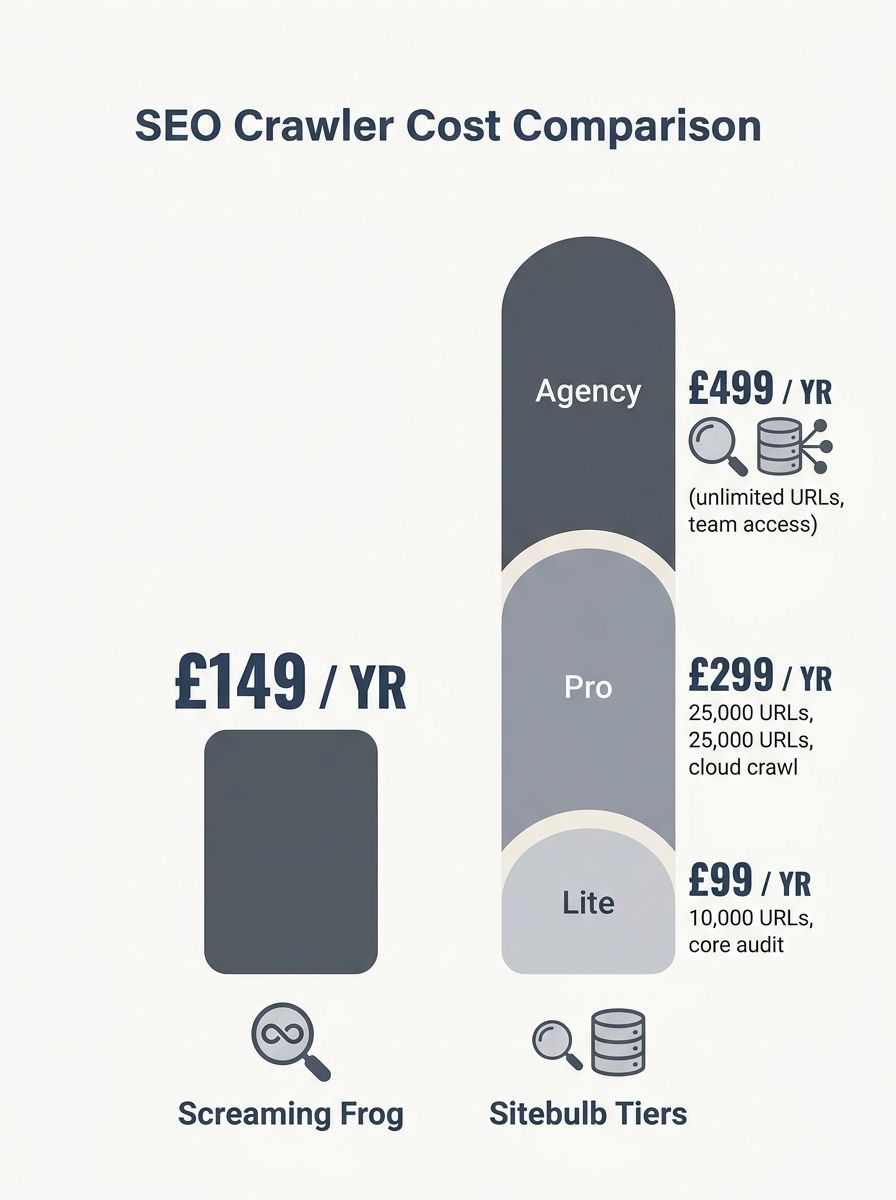
Screaming Frog charges a flat £259 per year (roughly $259 USD) for a single-user desktop license with no URL crawl limit. The free version caps at 500 URLs, which is enough for small sites or quick spot-checks but useless for real audits. There's no cloud option, no team plan, no browser-based access.
Sitebulb splits pricing across Desktop and Cloud tiers. Desktop Lite runs £11 per month; Desktop Pro runs £21 per month; Cloud Pro goes up to £30+ per month. The Pro plan supports up to 500,000 URLs per crawl. Cloud access lets distributed teams review the same audit data from a browser without installing anything locally.
That structural difference matters. According to Sitebulb's own comparison documentation, "Screaming Frog is desktop only, with no cloud capabilities," making it less suited for teams that need shared access or are running audits across multiple client accounts remotely. If you're a solo practitioner running audits on your own machine, Screaming Frog's flat annual fee is hard to beat on cost per crawl. If you're an agency with 3+ people who need to review findings, Sitebulb's Cloud Pro eliminates the file-passing bottleneck.
When you're building out a solo SEO tool stack, the £259 annual spend for Screaming Frog often represents the best value-per-URL in the entire budget. Compare that to Semrush's Site Audit, which bundles into a $129.95 per month subscription covering many tools beyond crawling, and the price-to-crawl math favors dedicated crawlers by a wide margin.
The Scale-Insight-Collaboration Framework
Why do so many site crawler comparison threads end with "it depends"? Because people evaluate crawlers on a single axis (features) when the real decision involves three:
Scale tolerance measures the maximum number of URLs the tool can crawl efficiently without choking. Screaming Frog handles millions of URLs on sufficiently powerful hardware. Sitebulb Pro caps at 500,000 URLs per project, and Desktop Lite caps lower.
Insight legibility measures how quickly you can go from raw crawl data to a prioritized list of issues. Screaming Frog exports CSVs and Excel files that you then sort, filter, and interpret manually. Sitebulb scores each issue by severity and provides plain-English explanations for all 300+ checks it runs.
Collaboration capability measures whether the findings can be shared, reviewed, and acted on by people who didn't run the crawl. Screaming Frog requires the other person to have the software installed or to read exported spreadsheets. Sitebulb Cloud generates shareable browser-based reports and white-label PDFs.
Evaluate both crawlers against all three axes before deciding. A technical SEO audit tool that scores 10/10 on scale but 3/10 on insight legibility will still slow your workflow down if you spend 4 hours manually interpreting every crawl export.
Where Crawl Visualization Changes the Audit
Sitebulb's crawl maps are the feature that draws the clearest line between these two tools. According to Sitebulb's crawl map documentation, the tool "provides useful technical insights about your site's architecture" by mapping URLs based on where they were first discovered by the crawler. The tree structure shows how child URLs sit underneath their parent URLs, giving you a visual read on content grouping and depth distribution.
This is the kind of output you'd send to a client or a dev team who won't read a 47-column spreadsheet. The crawl visualization reveals orphaned pages, overly deep content (anything past click-depth 4 is usually a red flag), and structural clusters that don't match the intended site taxonomy. For anyone working on information architecture and crawlability, these maps compress hours of manual analysis into a 30-second visual scan.
Screaming Frog offers basic visualization through its Crawl Tree Graph and Directory Tree features, but both are limited compared to Sitebulb's interactive, zoomable maps. You can export Screaming Frog data into external tools like Gephi or Google Sheets add-ons for network visualization, but that adds 30-60 minutes per audit to a workflow that Sitebulb handles natively.
Log File Analysis Belongs to Screaming Frog
Why does log file analysis tilt this comparison so heavily? Because Screaming Frog offers a dedicated, standalone Log File Analyser that processes server log data independently from crawl data. The tool lets you examine Googlebot behavior, crawl frequency by URL, response codes served to bots, and crawl budget waste on non-indexable pages.
MADX Digital's 2026 review notes that "Screaming Frog is a marketing agency offering more extensive features and capabilities" beyond what Sitebulb provides, and log file analysis is the clearest example of that gap. You can examine log data across daily, weekly, monthly, or custom date ranges, then cross-reference it against your crawl data to spot URLs that Googlebot hits repeatedly but that return 301 chains or 404s.
Sitebulb does not offer log file analysis at all. If your technical SEO debugging workflow requires understanding real search engine behavior on your server (as opposed to simulated crawl behavior from your machine), Screaming Frog is the only option in this two-tool comparison. seoClarity's enterprise audit guide recommends combining crawl data with log insights to understand actual search engine behavior, and Screaming Frog is the tool that makes that combination possible without a third subscription.
The maximum number of log events you can analyze in Screaming Frog is limited only by your hard drive capacity. For sites processing 10+ million log lines per month, that's a meaningful advantage over cloud-based log analyzers with row limits.
Custom Extraction and API Access
Screaming Frog supports custom data extraction via XPath, CSS selectors, and regex patterns. You can pull specific on-page elements (prices, author names, schema fields, publication dates) from every URL in a crawl and export them as structured columns in your CSV output. This is the feature that makes Screaming Frog indispensable for large-scale site migrations, where you need to verify that 50,000+ product pages all carry the correct canonical tag, hreflang attribute, or structured data block.
Screaming Frog also integrates directly with third-party APIs from Ahrefs, Majestic, Moz, Google Analytics, Google Search Console, and PageSpeed Insights. You can pull backlink counts, page authority scores, and Core Web Vitals data into the same crawl export, giving you a single spreadsheet that covers on-page issues, performance data, and link metrics simultaneously.
Sitebulb integrates with Google Analytics 4, Google Search Console, and Chrome UX Report data. It also supports exports to Looker Studio for custom dashboards. But it lacks the third-party SEO tool API integrations that let Screaming Frog serve as a central data hub for evaluating tools that earn their subscription cost.
Reporting and Client Delivery
Zeo's analysis of log file workflows observes that the real time cost in technical SEO isn't running the crawl. It's "examining the performance of the data" and communicating findings to stakeholders who don't speak SEO. This is where the tools diverge most sharply.
Screaming Frog produces spreadsheet-style exports (CSV, Excel, Google Sheets) that require you to build your own reporting layer. Power users appreciate this because they can manipulate the data however they want. But if you're delivering 8 audits per month to clients who expect polished PDFs, you're spending significant time in Google Slides or Canva reformatting crawl data into something presentable.
Sitebulb generates white-label PDF reports directly from the tool. Every issue includes a plain-English explanation of what's wrong, why it matters, and what priority level it carries. Sitebulb has won Best Search Software Tool twice at the UK Search Awards, and the reporting quality is a big reason why. The 14-day free trial (no credit card required) lets you test this reporting output against your actual client workflow before committing.

Feature Comparison at a Glance
Feature | Screaming Frog | Sitebulb |
|---|---|---|
URL crawl limit (paid) | Unlimited | Up to 500K (Pro) |
Annual cost (low end) | £259 | £132 (Lite, billed monthly) |
Cloud access | No | Yes (Cloud plans) |
Log file analysis | Yes (standalone tool) | No |
Crawl visualization | Basic (tree graph) | Advanced (interactive maps) |
Custom extraction | XPath, CSS, regex | Limited |
Third-party API integrations | Ahrefs, Majestic, Moz, GA4, GSC | GA4, GSC, Chrome UX |
Client-ready PDF reports | No (manual export) | Yes (white-label) |
Issue prioritization scoring | No | Yes (300+ issues scored) |
Free version | 500 URLs | 14-day full trial |
What The Numbers Still Can't Settle
The data points a clear direction for each tool. Screaming Frog is the stronger choice for practitioners who need unlimited crawl scale, log file analysis, custom data extraction, and API-based integration with link analysis tools. Sitebulb is the stronger choice for teams and agencies that need crawl visualization, scored issue prioritization, cloud collaboration, and reports that a non-technical stakeholder can actually read.
But the numbers don't capture how these tools feel inside a recurring workflow. Screaming Frog's interface is dense, data-forward, and designed for people who already know what they're looking for. Sitebulb's interface assumes you might not know where the problems are and guides you toward them. That UX gap doesn't show up in feature tables, but it determines whether a new team member can run a useful audit on day one or needs two weeks of ramp-up time.
The stat that's missing from every comparison is time-to-actionable-finding, the interval between hitting "Start Crawl" and having a prioritized fix list in front of a developer. For small-to-midsize sites under 50,000 URLs, Sitebulb consistently compresses that interval. For sites above 500,000 URLs or workflows that require log file cross-referencing, Screaming Frog is the only realistic option among these two. And for the growing number of practitioners who've stopped choosing, running both tools at a combined annual cost under £500 covers every gap in this comparison.
OrganicSEO.org Editorial
Editorial team writing about Ethical, white-hat, organic SEO education.
Related Articles
The Keyword Research Tool Budget Trap: How Much Data Do You Actually Need to Rank?
Ahrefs charges $129/month at its entry tier. Semrush starts at $139.95/month. Running both alongside a content optimization tool pushes monthly spend past $350 before you factor in annual commitments.
Ahrefs vs. Semrush for Keyword Research in 2026: Which Tool Actually Wins Where It Counts
Ahrefs and Semrush pull keyword data from fundamentally different pipelines — different crawlers, different clickstream providers, different difficulty algorithms.
Beyond Search Volume: Why Keyword Research Tools Miss Half Your Opportunity in 2026
Roughly 15% of the queries Google processes each day have never appeared in any keyword research tool's index. That figure represents the floor of what volume-based research misses, before accounting for the queries tools do track but measure with wildly conflicting numbers across platforms.