Why Publishing More Content Is the Wrong Default When Organic Traffic Plateaus
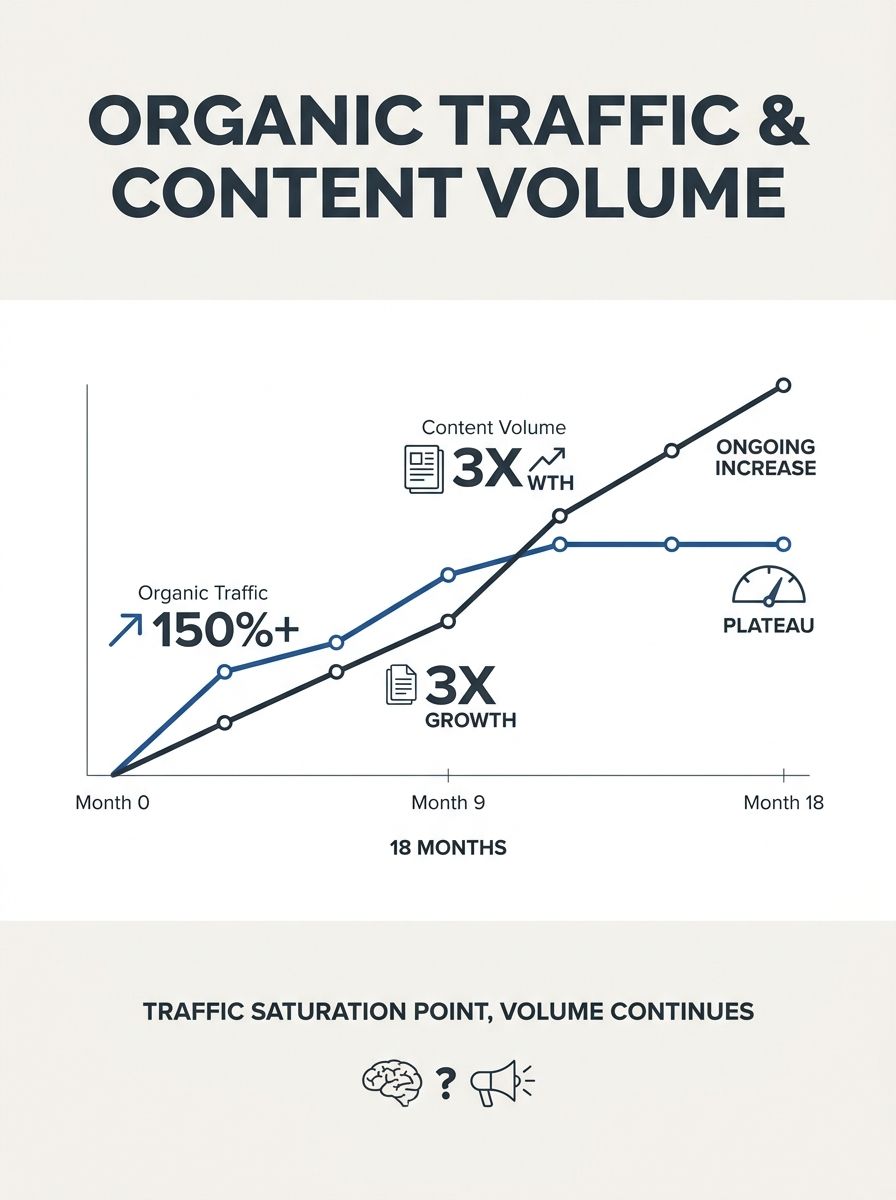
Google Search Console graphs tell the same story across thousands of sites: organic traffic climbs for 12 to 18 months, then flattens. The near-universal first response, publishing more and publishing faster, makes the plateau worse.

Why Publishing More Content Is the Wrong Default When Organic Traffic Plateaus
Google Search Console graphs tell the same story across thousands of sites: organic traffic climbs for 12 to 18 months, then flattens. The near-universal first response, publishing more and publishing faster, makes the plateau worse. The evidence-backed fix runs in the opposite direction: consolidate, prune, and strengthen what already exists.
When Volume Actually Works
Every site goes through a phase where more content equals more traffic. You're covering new topics, targeting fresh keyword clusters, and Google keeps rewarding you with indexed pages and impressions. The math is straightforward during this period: each new URL captures queries your site didn't rank for before.
This early phase creates a dangerous assumption. Teams internalize a mental model where content output and traffic growth move in lockstep. SEO strategies get built around editorial calendars with escalating publishing targets. Four posts per month becomes eight, becomes sixteen. Budgets follow the same trajectory.
The relationship between volume and growth has an expiration date, and almost nobody plans for when it arrives. That missing plan is where the plateau becomes a trap.
The Plateau Arrives
Why does organic traffic stagnation happen even when publishing continues at full pace? Because a site reaches an equilibrium point where new URL growth gets canceled out by the natural decay of older pages. Analysis from Mobidea documents a pattern that shows up across industries: 80% of a site's traffic comes from 20% of its pages. The remaining 80% of pages generate almost zero value.
That 80/20 split is the plateau in a single statistic. You're adding URLs to the long tail of pages nobody visits, while the pages that actually drive traffic age without updates. New content fills the same space your existing pages already occupy, often competing with them directly for the same keyword clusters.
When you look at your analytics at this stage, you'll typically find 150 or 200 published posts, with 30 to 40 of them generating essentially all of your search traffic. The rest sit there consuming crawl budget and diluting your site's topical signals. If you've ever worked through how site structure influences crawlability and authority flow, you've already seen how spreading link equity too thin across too many pages weakens every page's ability to rank.
This is usually the moment someone on the team says "we need to publish more." That instinct runs directly counter to what the data supports.
The Wrong Response and Its Consequences
When teams react to a content plateau strategy problem by doubling down on volume, three things typically break at once.
Keyword cannibalization accelerates. Semrush's research on content pruning identifies a direct mechanism: overlapping content creates cannibalization that decreases visibility across all competing pages. Five blog posts about the same topic don't create five chances to rank. They create five pages splitting click-through rates and confusing Google about which URL to surface. Your 2% CTR on one strong page becomes 0.4% spread across five weak ones.
Crawl budget gets wasted. Every low-value page Googlebot crawls is a page it didn't spend time on. If you've dealt with canonical tag misconfigurations draining crawl budget, you've seen this dynamic firsthand. Adding thin content multiplies the problem by giving crawlers more URLs that lead nowhere useful for users.
Site-wide quality signals drop. Google's helpful content system operates at the site level, not the page level. When a large percentage of your pages generate poor engagement signals (high bounce rates, short dwell times, zero return visits), those signals affect how Google scores your entire domain. Publishing 50 mediocre posts actively drags down the pages that were already performing well.
As DAU Agency's analysis puts it: "Publishing more pages won't fix weak positioning, poor site structure, slow load times, thin service pages, or low domain trust." The real work of SEO is visibility that translates into pipeline and revenue. Volume alone doesn't produce that.

Google's Own Endorsement of Subtraction
The pivot toward content consolidation SEO started getting explicit industry validation when the evidence became impossible to ignore. During Google's SEO Mythbusting series, Lily Ray of Path Interactive asked developer advocate Martin Splitt whether it made sense to consolidate two similar pieces into one article and do "a lot of merging and redirecting."
Splitt's answer, as Search Engine Land reported: "Definitely."
Google didn't stop at verbal endorsement. The company applied the same logic internally, consolidating six individual websites into fewer, stronger properties. The reasoning mirrors what SEOs had been discovering through their own audits: spreading topical authority across many overlapping pages weakens all of them simultaneously.
Content consolidation reduces ambiguity by strengthening clear, authoritative pages rather than scattering ranking signals across many overlapping URLs, as Elite SEO Consulting's analysis documented. When you merge three posts about the same topic into one thorough page and 301-redirect the old URLs, you concentrate backlinks, internal link equity, and engagement metrics into a single destination.
Ten Speed's research on content consolidation tracked what happens after merging overlapping content. The consolidated page expanded the number of queries it qualified for, and traffic grew for six additional months following the merge. Six months of compounding growth from removing pages. That's the opposite of what the "publish more" instinct predicts.
Pruning and Consolidation in Practice
Content pruning vs publishing doesn't have to be an either/or decision made once. It's a recurring audit cycle, and the documented results are consistent enough to treat as a reliable playbook.
One case study from Insight Savvys showed a 32% organic traffic boost from a structured pruning strategy. The approach followed a specific sequence: audit all pages by traffic and backlink profile, bucket them into categories, then apply different treatments to each bucket.
Pages with backlinks but no traffic get 301-redirected to the strongest topically related page. Pages with neither links nor traffic get removed entirely. Pages with some traffic but outdated content get refreshed with current data and republished.
The financial services space offers a useful illustration. Rather than maintaining five mediocre blog posts about 401k rollovers competing for the same keywords, consolidation combines them into one authoritative resource. That single page concentrates all ranking signals and provides a better experience for readers who don't want to bounce between five partial answers to the same question.
Building a search intent map across your site is the prerequisite step. You need to know which pages serve the same intent before you can decide what to merge. Without that map, you're pruning blind and risk removing pages that serve a distinct purpose you hadn't recognized.
How Consolidation Differs from Deleting Pages
The distinction matters because content pruning done poorly looks like content destruction. A structured approach has different treatments depending on the page's current value.
Page Type | Traffic | Backlinks | Treatment |
|---|---|---|---|
Strong performers (top 20%) | High | Yes | Refresh and expand with current data |
Overlapping content | Low to moderate | Some | 301-redirect to strongest sibling URL |
Thin or outdated, no links | Zero | None | Remove or noindex |
Thin or outdated, has links | Zero | Yes | 301-redirect to topically relevant page |
Seasonally relevant | Periodic | Varies | Update annually, keep URL stable |
The critical detail in this table: pages with backlinks should never be deleted outright. Those inbound links carry authority, and a 301 redirect transfers approximately 90-99% of that equity to the destination page. Deleting the URL throws away link value you've already earned, sometimes over years of building referring domains through white-hat outreach.
If your internal link structure has dilution problems, consolidation compounds the fix by reducing the number of pages that internal links need to support. Fewer pages means each remaining page gets a larger share of your site's internal authority. A site that goes from 200 URLs to 130 well-maintained ones concentrates the same total link equity across 35% fewer destinations.

Where The Data Lands Today
The evidence from multiple case studies, Google's own organizational behavior, and the 80/20 traffic distribution pattern all converge. When organic traffic plateaus, the productive response is to audit what you already have, consolidate overlapping content, prune dead weight, and update the pages that are already working.
A 32% traffic lift from pruning. Six months of compounding growth from consolidation. Site-wide quality improvements from reducing the denominator of poor-engagement pages. These results all required removing or merging content rather than adding more of it.
Publishing new content still makes sense when it targets genuinely unoccupied keyword territory your site has authority to claim. But that's a targeted, research-driven decision after the consolidation work is done. The sites that break through organic traffic stagnation are the ones treating their existing content library as the primary asset worth investing in. New URLs are the exception, justified by gap analysis, not a reflex triggered by a flatlined graph.
OrganicSEO.org Editorial
Editorial team writing about Ethical, white-hat, organic SEO education.
Related Articles
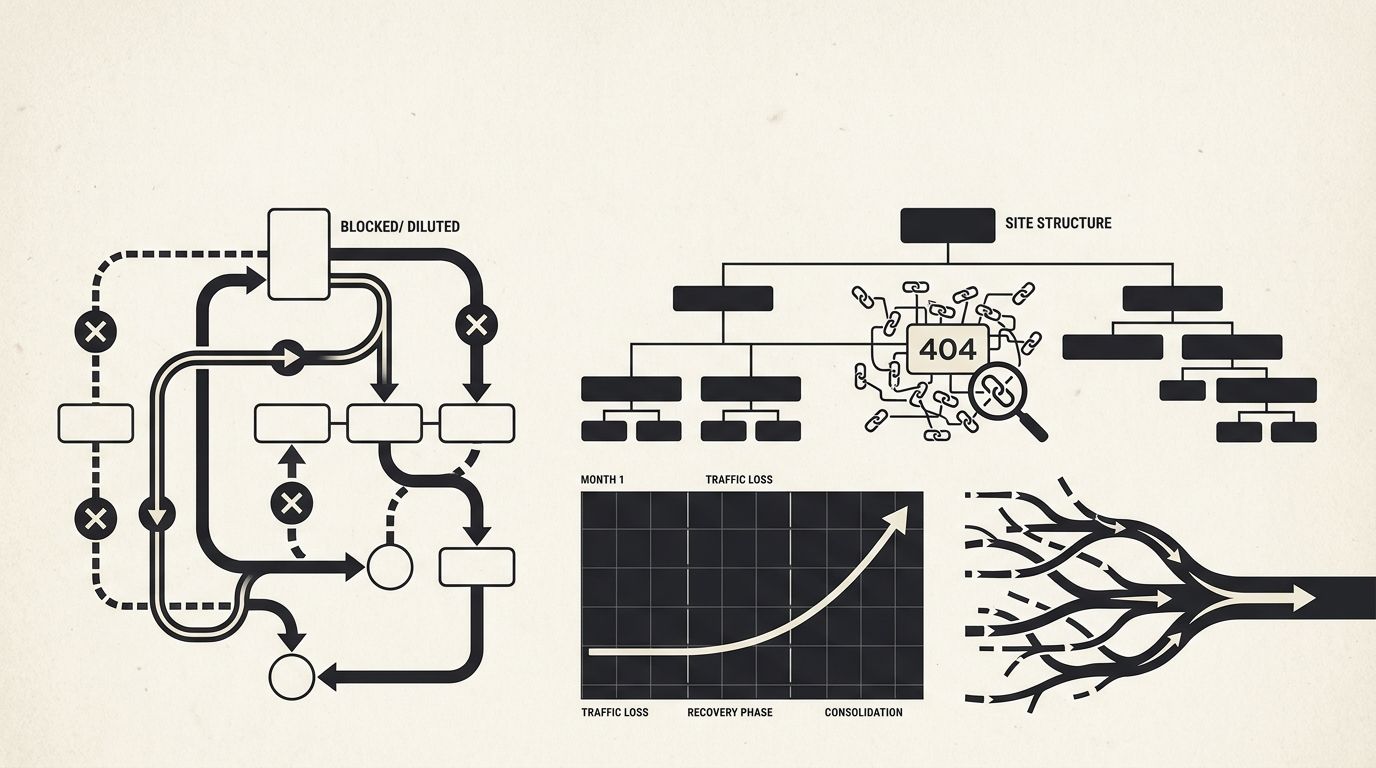
How a 14-Page Service Site Recovered 60% of Lost Organic Traffic by Fixing Internal Link Dilution
Every internal link on a page splits that page's accumulated PageRank among all outgoing targets. When a 14-page service site carries more links in its footer and navigation than it has indexable URLs, each money page starves for authority.

When Keyword Research Data Conflicts With Ranking Reality: The Intent-Volume Paradox
Every major keyword tool defaults to sorting results by search volume descending. That single UX decision has trained an entire generation of SEOs to build content around the metric least predictive of whether a page will actually rank, earn clicks, convert visitors, or hold its position over time.

Keyword Allocation Strategy: How to Map Your Research to Site Architecture Without Diluting Authority
Assigning the same target keyword to two or more URLs forces Google to choose which page deserves the ranking, and it frequently picks the wrong one.