The Keyword Research Refresh Trap: When Continuous Monitoring Beats Quarterly Audits
Quarterly keyword audits leave a 90-day blind spot where ranking positions erode, search intent shifts, and competitors claim territory unchecked. Continuous keyword monitoring SEO workflows detect drift within days, giving teams time to respond before traffic loss compounds.
The Keyword Research Refresh Trap: When Continuous Monitoring Beats Quarterly Audits
Quarterly keyword audits leave a 90-day blind spot where ranking positions erode, search intent shifts, and competitors claim territory unchecked. Continuous keyword monitoring SEO workflows detect drift within days, giving teams time to respond before traffic loss compounds. The standard three-month refresh cycle, still the default at most organizations, was designed for a slower search environment that no longer exists.
How Quarterly Became the Default
The three-month keyword audit cycle emerged during a period when Google's algorithm updates rolled out a handful of times per year. You'd run your audit in January, action the findings through February and March, then wait for the next cycle. Ahrefs and Semrush both structured their educational content around this cadence, and SEO teams adopted it because it matched their reporting rhythms. Quarterly business reviews, quarterly keyword reviews. Clean and simple.
For years, this worked well enough. Google's index updated slowly, SERP features changed gradually, and a keyword that ranked #4 in January was likely still within a few positions by April. The three-month keyword refresh cycle became gospel in SEO education, and entire workflows were built around it.
But the environment that justified quarterly audits started deteriorating around 2023, and by 2025 it was gone. Google confirmed running thousands of ranking experiments simultaneously. AI Overviews reshaped click-through rates on informational queries. And competitor content refresh cycles accelerated: according to a Siege Media data study, keywords with difficulty scores above 90 see top-ranking content updated every 320 days on average, while lower-difficulty keywords get refreshed within two years. The competitive surface moves faster at the top, and quarterly audits can't keep pace with that velocity.
The 90-Day Blind Spot Revealed
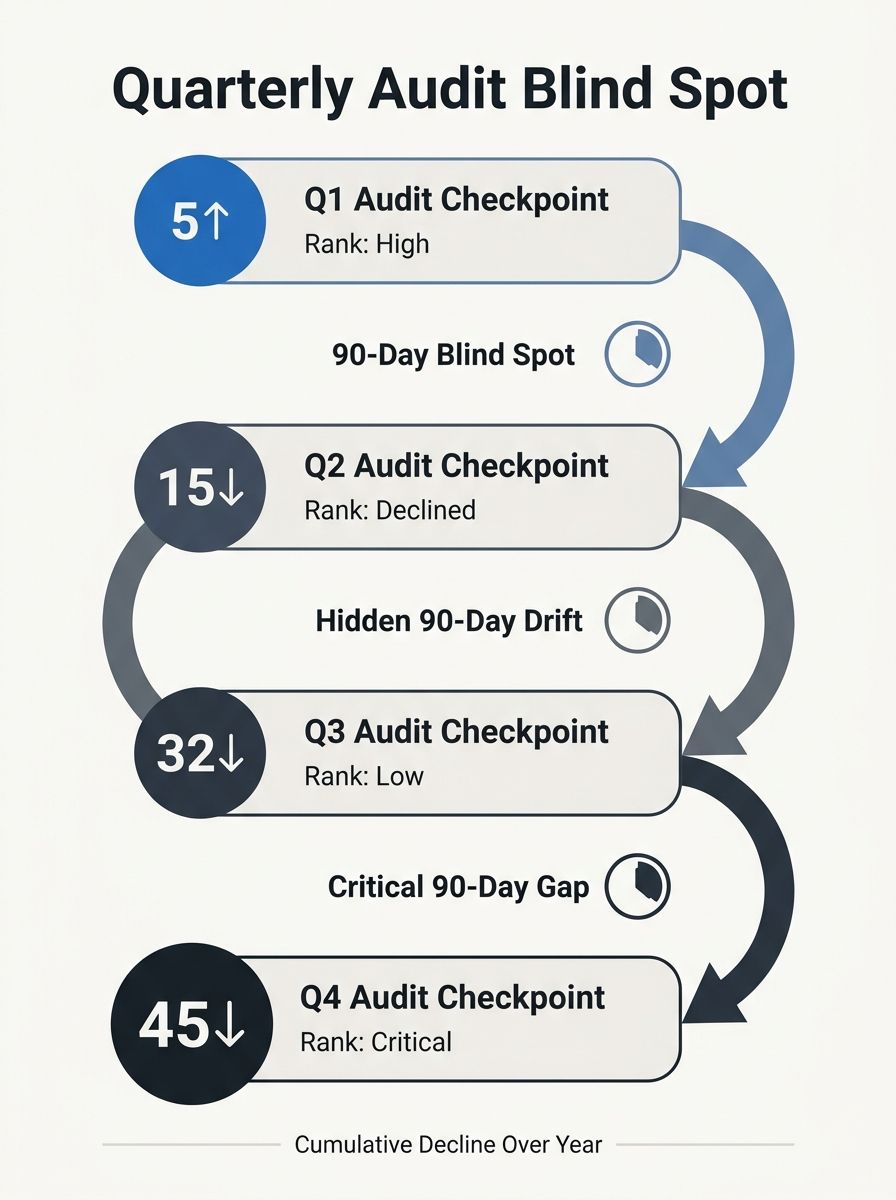
The real cost of quarterly audits isn't the audit itself. It's the 89 days between audits where nobody's watching. A keyword can drop from position 3 to position 11 in the space of a few weeks after a core update, a competitor's content refresh, or a shift in how Google interprets search intent for that query. If your next audit isn't scheduled for another two months, you won't discover the drop until the damage has compounded.
This mirrors a problem well-documented in enterprise risk management. As Diligent's research on continuous monitoring frameworks puts it, "traditional auditing asks 'What happened?' after the fact, while continuous monitoring asks 'What's happening right now?'". The parallel to SEO is direct. A quarterly keyword audit tells you what changed over the past 90 days. Continuous keyword monitoring tells you what's changing today, giving you a window to act before position loss becomes traffic loss becomes revenue loss.
Consider what happens in practice. Your Q1 audit reveals that 15 target keywords dropped by 5+ positions since the Q4 audit. Your team investigates, finds that a competitor published better content on 8 of those topics in mid-January, and Google's intent classification shifted on 3 others. By the time you execute content updates, it's late March. The competitor has been absorbing your traffic for two full months. You've lost link equity signals, your CTR has dropped, and recovering those positions now requires significantly more effort than maintaining them would have.
That two-month delay is the trap. And it compounds: every quarter you discover problems that existed for weeks before detection, you're always playing catch-up instead of defending positions proactively.
When Drift Detection Entered the SEO Vocabulary
The concept of "drift" migrated into SEO from machine learning, where model performance degradation between training cycles is a well-studied problem. Tools like Arize, Evidently, WhyLabs, and Fiddler were built to detect AI drift across five distinct problem types, using statistical tests to identify when inputs or outputs deviate from expected distributions.
Keyword ranking drift detection applies the same logic. Instead of monitoring whether a model's predictions have shifted, you're monitoring whether your keyword positions have deviated from a baseline. The math is different, but the principle is identical: catch small deviations early before they cascade into large performance losses.
The practical shift happened when rank tracking tools moved from weekly or bi-weekly snapshots to daily position checks. Respona's 2026 survey of rank tracking tools documents platforms with daily tracking starting at $59/month, with higher tiers offering more keywords. Tools like these allow you to set threshold alerts: if a keyword drops more than 3 positions, if a new SERP feature appears for a tracked query, if a competitor enters the top 10 for a term you own. Real-time SEO tracking went from luxury to baseline capability.
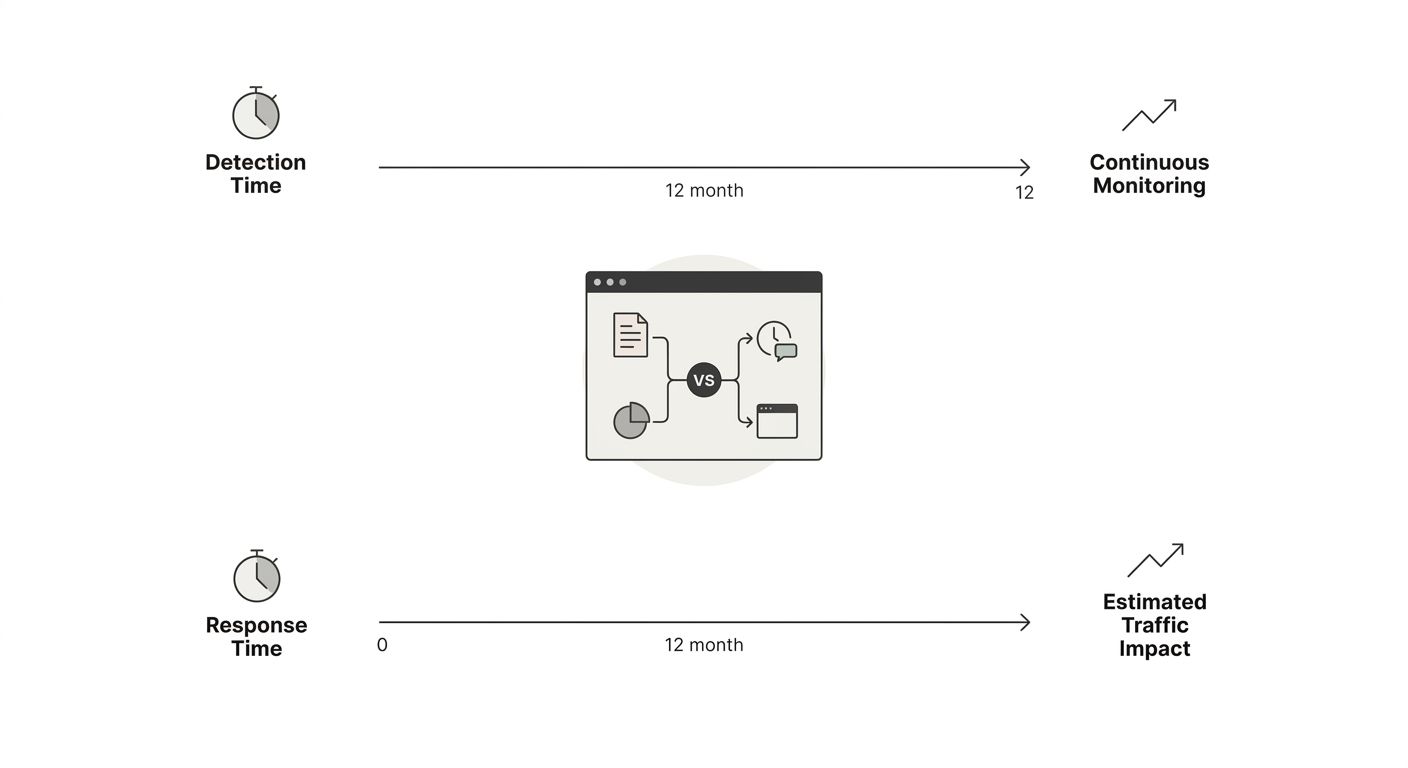
This created a new operational model. Instead of batching keyword analysis into quarterly sessions, teams started running continuous scans and responding to alerts as they fired. The audit didn't disappear; it changed form. Strategic keyword audits in 2026 focus on higher-order questions like portfolio rebalancing, new market entry, and intent category shifts, while daily monitoring handles the tactical work of drift detection and rapid response.
The Hybrid Model That Actually Works
Abandoning quarterly audits entirely creates its own problems. Daily rank tracking produces a flood of position changes, most of which are normal SERP volatility rather than meaningful drift. Without periodic strategic reviews, you lose the ability to zoom out and ask whether your keyword portfolio still matches your business objectives.
The teams getting this right in 2026 run a two-layer system. The first layer is continuous: daily rank tracking with automated alerts for position changes beyond configurable thresholds. A drop of 3+ positions on a keyword driving more than X monthly sessions triggers an investigation. A new AI Overview appearing on a transactional query you rank for triggers a CTR impact assessment. A competitor entering the top 5 for a high-value term triggers a content gap review.
The second layer is periodic but no longer bound to a fixed quarterly schedule. Strategic reviews happen when triggered by events: after a Google core update, after a major product launch, after entering a new market. These reviews examine the keyword portfolio from the top down. Are we still targeting the right intent categories? Has our competitive landscape changed fundamentally? Should we retire keyword targets that no longer align with business goals?
Here's a framework for deciding what belongs in each layer:
Signal Type | Monitoring Layer | Review Frequency | Action Trigger |
|---|---|---|---|
Individual keyword position changes | Continuous (daily) | Daily automated scan | 3+ position drop on high-traffic terms |
New SERP feature appearance | Continuous (daily) | Daily automated scan | AI Overview or featured snippet on tracked queries |
Competitor content publishing | Continuous (daily-weekly) | Weekly digest | New competing page in top 10 |
Search intent shifts for a query cluster | Periodic (event-driven) | After core updates | SERP composition changes (informational → transactional) |
Keyword portfolio alignment with business goals | Periodic (strategic) | After business milestones | Product launch, market entry, pivot |
Content decay across topic clusters | Periodic (monthly) | Monthly review | Declining impressions across 3+ pages in a cluster |
The continuous layer catches the stuff that quarterly audits miss. The periodic layer catches the stuff that daily noise obscures. Neither one works well alone.
Why the Trap Persists
If continuous monitoring is clearly superior for drift detection, why do so many teams still default to quarterly-only cycles? Three reasons.
Workflow inertia. The quarterly audit is a known quantity. It has a start date, a deliverable, and a clear end. Continuous monitoring feels amorphous. Teams that are used to producing a "Q2 Keyword Report" don't know how to structure their work around an always-on process. The shift requires rethinking not just tools but how the SEO function reports its work internally.
Tool cost confusion. Teams assume that continuous tracking costs dramatically more. And it can, if you try to track every keyword in your universe daily. But the real move is selective: track your top 100-200 revenue-driving keywords daily, your next 500 weekly, and your long-tail monthly. This tiered approach keeps costs manageable while catching the drift that matters most. We've written about auditing your tool stack to cut waste without losing coverage, and the same logic applies here.
Alert fatigue. Poorly configured continuous monitoring drowns teams in notifications. Every normal SERP fluctuation looks like an emergency. Within weeks, the team starts ignoring alerts, and you're back to a de facto quarterly review because nobody trusts the signals. The fix is setting thresholds high enough to filter normal volatility (positions fluctuate by 1-2 spots daily, and that's noise) but low enough to catch real movement before it compounds.

Where the Data Looks Today
The SEO industry's understanding of keyword research has shifted from treating it as a periodic task to recognizing it as ongoing strategic demand intelligence. AI search techniques, topic modeling, and intent signal analysis have made the landscape more dynamic, and the tools have followed. Daily rank tracking, automated SERP change detection, and AI-powered drift alerts are now standard features across major platforms, as documented across leading SEO firm toolkits.
The trap isn't that quarterly audits are useless. They served a real purpose, and strategic periodic reviews still do. The trap is treating the quarterly cadence as your primary detection mechanism for ranking changes. By the time a quarterly audit surfaces a problem, the window for low-effort correction has usually closed. You're spending 10x the resources to recover positions you could have defended with a timely content update or internal link adjustment.
The teams that consistently maintain their organic positions treat attribution and measurement as a continuous practice, the same way a dev team treats production monitoring. You don't wait for a quarterly review to discover your site went down. You shouldn't wait for a quarterly audit to discover your rankings did either.
OrganicSEO.org Editorial
Editorial team writing about Ethical, white-hat, organic SEO education.
Related Articles
The Quarterly Keyword Refresh Cycle: How to Catch Ranking Declines Before They Compound
Ranking declines become visible in position-tracking tools 4 to 6 weeks after they first appear in impression data.
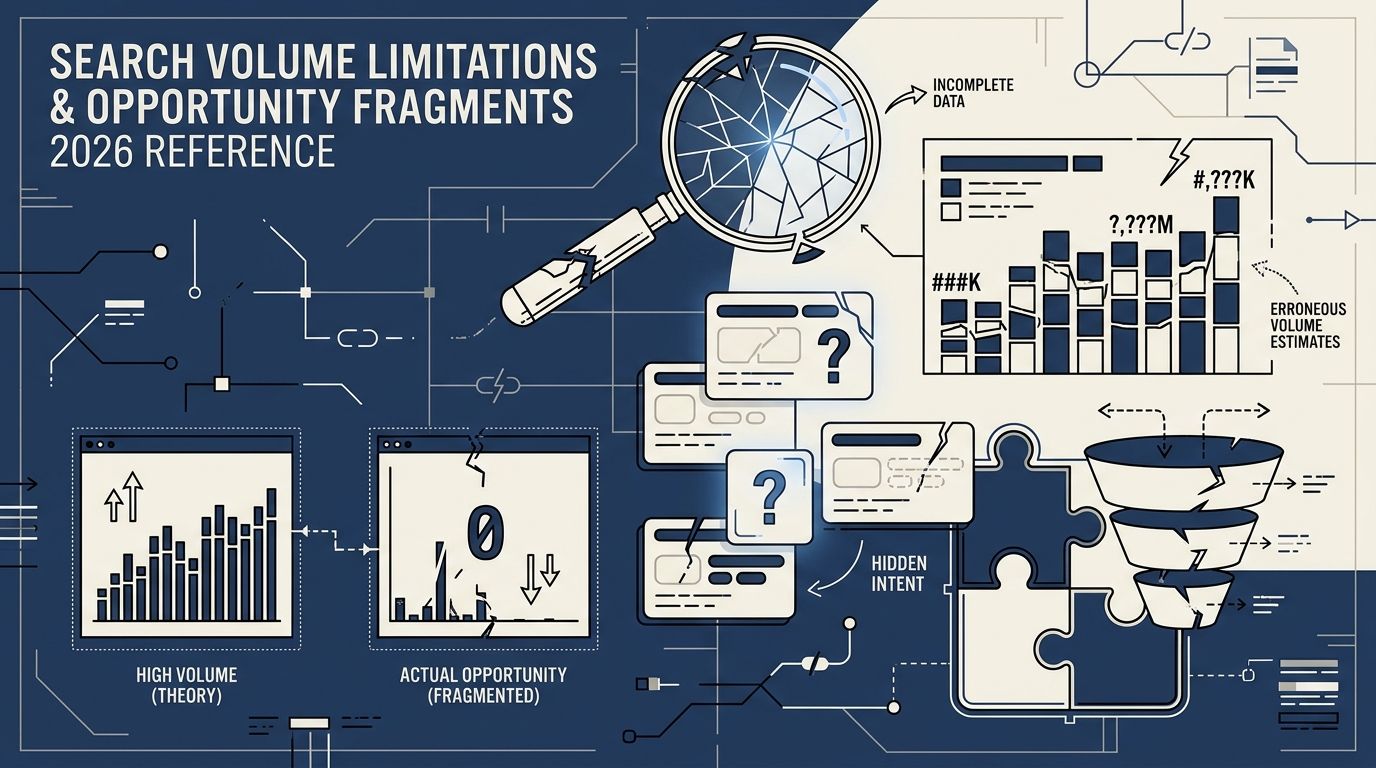
Beyond Search Volume: Why Keyword Research Tools Miss Half Your Opportunity in 2026
Roughly 15% of the queries Google processes each day have never appeared in any keyword research tool's index. That figure represents the floor of what volume-based research misses, before accounting for the queries tools do track but measure with wildly conflicting numbers across platforms.
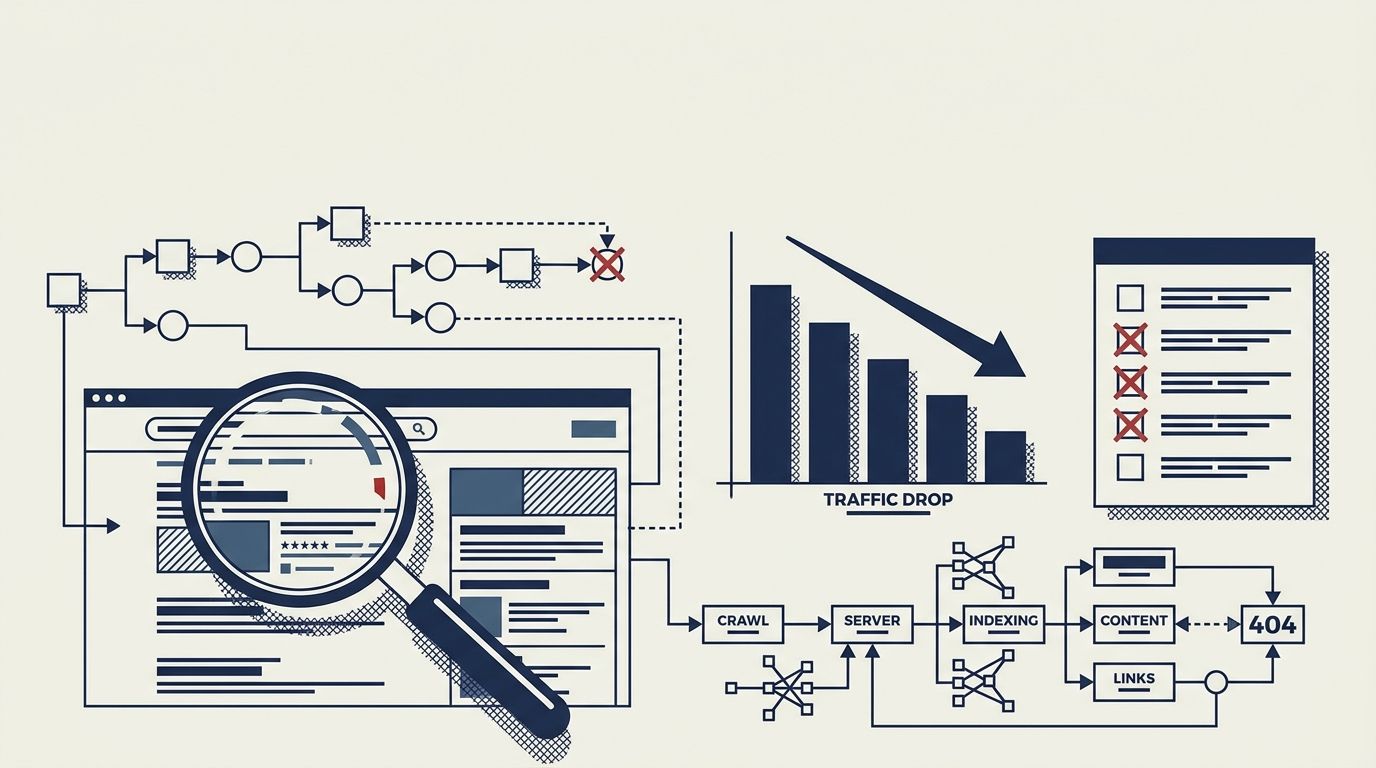
The SEO Debugging Checklist: How to Diagnose Visibility Drops Systematically (Not Frantically)
Diagnosing organic traffic drops requires a bottom-up diagnostic sequence through five layers: Crawl, Render, Index, Rank, and Click. Fixing lower layers first prevents wasted hours rewriting content that Google never crawled in the first place.